
Ship Launching Airbags: The Portable, Reusable System That Replaced Million-Dollar Slipways
04/09/2026Beenest Ship Launching Airbags: The Puncture-Resistant Way to Launch Ships Without a Million-Dollar Slipway
10/09/2026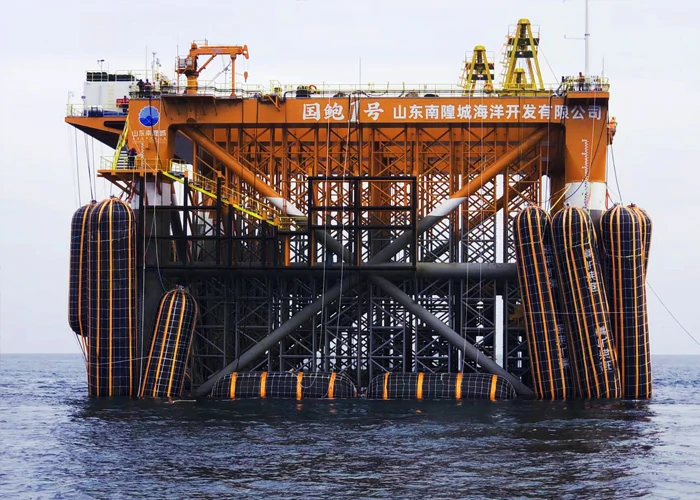
Imagine a 40-ton fishing vessel sunk in 12 meters of water behind a breakwater. A salvage crane can’t reach it — the channel is too shallow, the mobilization cost is brutal, and every tide is working against you. Now imagine instead a dive team placing a handful of bright yellow buoyancy airbags around the hull, inflating them from the surface, and watching the vessel rise in a controlled, staged ascent until it floats free.
That’s the whole value proposition of buoyancy airbags: they convert compressed air into controllable upward force in exactly the place a crane can’t go — underwater, remote, shallow, or offshore. They pack flat into a workboat, deploy in minutes, and replace multimillion-dollar heavy-lift assets for a surprising range of jobs: salvage, refloating, pipeline float-out, cable laying, subsea module positioning, pontoon support, and emergency flotation.
This guide explains what buoyancy airbags actually are, how they differ from marine airbags used for launching and from marine fenders / rubber fenders used for berthing protection, where they win, and how to specify them without making dangerous assumptions.
📌 Google-Selected Summary (Key Takeaway)
Buoyancy airbags are inflatable flotation devices — also called marine buoyancy bags, salvage lift bags, or underwater lift bags — engineered to generate controlled upward force in water. They’re built from heavy-duty PVC-coated polyester fabric or cord-reinforced rubber, fitted with inflation/deflation ports, overpressure relief valves, and load-rated lifting straps or D-rings. Common configurations include parachute-type open-bottom bags for deep-water lift, pillow/enclosed bags for shallow water and tight spaces, and cylindrical buoyancy airbags for pipeline, hose, and cable float-out. Quality commercial bags are produced and tested to reference practices such as IMCA D 016, with safety factors commonly quoted at 5:1, 6:1, or 7:1 depending on bag type and certification. They do not work like marine fenders or rubber fenders: fenders absorb impact energy when a vessel contacts a dock; buoyancy airbags provide lift, support, and stabilization. And while they belong to the broader marine airbags family alongside ship-launching airbags, a buoyancy bag is rigged and valved for submerged lifting, not for rolling a hull down a slipway.
From “How Do We Lift That?” to “We Already Have the Tool”
Every salvage supervisor has faced the same problem: the object is heavy, the site is awkward, and the obvious solution — a floating crane — is too slow, too expensive, or physically unable to get there.
Traditional alternatives had hard limits:
- Salvage pontoons work, but they’re big, heavy, and slow to mobilize.
- Crane barges need depth, weather windows, and a budget that justifies the call-out.
- Fixed flotation collars can’t be adjusted once the load shifts.
Buoyancy airbags changed the economics. A diver or ROV places the bag, connects the inflation line, and the bag fills with air from a compressor, scuba cylinder bank, or surface supply. As air displaces water, the bag produces buoyancy equal to the weight of the water it displaces — minus the bag’s own weight and the air column’s pressure effects at depth. Vent valves let the team bleed lift gradually, so the load rises slowly instead of shooting to the surface.
💡 The core insight: Buoyancy is just displaced water. An airbag’s job is to hold that air in the right shape, at the right pressure, with rigging that won’t fail — exactly where the load needs it.
That sounds simple. The engineering is in the control: shape, valve strategy, depth compensation, load distribution, and preventing uncontrolled ascent.
The Three Types You’ll Actually Specify
Not every buoyancy airbag is the same. Choosing wrong doesn’t just reduce efficiency — it can make the lift unsafe.
🔹 Parachute-Type (Open-Bottom) Lift Bags
Teardrop-shaped with an open bottom. Air enters from the top; water can flow out the bottom as the bag rises.
Why it matters: As the bag ascends, ambient pressure drops and the air wants to expand. The open bottom lets excess air escape naturally, which helps prevent burst and gives a more controlled ascent — ideal for deep-water salvage.
Use it for: Sunken vessels, submerged containers, deep reef recovery, staged wreck refloating.
🔹 Pillow / Enclosed Buoyancy Bags
Flat or rounded enclosed fabric bags with top lifting straps and a valve system. No open bottom.
Why it matters: They sit flush against hull sides, decks, caissons, or subsea frames, and they’re easy to position in confined spaces.
Use it for: Shallow-water salvage, inside-compartment flotation, stabilizing a flooded hull, towing support, dock float-up repairs.
🔹 Cylindrical Buoyancy Airbags
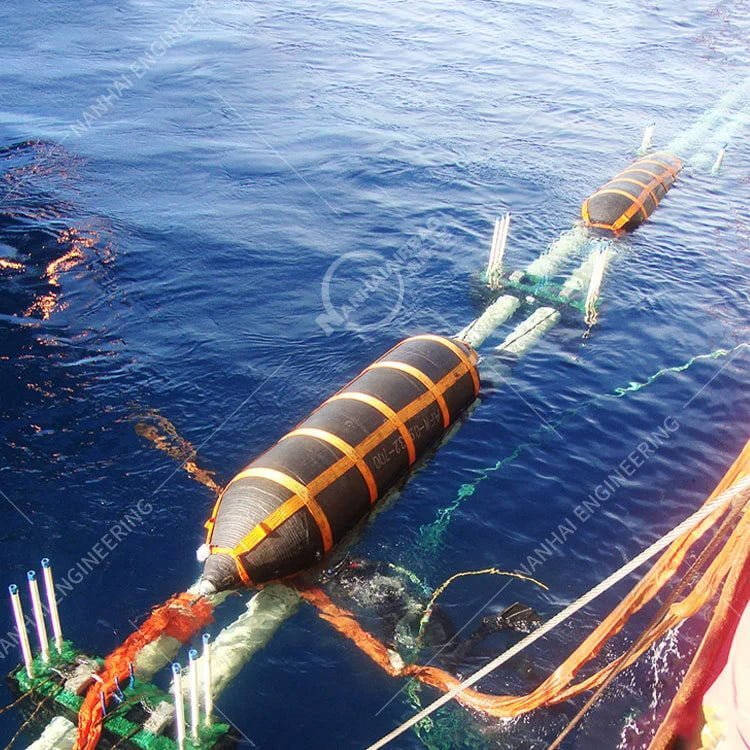
Long inflatable cylinders — closer in form to marine airbags — wrapped around pipelines, hoses, cables, or used as temporary pontoons.
Why it matters: They provide distributed buoyancy along a length, not point lift. That’s critical for pipelines that would bend or crack under concentrated force.
Use it for: Subsea pipeline float-out, dredging hose support, power/cable lay operations, caisson transport, bridge-girder flotation.
The Advantages — With Operational Context
1. Access Anywhere a Workboat Can Reach
Deflated buoyancy airbags are compact. A small vessel can carry enough lift capacity to refloat a sizable hull.
- Example: A stranded barge on a tidal flat. A crane barge can’t ground itself there. A 6-meter skiff can deliver four 5-ton pillow bags, divers set them under the hull, and the barge lifts on the rising tide with controlled inflation.
2. Staged, Controllable Lift — Not a Sudden Yank
With relief valves and vent lines, the team inflates incrementally. Load comes up evenly; hull stress stays manageable.
- Example: A sunken fiberglass vessel. Point-lifting one corner could snap the deck. Distributed bags plus gradual venting let the hull level out, water pumps out, and the vessel surfaces intact.
3. Massive Cost Avoidance vs. Heavy-Lift Cranes
Mobilization, weather standby, and crane barge day rates are steep. Buoyancy bags don’t eliminate cranes when true heavy-lift is needed — but for many mid-weight recoveries they remove the crane entirely.
- Example: A sunken workboat in a harbor channel. Instead of a crane barge charter plus channel closure, the port uses salvage-airbag divers, clears the obstruction in a tide window, and reopens the berth faster.
4. Distribute Load Gently — Protect Sensitive Structures
Proper rigging spreads force across hull panels or subsea frames. That’s why salvage teams use multiple smaller bags rather than one giant bag.
- Example: Recovering a sunken aircraft or archeological cache: low pressure against the structure, multiple attachment points, slow ascent, no crushing contact.
5. Reusable and Portable
Quality bags are repaired, retested, and redeployed. A single inventory serves salvage, pipeline works, and emergency response.
6. Depth-Aware Design Options
Parachute bags handle expansion on ascent; enclosed bags are predictable in shallow water; cylindrical bags give linear support. The right shape matches the physics of the site.
Buoyancy Airbags vs. Marine Airbags vs. Marine Fenders
This is where most buyers confuse terminology. All three are “marine inflatables” in casual language — but they are not interchangeable.
| Item | Primary job | Load type | Typical standard/method | Shape |
|---|---|---|---|---|
| Buoyancy airbags / salvage lift bags | Generate lift, flotation, support underwater | Quasi-static buoyancy + rigged load | IMCA D 016 reference practice; manufacturer test | Parachute, pillow, cylindrical |
| Ship launching airbags | Lift hull off blocks and roll it into water | Quasi-static dead load, rolling | ISO 14409 / ISO 17682 | Cylinder with conical ends |
| Pneumatic marine fenders | Absorb berthing impact | Dynamic impact energy | ISO 17357 | Cylinder with hemispherical ends |
| Rubber fenders | Protect fixed quay or vessel contact | Impact energy, fixed mount | PIANC guidance | Cell, cone, arch, D, V, etc. |
Rule of thumb: If the problem is “lift it,” use a buoyancy airbag. If the problem is “move it down a slipway,” use a launching airbag. If the problem is “stop it hitting the dock,” use a fender. Marine fenders and rubber fenders are protection devices; buoyancy airbags are lift devices.
Construction: What Makes a Buoyancy Airbag Trustworthy
| Component | What it does |
|---|---|
| Fabric body | PVC-coated polyester for lift bags; cord-reinforced rubber for heavy salvage airbags |
| Welded / vulcanized seams | RF-welded fabric seams or wrapped rubber layers preserve airtight integrity under cyclic pressure |
| Inflation port | Surface line, compressor, or cylinder fill; often 1/4″ NPT or quick-connect |
| Overpressure relief valve | Prevents overinflation as depth changes or surface filling over-pressures the bag |
| Dump / vent valve | Controlled descent or pressure bleed during ascent |
| Lifting straps / harness | Resin-treated webbing or belt slings, rated with documented safety factor |
| D-rings / shackles | Secure attachment to load or rigging |
| Pressure gauge / line | Lets the team monitor fill and compute available buoyancy |
Safety factors are frequently quoted as 5:1, 6:1, or 7:1 depending on bag class and testing regime. Always ask for the test method, not just the number.
Sizing: The Math That Prevents Failure
Available lift from a buoyancy bag is not “its label number” automatically. The label usually states net buoyancy — the lift after subtracting bag weight — at or near the surface. At depth, you must account for:
- Displaced water weight = volume × water density
- Bag tare weight
- Gas density / pressure in the bag at depth
- Freeboard and submersion — partial inflation changes lift
- Angle load on straps and shackles
- Dynamic effects — surge, current, swinging load, ascent acceleration
Simplified field formula:
Usable lift ≈ displaced water weight − bag weight − air-weight correction − rigging/angle losses
Then divide the required lift by usable lift per bag, and add margin. In real projects, engineers also check hull/bag contact pressure, number of bags, symmetry, and ascent rate.
Example: A 20-tonne submerged object in seawater needs more than 20 tonnes of net buoyancy because of mud suction, list correction, and safety margin. You might specify six 5-tonne bags with controlled staging rather than four bags at full label capacity — the extra bags protect against one bag underperforming and reduce point loading.
Where Buoyancy Airbags Dominate: Application Map
| Application | Why buoyancy airbags win |
|---|---|
| Marine salvage & wreck refloating | Deploy where cranes can’t; stage the ascent |
| Stranded barge / grounded vessel | Tidal-flat access, low mobilization cost |
| Subsea pipeline float-out | Cylindrical bags give distributed, linear buoyancy |
| Cable & hose laying | Support long flexible lines without over-bending |
| Caisson / concrete block placement | Fine buoyancy control for accurate underwater seating |
| Offshore wind & subsea O&M | Auxiliary buoyancy for anchors, piles, modules |
| Emergency flotation | Stabilize flooded hull before towing or repair |
| Archaeology & science | Gentle, adjustable lift for fragile objects |
| Temporary pontoon / dry-dock assist | Replace or supplement fixed flotation |
Transition: Why Operators Keep Choosing Buoyancy Airbags Over Bigger Iron
The first time you watch a 10-tonne bag straighten a listing hull, the appeal is obvious: no crane boom, no depth limitation from the crane’s draft, no waiting on weather for a bigger asset. But the reason professionals standardize on them is repeatability — the same bags, the same rigging plan, the same vent procedure, job after job.
And the reason they stay safe is discipline: correct bag type for depth, correct safety factor, correct attachment points, and a ascent plan that respects the fact that air expands as it rises.
Keep reading — the next sections cover the mistakes that sink salvage plans, the FAQs searchers actually type into Google, and the exact next step to specify your own system.
The 8 Mistakes That Turn a Lift Into an Incident
- Using label buoyancy as usable lift at depth — ignore water density, tare, and pressure effects and you under-lift.
- Wrong bag type — enclosed bag in deep water can overpressurize on ascent; parachute bag in a confined hull compartment may not fit.
- No relief valve or vent plan — uncontrolled ascent can damage the load and endanger divers.
- Poor rigging geometry — single-point lift on a long object creates bending and rotation.
- Ignoring mud suction — silt vacuum can hold a sunken hull far beyond its weight.
- Asymmetric inflation — one side rises first, the load rolls or sheds bags.
- Sharp-edge contact — hull rust, rebar, or rock cuts the fabric; use padding and protection mats.
- No contingency for bag loss — if one bag fails, does the plan still control the load? It must.
FAQ — The Questions People Actually Search About Buoyancy Airbags
❓ What are buoyancy airbags?
Buoyancy airbags are inflatable flotation bags — also called marine buoyancy bags, salvage lift bags, or underwater lift bags — that generate controlled upward force by displacing water with air. They’re used for salvage, refloating, pipeline float-out, cable support, subsea positioning, and emergency flotation. They belong to the broader marine airbags family but are configured for lifting, not slipway rolling.
❓ How much weight can a buoyancy airbag lift?
It depends on volume, shape, water density, bag weight, inflation level, and depth. Manufacturers label bags from 100 kg class up to 50-tonne, 100-tonne, or larger custom units. Always use net buoyancy at your operating condition, not the marketing number at the surface, and add safety margin.
❓ What’s the difference between buoyancy airbags and salvage airbags?
Often the same product family with different names. “Buoyancy airbag” emphasizes the flotation force; “salvage airbag” emphasizes the recovery application. Both can be parachute, pillow, or cylindrical types. Heavy rubber salvage airbags may use cord-reinforced construction similar to ship-launching airbags, while diver lift bags often use PVC-coated fabric.
❓ Are buoyancy airbags the same as marine fenders or rubber fenders?
No. Marine fenders and rubber fenders absorb impact energy when a vessel contacts a berth, another vessel, or a structure. Buoyancy airbags provide lift and support. Using a fender to lift, or an airbag to cushion berthing, is unsafe unless the product is specifically certified and configured for that job.
❓ What standard applies to buoyancy airbags?
Commercial underwater lift bags are commonly built and tested to IMCA D 016 practice, with safety factors often 5:1–7:1 depending on bag type and certification. Rubber salvage airbags may also reference ISO 14409 construction methods, but the lift-bag application itself is usually specified by IMCA and manufacturer test data. Always request the test report, not just a compliance line.
❓ Which is better: parachute or pillow buoyancy bags?
Parachute open-bottom bags are preferred for deeper water because they can vent expanding air during ascent. Pillow or enclosed bags are better in shallow water, tight compartments, and stable support tasks. Cylindrical bags are best for pipelines and long distributed loads.
❓ Can buoyancy airbags be used for pipeline float-out?
Yes — cylindrical buoyancy airbags are widely used to give uniform support along a pipeline or hose during laying, relocation, or recovery. They reduce tension and help control seabed landing without concentrated point loads.
❓ How are buoyancy airbags inflated underwater?
From the surface via an inflation line and compressor, or from diver-carried cylinders through a regulated port. Overpressure relief valves protect the bag as pressure changes; dump valves let the team bleed lift for controlled descent or ascent.
❓ Are buoyancy airbags reusable?
Quality bags are. After each job they’re rinsed, inspected for abrasion/cuts/seam damage, repaired if needed, and retested. Service life depends on fabric grade, UV exposure, abrasion, and handling — not a fixed clock.
❓ Can I use ship launching airbags instead of buoyancy airbags?
Sometimes for coarse flotation, but not as a substitute for certified lift bags. Launching airbags are built to roll hull weight on a slipway; salvage/lift bags are built with lifting harnesses, vent/relief valves, and depth-appropriate shapes. For any load-rated underwater lift, specify the correct buoyancy/lift bag.
❓ What safety factor should I require?
Common commercial lift bags are quoted at 5:1, 6:1, or 7:1 depending on type and standard. The right margin also depends on dynamic load, angle, and ascent plan — don’t choose on the ratio alone; check the test method and certifying body.
The Bottom Line: When to Choose Buoyancy Airbags
Buoyancy airbags earn their place because they solve the problem cranes can’t always solve: controlled lift in shallow, remote, underwater, or time-critical conditions.
✅ Choose buoyancy airbags when:
- You need lift where cranes can’t reach
- The load is submerged, grounded, or flood-damaged
- You want staged, adjustable ascent
- The object is long or fragile and needs distributed buoyancy
- You need portable, reusable equipment
- Speed and mobilization cost matter
⚠️ Do not use them like fenders: marine fenders and rubber fenders protect against impact; buoyancy airbags protect against sinking and mispositioning by providing lift. And don’t assume a launch airbag is automatically a lift bag — configure the right product for the right physics.
Next step: Define the submerged weight, water density, depth, seabed condition, object length/shape, and acceptable ascent rate. Then select bag type — parachute, pillow, or cylindrical — and calculate net buoyancy per bag at depth, with safety factor, rigging angle, and contingency for one-bag loss. Request IMCA D 016-aligned test documentation and a written lift plan before anyone inflates anything.
Keywords naturally covered: buoyancy airbags, marine airbags, marine fenders, rubber fenders, salvage lift bags, underwater lift bags, marine buoyancy bags, parachute lift bag, pillow buoyancy bag, cylindrical buoyancy airbag, pipeline float-out, IMCA D 016, net buoyancy, overpressure relief valve, subsea lifting, vessel refloating, emergency flotation, ISO 14409, ISO 17357, PIANC fender guidance.
