
Composite Fenders: The Low-Friction Upgrade Most Berths Overlook
22/10/2026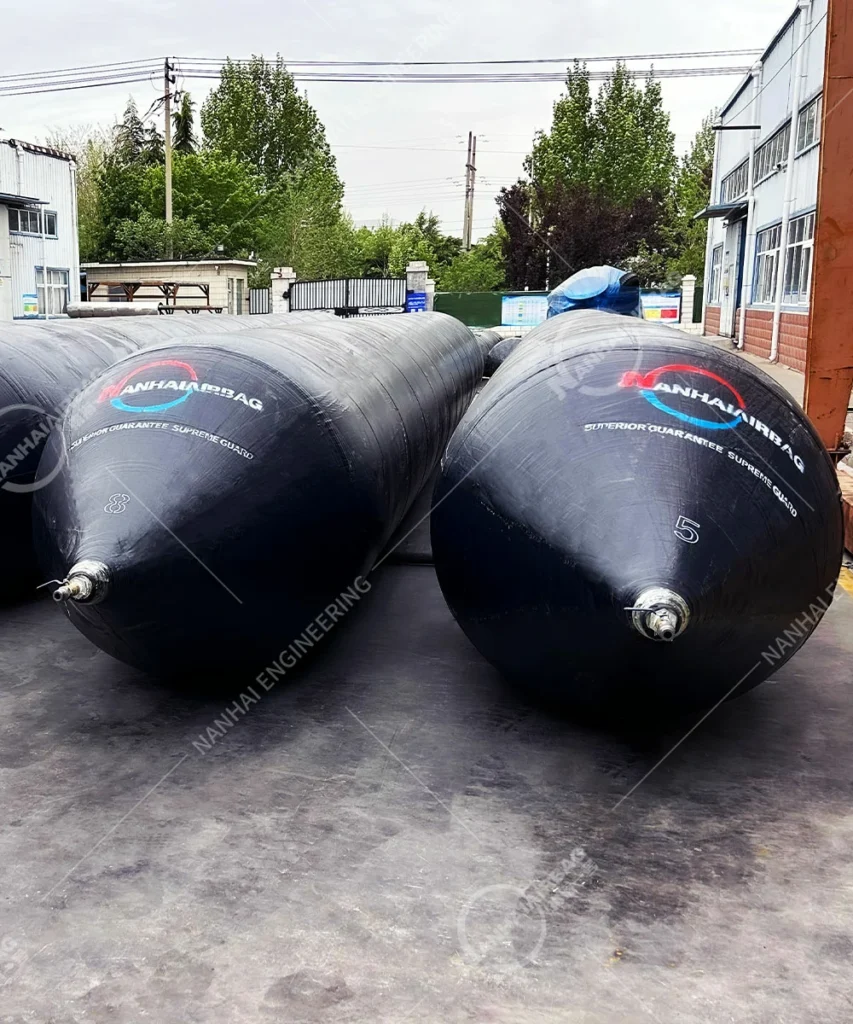
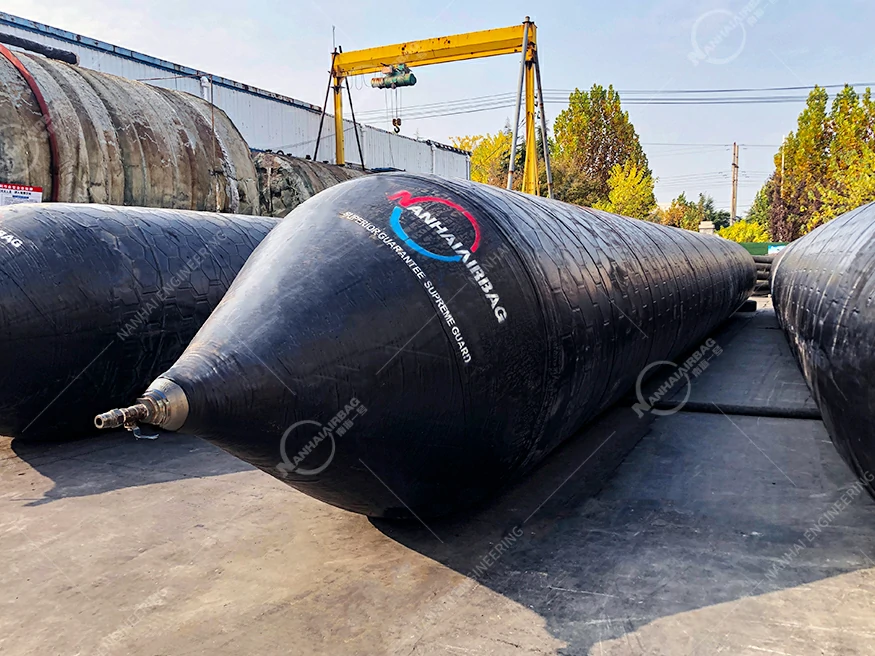
Ship launching airbags are heavy-duty, cord-reinforced inflatable rubber cylinders that lift a vessel off its blocks and roll it into the water. Placed under the hull, inflated to working pressure, and guided by winches, they replace expensive concrete slipways and dry docks for vessels from small workboats to 10,000+ ton ships. Built to ISO 14409 with a burst safety factor of ≥4:1, marine airbags cut launch infrastructure cost, reuse for years, and distribute hull load far more gently than hard ways. They are not berthing fenders—unlike marine fenders or rubber fenders, which protect a hull on the dock, ship launching airbags carry quasi-static weight and movement during launch, haul-out, and salvage.
If you run a shipyard, repair berth, or marine engineering project, the launch day is where most of your capital risk sits. Keep reading—because the right airbag plan can turn a million-dollar slipway project into a portable, repeatable operation that fits in a shipping container.
What Are Ship Launching Airbags?
Ship launching airbags—also called marine airbags, marine rubber airbags, pneumatic rollers, or launch bags—are cylindrical tubes made from:
- Inner rubber layer – airtight, seawater-resistant seal
- Synthetic tire-cord plies – nylon/polyester reinforcement (typically 4–12 layers)
- Outer rubber layer – abrasion, UV, and impact protection
Deflated, they slide under the hull. Inflated, they become load-bearing rollers.
Typical specifications
| Parameter | Common range |
|---|---|
| Diameter | 0.8 – 2.5 m (up to 3.0 m) |
| Effective length | 6 – 24 m |
| Working pressure | 0.05 – 0.20 MPa |
| Cord plies | 4 – 12 layers |
| Burst safety factor | ≥ 4:1 vs working pressure |
| Standard | ISO 14409 / ISO 17682 |
A 1.5 m × 12 m, 6-ply bag can support roughly 100–150 tons per linear meter at safe working pressure.
Why Shipyards Switched to Airbag Launching
Traditional ship launching meant one of two things: pour a permanent concrete slipway, or book a dry dock months in advance. Both are expensive, fixed, and slow.
Airbag launching changed the economics of small-to-mid shipbuilding.
1. Massively lower capital cost
No rails, no cradles, no deep civil works.
Example:
A yard building 500-ton barges can launch with a fleet of airbags for a fraction of what a reinforced slipway costs. For sub-5,000-ton vessels, airbags typically cut launch-related civil cost by 60–80%.
2. Reusable across hundreds of cycles
A quality airbag isn’t a one-time consumable. With rinsing, drying, inspection, and proper storage, a bag can run 80–200 launch cycles and last 6–10+ years.
Example:
A repair yard launching and hauling out fishing boats weekly gets years of service from the same airbag fleet—then packs them away between jobs.
3. Portable to any reasonable site
Deflated airbags fold down and ship in containers. That means you can launch from:
- a graded beach,
- compacted soil,
- a temporary ramp,
- a remote repair site,
- or a shared yard without permanent infrastructure.
Example:
A disaster-response crew can move airbags to a stranded vessel, refloat it, and leave—no crane, no dock.
4. Gentler on the hull
Hard wooden ways concentrate load on keel blocks. Airbags conform to the hull bottom, spreading weight across a wide contact patch.
That reduces local plate stress, frame bending, and the risk of keel-line damage during movement.
5. One system, many jobs
Buy airbags for launching—keep using them for:
- vessel haul-out and dry-land repair
- bottom inspection
- marine salvage and refloating
- moving caissons, bridge elements, heavy modules
- temporary buoyancy support
That multi-job ROI is why airbags beat single-purpose slipways for most commercial yards.
How Airbag Launching Works
The physics is simple. The execution is engineering.
- Prepare the track – clear sharp objects, check slope (roughly 1:70 to 1:10 workable), verify ground bearing.
- Place deflated bags – transverse under the hull, spaced by weight distribution.
- Inflate gradually – compressors bring bags to 0.05–0.20 MPa; hull lifts off blocks evenly.
- Remove keel blocks – only after the hull is fully borne by bags.
- Release with winch control – vessel rolls forward at ~0.5–1 m/s; airbags rotate like conveyor rollers.
- Water entry – buoyancy takes over, rear bags shed load, hull floats free.
- Recover and deflate – rinse, dry, store for next cycle.
The key difference from a fender: this is quasi-static load support, not impact energy absorption.
Ship Launching Airbags vs. Marine Fenders
This is the #1 confusion in marine procurement. Let’s settle it.
| Feature | Ship launching airbags | Marine / rubber fenders |
|---|---|---|
| Primary job | Lift, roll, launch, salvage | Absorb berthing impact |
| Load type | Quasi-static hull weight | Dynamic kinetic energy |
| Shape | Long cylinder, tapered ends | D, W, square, cone, cell, pneumatic |
| Mounting | Temporary, under keel | Fixed or floating at dock/hull |
| Standard | ISO 14409 / ISO 17682 | ISO 17357 (pneumatic), PIANC |
| Example use | Launch a new build into the river | Protect tug pushing a bulker |
A modern shipyard uses marine airbags on launch day to get the vessel into the water—and rubber fenders on the berth to protect it every time it docks afterward. Both belong in the marine protection ecosystem, but they are never interchangeable.
How to Size and Select Launching Airbags
Don’t buy “by diameter only.” You need a real load calculation.
What to specify
- Vessel lightship weight + outfitting margin
- LOA, beam, draft, center of gravity
- Slipway slope and surface condition
- Required water depth at entry
- Airbag diameter and effective length
- Ply count (4–12)
- Working pressure and safety factor
- ISO 14409 compliance + burst-test report
- Classification support (CCS/BV/ABS/DNV/LR if required)
Rough calculation logic
Total weight on bags = vessel launch weight − buoyancy gain
Single bag capacity ≈ working pressure × contact width × effective length × safety derating
Then: add 15–30% spare capacity and keep 2–4 spare bags on site.
⚠️ The real constraint is usually hull span between bags, not bag capacity. Too-wide spacing bends plates.
Safety Non-Negotiables
Airbags are safe when engineered—and dangerous when guessed.
Before every launch:
- Pressure-hold test: inflate to 1.1× working pressure, hold 30 min, drop <5%
- Relief valve on every compressor
- Certified pressure gauges
- Cleared track: no nails, rocks, weld beads, sharp edges
- Cross-slope tolerance verified
- Wind/current within limits (avoid Beaufort 5–6+)
- Winch, anchors, emergency stop briefed
Retire any bag with cord exposure, deep cuts, or through-wear on the outer rubber.
Maintenance and Storage
A good airbag fleet is treated like lifting gear, not party balloons.
- Rinse with fresh water after seawater use
- Dry completely before folding
- Light talc/dusting to prevent rubber layers sticking
- Store indoors, cool, dark, away from acid/alkali/sharp objects
- Inspect after every 10 launches or any hard contact
- Log cycles and pressure tests
Related Questions People Ask About Ship Launching Airbags
What are ship launching airbags used for?
Primarily launching new builds into water. Also vessel haul-out, dry-dock alternative, marine salvage, refloating grounded ships, and moving heavy marine structures like caissons or bridge elements.
Are marine airbags the same as pneumatic fenders?
No. Marine airbags lift and roll a hull under static weight. Pneumatic fenders absorb impact during berthing. Different cord geometry, different standards, different end fittings—never substitute one for the other.
How much weight can ship launching airbags support?
Depends on diameter, length, ply count, and pressure. A 1.5 m × 12 m, 6-ply bag supports ~100–150 t/m. Multiple bags launch vessels from tens of tons to 10,000+ tons with correct engineering.
What size airbag do I need?
Start from vessel weight per unit length, then match diameter and ply to working pressure. A supplier should return a calc sheet with bag count, spacing, and pressure distribution—not just a price list.
How many airbags do I need for a launch?
Divide supported weight by single-bag capacity, add 15–30% margin, then check hull bending between bags. A 500-ton barge might need dozens of bags distributed along keel and bilge.
Do airbags damage the hull?
Not when correctly specified. They usually reduce point stress compared with hard sliding ways because rubber conforms to the hull bottom.
Can airbags launch large ships?
Yes—up to several thousand tons and beyond with enough bags, higher ply counts, and strict calculations. Very large or high-frequency launches may still favor dry docks or engineered slipways.
How long do ship launching airbags last?
With proper care, 6–10+ years and 80–200 cycles. Lifespan depends on use frequency, UV exposure, abrasion, and storage discipline.
What slope do I need for airbag launching?
Typically 1:30 to 1:10, though favorable sites can work near 1:70. Truly flat ground needs external winch or tug pull. Slope error and cross-level tolerance must be surveyed before launch.
Are ISO 14409 airbags certified?
Reputable suppliers provide ISO 14409 compliance, hydrostatic burst reports, and optional class approvals (CCS, BV, ABS, DNV, LR). Always ask for test evidence, not just a label.
Bottom Line
Ship launching airbags turned shipbuilding from a capital-heavy infrastructure game into a portable marine engineering process. They give yards:
- lower upfront cost,
- reusable equipment,
- flexible launch sites,
- gentler hull loading,
- and salvage/haul-out value long after launch day.
Just remember: airbags are for moving the vessel, while marine fenders and rubber fenders are for protecting it at the berth. Specifying both correctly is what keeps a ship safe from build to berth to retirement.
👉 Next step: pull your vessel’s lightship weight, LOA, beam, and launch slope, then request an ISO 14409 airbag calculation sheet—not a quote from a diameter dropdown.
Want help comparing airbag launching vs. a fixed slipway for your specific yard? Start with two numbers: vessel weight per meter and site slope. Those decide everything else.
Keywords used
ship launching airbags · marine airbags · marine fenders · rubber fenders · ISO 14409 airbags · pneumatic rollers · vessel launch · haul-out · marine salvage · shipyard launching
