
Arch Rubber Fender: The High-Efficiency Choice for Modern Marine Berthing
16/06/2026Ship Launching Airbags: The Complete Guide to Safe, Low-Cost, Infrastructure-Free Vessel Launching
23/06/2026
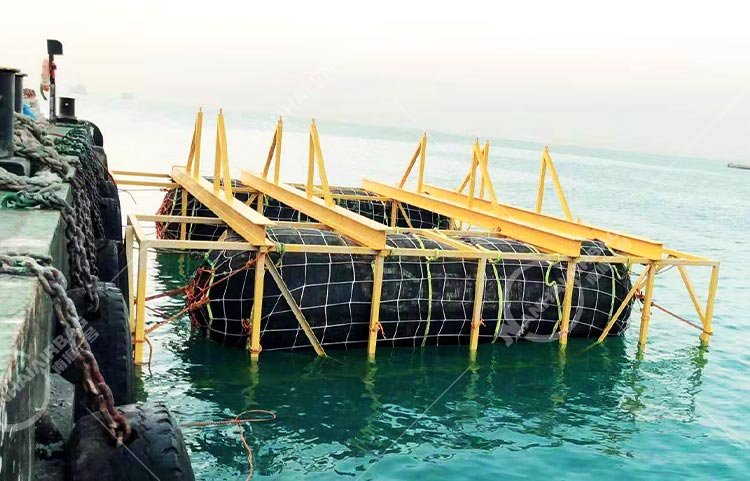
Buoyancy airbags—also known as marine salvage airbags or floating lift bags—are heavy-duty, inflatable rubber structures engineered to generate controllable upward thrust in marine environments. Built from multiple layers of synthetic-tire-cord fabric and reinforced rubber, they displace water to create buoyancy forces ranging from a few tons to over 200 tons per unit, making them the go-to solution for ship salvage, underwater construction, shallow-water draft reduction, and emergency refloating operations.
What Are Buoyancy Airbags, Really?
If you’ve ever seen a grounded vessel stuck in a mudflat—or a sunken hull resting on the seabed—you already understand the problem buoyancy airbags are designed to solve. Cranes can’t always reach. Dry docks take months to schedule. Rigid pontoons are bulky, expensive to mobilize, and difficult to position against an irregular hull shape.
Buoyancy airbags fill that gap. Literally and figuratively.
They’re large, cylindrical (or sometimes pillow-shaped) inflatable units made of marine-grade rubber reinforced with high-tensile nylon/tire-cord fabric layers. When compressed air fills the bag underwater or alongside a hull, the airbag displaces water and generates lift. Strap several together, control their inflation precisely, and you can refloat a several-thousand-ton ship without a crane in sight.
Quick distinction: Buoyancy airbags belong to the broader marine airbags family—which also includes ship launching airbags(the ones that roll vessels down a slipway). The key difference? Launching airbags are built for rolling load-bearing; buoyancy/salvage airbags are optimized for vertical/submerged lift and sustained flotation. Both are cousins to rubber fenders, but where marine fendersprotect hulls from impact at the berth, buoyancy airbags move and liftthe vessels themselves.
Why the Industry Is Moving Toward Buoyancy Airbags: 5 Core Advantages
1. Massive Lift Capacity Without Massive Equipment
A single heavy-duty cylindrical buoyancy airbag (say, 2.0 m diameter × 18 m long) can deliver 55+ tons of net buoyancy—and the largest units on the market exceed 100–200 tons per bag. String together a coordinated spread of 8–12 bags, and you’re talking about lifting a 1,000+ ton vessel.
Real-world example: On the Danube River, a grounded passenger ship was refloated using a spread of rubber salvage airbags positioned by divers, eliminating the need for a heavy-lift crane barge entirely. The operation took days instead of weeks and at a fraction of the mobilisation cost.
2. They Go Where Cranes Can’t
Shallow water. Remote riverbanks. Reef-adjacent grounding sites. Confined harbor corners. Deflated buoyancy airbags pack down small, ship easily on a flatbed truck, and can be deployed by a small crew with compressors and divers. Compare that to a floating crane that may need 8+ meters of draft and cost thousands per day just to stage.
Example: In Southeast Asian river shipyards built on soft soil with limited water depth, buoyancy airbags double as both launching rollers andemergency lift-assist tools—no permanent dry-dock infrastructure required.
3. Controlled, Low-Pressure Lift = Less Hull Stress
Unlike a crane’s point-load hook, buoyancy airbags distribute force across a large contact patch on the hull. The soft, conforming rubber surface spreads pressure evenly, which means less risk of buckling plates or cracking frames during a refloat.
Engineers typically maintain a safety factor > 5.0 on quality ISO 14409-certified airbags, and built-in relief valves prevent dangerous over-pressurisation during deep-water lifts.
4. Multi-Purpose Versatility Across the Project Lifecycle
Buoyancy airbags aren’t one-trick ponies. The same robust build that salvages wrecks also handles:
| Application | How It Works |
|---|---|
| Ship / boat salvage | Bags strapped under or alongside the hull are inflated to break suction from the seabed and lift the vessel to a floatable position |
| Draft reduction | Bags attached externally reduce a vessel’s draft so it can clear shallow channels or cross bars |
| Pipeline / cable float-out | Bags provide temporary flotation during subsea pipeline installation and river crossings |
| Temporary floating platforms | Multiple bags lashed together form a makeshift pontoon bridge, work raft, or dock-gate support |
| Heavy-object underwater positioning | Bridge caissons, cofferdams, and prefab concrete sections can be lowered, positioned, and floated into place with bag-controlled buoyancy |
5. Cost-Effective Reusability
A quality buoyancy airbag, properly cleaned and stored, delivers 6–8 years of service life (some rated up to 15+ years with care). One fleet of airbags can serve dozens of operations. When you amortize that over multiple projects, the per-lift cost drops dramatically compared to chartering specialized salvage vessels.
How Buoyancy Airbags Work (The Physics, Simply Explained)
The principle is Archimedes’ law at work: an immersed body experiences an upward force equal to the weight of the fluid it displaces. An airbag filled with air weighs almost nothing compared to the seawater it pushes aside—so the net effect is a powerful upward vector you can harness.
The operational sequence looks like this:
- Prep & positioning – Divers (or ROVs) guide partially inflateddeflated bags under/alongside the target. Sharp rocks and debris are cleared from the seabed contact zone.
- Securing – Lifting straps, shackles, and polyester webbing built into the bag’s body are clipped to designated hull pad-eyes or chain-through-bolt attachments. Suction pads or soft slings work for smooth-sided hulls without fixed tie points.
- Controlled inflation – A manifold system feeds compressed air through hoses. Bags inflate gradually and sequentially, keeping the vessel level and preventing uncontrolled rolling or snapping loads.
- Lift & recovery – As buoyancy builds, the hull breaks free from the bottom. Once afloat, towing or pumping can commence. Bags are either detached at surface or left attached (deflated partially) for transit support.
⚠️ Critical safety note: Never improvise buoyancy with marine fenders or pneumatic fenders. Rubber fendersare impact-absorption devices—built to take sideways compressive hits at the dock, not to carry distributed lift loads. Using a fender as a lift bag risks catastrophic rupture. Use purpose-built buoyancy/salvage airbags with certified safety factors.
What to Look for When Specifying Buoyancy Airbags
| Specification | What to Check |
|---|---|
| Diameter & Length | Common range: Ø0.5 m – 3.0 m; lengths 5 m – 30 m (custom sizes available) |
| Reinforcement Layers | 4–12 layers of synthetic tire-cord fabric; more layers = higher pressure rating |
| Working Pressure | Typically 0.05–0.25 MPa depending on diameter and ply count |
| Safety Factor | Look for ≥ 5:1 between working pressure and burst pressure |
| Certification | ISO 14409 / ISO 17682 compliance; classification society approval (ABS, BV, LR, DNV, CCS, etc.) |
| Outer Rubber Compound | Natural rubber / EPDM blends with UV, salt, and abrasion resistance. Outer layer thickness up to ~12 mm on heavy-duty models |
| Fittings | Stainless or hot-dip-galvanised valves, pressure gauges, lifting rings, and perimeter webbing straps |
| Auto Relief Valve | Essential for deep-water work—vents excess pressure as the bag rises and ambient pressure drops |
Related Questions (The Stuff People Actually Google)
❓ What’s the difference between buoyancy airbags and marine fenders?
Marine fenders (including D-shaped, W-shaped, arch rubber fenders, and pneumatic fenders) are passive protection—they sit on quay walls or hang alongside a hull to absorb berthing impact energy. Buoyancy airbags are active lifting devices—they generate upward thrust to move, lift, or support vessels and subsea structures. They solve completely different problems, and you should never substitute one for the other.
❓ How much weight can a buoyancy airbag lift?
It depends on volume and water density. A 2 m × 18 m cylindrical airbag fully submerged in seawater delivers roughly 55 tons of net buoyancy; a 3 m × 20 m unit can exceed 140 tons. Total lift is the sum of all bags deployed, minus the weight of rigging and any retained water.
❓ Can buoyancy airbags be used for ship launching too?
Many marine airbags are indeed multi-role—ship launching airbags and salvage buoyancy airbags share the same layered-rubber architecture. But for a dedicated launch, you’d spec rolling-type launching airbags (optimised for continuous surface contact and rolling shear). For salvage and flotation, you want bags with external lifting straps, certified shackle points, and (often) auto-relief valves for depth-varying pressure.
❓ Are rubber buoyancy airbags better than PVC lift bags?
For serious marine salvage, rubber tire-cord airbags massively outperform PVC bags. PVC lift bags are lighter and cheaper for shallow-water, diver-friendly lifts under ~10–20 tons. But rubber salvage airbags have breaking strengths 2× higher than PVC coatings, up to 10× the outer thickness for abrasion resistance, and can handle rougher seabed conditions and deeper work.
❓ What standards should buoyancy airbags meet?
Look for ISO 14409:2011 (ship launching airbags — general requirements) and associated guidance under ISO 17682:2013 for methodology. Reputable suppliers also offer certification through ABS, BV, LR, DNV, CCS, or NK class societies.
❓ How long do buoyancy airbags last?
With proper care: 6–8 years of active service life is typical; premium units with enhanced outer coatings can stretch beyond 10–15 years. Key maintenance steps: rinse with fresh water after saltwater use, dry thoroughly, apply talc/anti-stick treatment, store in a cool shaded space, and pressure-test before each deployment.
The Bottom Line
Whether you’re managing a shipyard on a soft-soil riverbank, running a port salvage response plan, or installing subsea pipelines in a remote location, buoyancy airbags give you controllable, portable, high-capacity flotation without the eye-watering price tag of cranes and dry docks. The technology has matured—backed by ISO standards, classification-society certification, and thousands of successful lifts worldwide.
Next step: If you’re sizing airbags for a specific vessel or salvage scenario, the decisive variables are displacement, hull contact geometry, water depth, and seabed condition. Gather those four numbers, and you can spec the right diameter, ply count, and bag quantity with confidence. Need a worksheet or load-distribution layout? That’s exactly the kind of detail we’ll break down in the next section—just let us know your vessel’s DWT and the site conditions.
Keywords: buoyancy airbags, marine airbags, marine fenders, rubber fenders, marine salvage airbags, ship launching airbags, ISO 14409
