
Ship Launching Airbags: How Modern Yards Launch Vessels Without Slipways
27/10/2026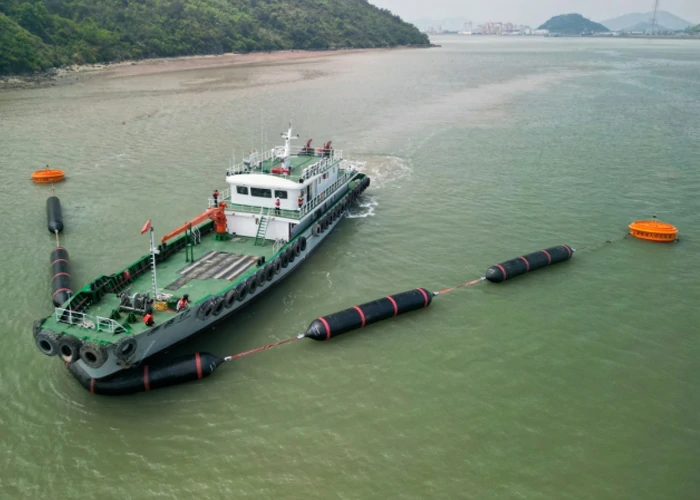
Buoyancy airbags are heavy-duty, cord-reinforced inflatable rubber units that generate controlled upward lift by displacing water. Used for marine salvage, vessel refloating, pipeline float-out, caisson positioning, and emergency flotation, they let teams lift grounded or sunken hulls without heavy-lift cranes or dry docks. Built from marine-grade rubber with synthetic tire-cord plies and safety factors commonly ≥5:1, commercial units typically range from a few tons to 100+ tons of net buoyancy each. Unlike marine fenders or rubber fenders—which absorb berthing impact—buoyancy airbags belong to the marine airbags family and exist to move, support, and float the vessel itself.
If you handle salvage, ship repair, or subsea construction, the hardest moment is rarely the dive—it’s the lift. Cranes are expensive, draft-limited, and slow to mobilize. Dry docks are booked months out. Keep reading, because buoyancy airbags solve a problem those tools can’t: controlled lift in shallow, remote, or time-critical water.
What Are Buoyancy Airbags?
Buoyancy airbags—also called marine salvage airbags, underwater lift bags, or flotation airbags—are inflatable structures made from:
- Airtight inner rubber layer – holds compressed air underwater
- High-tensile synthetic cord plies – carry the lift load (typically 3–12 layers)
- Abrasion-resistant outer rubber – resists seabed, hull edges, and UV
- Lifting eyes, straps, relief valves – for rigging and pressure control
They come in cylindrical, pillow, and parachute configurations. Cylindrical cord-reinforced units are the workhorses for heavy salvage; parachute and pillow bags are common for diver-operated lifts and tight spaces.
Where they live in the product family
- Buoyancy airbags → lift, float, support (this article)
- Ship launching airbags → roll hull weight down a slipway
- Marine / rubber fenders → cushion impact at the berth
All three touch the water. Only one is built to pick something up.
Why Buoyancy Airbags Changed Marine Salvage
Traditional salvage meant three options: crane barge, steel pontoon, or dry dock. Each has a ceiling—draft, cost, schedule, or access.
Buoyancy airbags removed those ceilings.
1. Lift where cranes physically can’t reach
Deflated bags pack into a workboat or flatbed, go underwater with divers, and inflate exactly where the load sits.
Example:
A passenger vessel grounds on a river mudflat. A crane barge can’t get close enough. Salvage divers slide deflated buoyancy airbags under the hull, inflate them in stages, and break the vessel free from suction—no dredging, no crane.
2. Distributed lift = less hull stress
A crane hook is a point load. A buoyancy airbag is a wide, conforming contact patch.
That matters for:
- thin-plated salvage hulls,
- flooded compartments,
- fragile historic wrecks,
- long pipelines that would bend under point lifts.
Example:
Refloating a sunken fishing boat with four evenly spaced cylindrical airbags spreads the load along the keel and bilges instead of ripping a single hole in the deck.
3. Adjustable, staged lift
You don’t “yank” with airbags—you inflate gradually, watch trim and list, and add pressure in controlled steps.
Relief valves and dump valves let the team:
- prevent sudden surfacing,
- correct list during ascent,
- hold the object at depth,
- shed lift slowly for controlled placement.
That level of control is why salvage engineers trust them on unstable wrecks.
4. One fleet, many jobs
Buy buoyancy airbags for salvage, keep using them for:
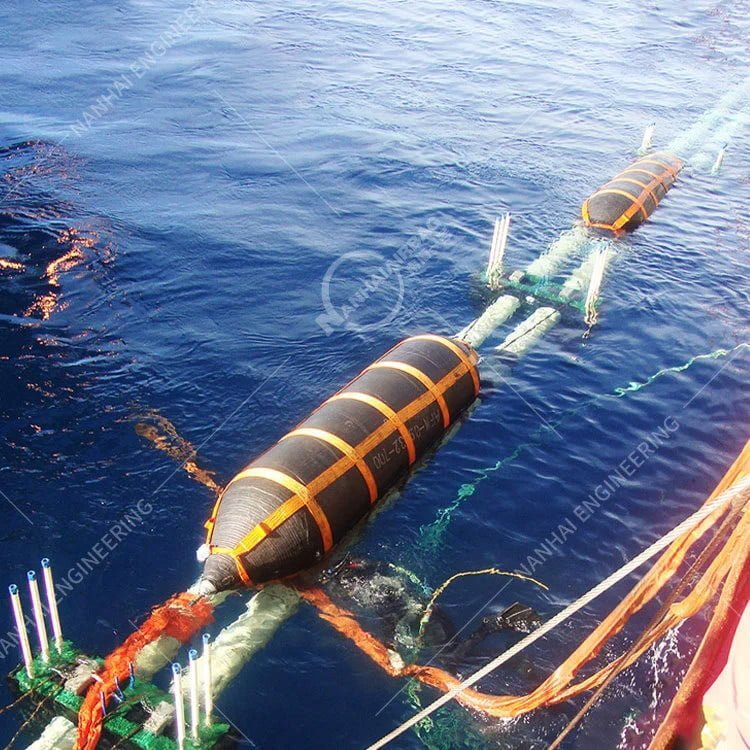
- pipeline and cable float-out during lay operations
- caisson positioning for bridge works
- temporary flotation for docks and rafts
- draft reduction to move a vessel through shallow bars
- internal compartment inflation to displace water
That reuse is what makes the fleet pay for itself.
Buoyancy Airbags vs. Marine Fenders vs. Launching Airbags
This is the confusion Google keeps surfacing. Settle it before you specify.
| Product | Job | Load type | Standard |
|---|---|---|---|
| Buoyancy airbags | Lift, float, support submerged loads | Quasi-static buoyancy/lift | ISO 14409 construction; IMCA D 016 for lift bags |
| Ship launching airbags | Roll vessel down slipway | Rolling static weight | ISO 14409 / ISO 17682 |
| Pneumatic / rubber fenders | Absorb berthing impact | Dynamic kinetic energy | ISO 17357 (pneumatic), PIANC for fixed |
A fender protects a hull when it touches a dock. A buoyancy airbag picks the hull up when it’s already on the bottom. Never substitute one for the other.
Typical Specifications
Commercial cord-reinforced buoyancy/salvage airbags commonly offer:
| Parameter | Typical range |
|---|---|
| Diameter | 0.8 – 2.5 m (custom to 3.0 m) |
| Effective length | 3 – 24 m |
| Working pressure | 0.05 – 0.25 MPa |
| Net buoyancy | 2 – 100+ tons per unit |
| Cord plies | 3 – 12 layers |
| Safety factor | ≥5:1 (some ratings 3.5:1–6:1 by type) |
| Temperature | -20 °C to +60 °C |
| Standard | ISO 14409 / ISO 17682 construction |
A 2.0 m × 18 m cylindrical unit can deliver roughly 55+ tons of net buoyancy; larger custom builds exceed 100–200 tons per bag.
How a Buoyancy Lift Works
- Survey the target – weight, water depth, seabed type, list, suction risk.
- Position deflated bags – under hull, alongside, or inside compartments.
- Secure rigging – slings, straps, netting, or internal inflation.
- Inflate gradually – from surface compressor or dive bottles.
- Break suction – lift inches at a time until the hull frees from the bottom.
- Control ascent – monitor trim, bleed pressure, keep symmetrical lift.
- Hold or tow – stabilized on the surface for repair or transit.
- Deflate, rinse, inspect, store.
The goal is never “maximum pressure fast.” It’s controlled, balanced flotation.
Sizing: Don’t Guess the Lift
Net buoyancy is not the label number. It’s:
Net lift = displaced water weight − airbag self-weight − bound hardware − depth/pressure losses
What to specify in a quote
- Submerged weight of object (plus seabed suction margin)
- Water depth and current
- Target lift height or draft reduction
- Number of lift points / contact locations
- Diameter, length, ply count
- Working pressure and relief-valve setting
- Rigging style: straps, net, internal placement
- ISO 14409 build + third-party test report (BV/ABS/DNV/CCS on request)
⚠️ Always add margin for asymmetry. A 1,000-ton object should not be supported by “exactly 1,000 tons” of bag capacity.
Safety Non-Negotiables
Buoyancy ops fail on细节, not on equipment.
- Pressure-hold test before deployment
- Relief valves set below max working pressure
- Even bag spacing to avoid list or hull bending
- Sharp-object clearance: no rock edges, rebar, hull burrs
- Diver comms + ascent monitoring
- Redundant inflation lines
- Retire any bag with cord exposure, seam separation, or through-wear
Treat airbags like rated lifting gear—because that’s exactly what they are.
Maintenance and Storage
- Rinse with fresh water after every seawater job
- Dry fully before folding
- Inspect seams, eyes, valves, and cord edges
- Check for abrasion, cuts, and deformation
- Store cool, dry, away from oil/acid/sharp items
- Log cycles and pressure tests
With care, quality units deliver years of service across dozens of operations.
Related Questions People Ask About Buoyancy Airbags
What are buoyancy airbags used for?
Salvage and refloating of grounded or sunken vessels, underwater equipment recovery, pipeline/cable float-out, caisson positioning, draft reduction, and emergency flotation for flooded hulls.
Are buoyancy airbags the same as marine fenders?
No. Marine fenders and rubber fenders absorb impact during berthing. Buoyancy airbags lift and support weight. Different job, different reinforcement, different safety standard.
How much can a buoyancy airbag lift?
Depends on volume, pressure, water density, depth, and bag weight. Commercial cord-reinforced units range from a few tons to 100+ tons net lift per bag. Always calculate net buoyancy, not surface-label lift.
What’s the difference between buoyancy airbags and salvage airbags?
Mostly naming. “Buoyancy airbag” emphasizes flotation force; “salvage airbag” emphasizes the recovery job. Heavy rubber versions are often the same product family.
Parachute, pillow, or cylindrical—which should I choose?
- Cylindrical cord-reinforced → heavy salvage, pipelines, big loads
- Parachute (open-bottom) → deeper water, controlled ascent
- Pillow/enclosed → shallow water, compartments, tight spaces
Can buoyancy airbags be used instead of launching airbags?
Sometimes for coarse flotation, but not as a certified substitute. Launching airbags are built to roll; salvage/lift bags are built to hold lift with rigging and relief control.
What safety factor should I require?
Common commercial ratings are 5:1, with some configurations 3.5:1–6:1 depending on type and certifying body. Require the test report, not just the ratio.
Do buoyancy airbags work in seawater?
Yes. They’re built for marine service—saltwater, UV, abrasion, and dynamic subsea conditions.
How are they inflated underwater?
From the surface via compressor and inflation lines, or from diver-carried gas through regulated ports. Relief and dump valves manage pressure as depth changes.
Can they lift pipelines during installation?
Yes. Cylindrical buoyancy airbags give distributed floatation along a pipe span, reducing tension and controlling seabed landing without point loads.
Bottom Line
Buoyancy airbags turn one of the hardest problems in marine work—lifting something heavy from the water—into a portable, repeatable, engineer-controlled operation.
They give you:
- crane-class lift without the crane,
- distributed load that protects fragile hulls,
- staged, adjustable ascent,
- and reusable gear that pays back across salvage, construction, and repair.
Just remember the line that keeps projects safe: buoyancy airbags move and float the vessel; marine fenders and rubber fenders protect it at the berth. Specifying both correctly is what gets a wreck from the seabed to the repair dock without a second incident.
👉 Next step: pull the submerged weight, water depth, and suction estimate for your target object, then request an ISO 14409 buoyancy calculation sheet with net-lift numbers—not just a diameter and price.
Want help choosing between cylindrical salvage bags, parachute lift bags, and steel pontoons for your specific recovery? Start with three inputs: object weight, water depth, and how uneven the seabed is.
Keywords used
buoyancy airbags · marine airbags · marine fenders · rubber fenders · salvage airbags · underwater lift bags · flotation airbags · vessel refloating · pipeline float-out · ISO 14409
