
Buoyancy Airbags: The Complete Guide to Marine Lifting, Salvage & Flotation Solutions
18/06/2026Square Rubber Fenders: The Rugged, Cost-Effective Workhorse of Marine Berthing
25/06/2026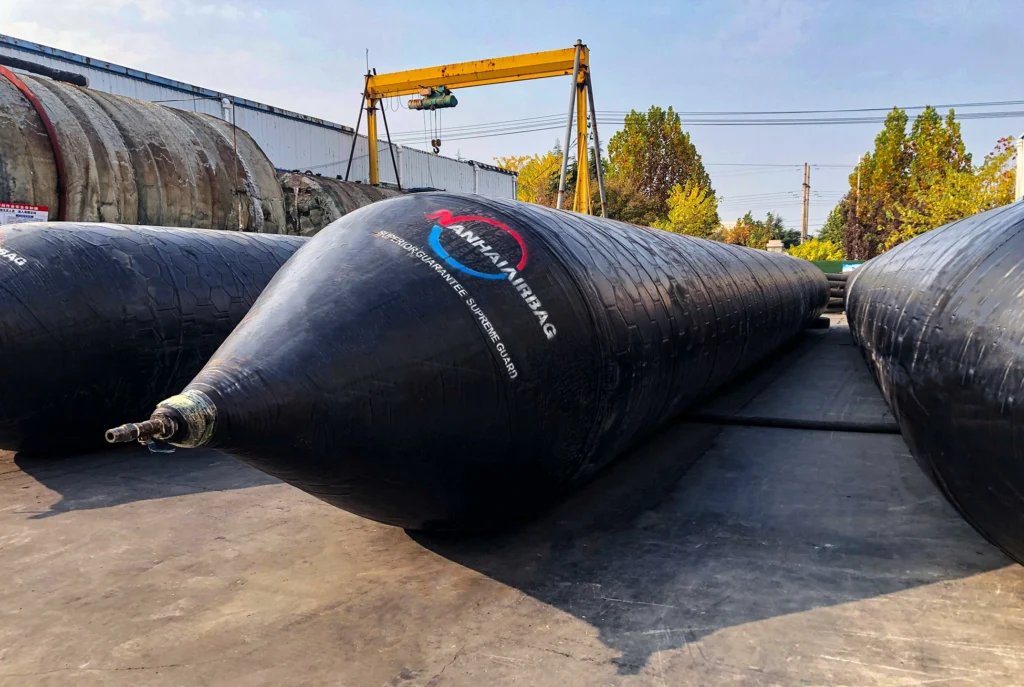
Ship launching airbags—also called marine launching airbags, roller bags, or inflatable launch airbags—are heavy-duty, multi-layer rubber cylinders reinforced with synthetic tire-cord fabric that lift a vessel off its keel blocks and rollit down a prepared slipway into the water in a controlled, continuous motion. Governed internationally by ISO 14409:2011 and ISO 17682:2013, these airbags replace expensive permanent slipways, rails, and greased wooden ways with a portable, reusable system that works on mild slopes (as gentle as ~1:70), scales from small workboats to vessels well into the tens of thousands of DWT, and can be deployed, deflated, and stored for the next launch cycle.
What Ship Launching Airbags Actually Are (And What They’re Not)
Invented and refined in the early 1980s (the first documented airbag-assisted launch was a 60 DWT tank barge in Shandong, China in 1981), the technology has evolved from canvas-reinforced experimental “balloons” into a mature, classification-society-accepted launching method used by thousands of shipyards worldwide.
A ship launching airbag is a long cylindrical body with two conical heads, built from:
| Layer / Component | What It Does |
|---|---|
| Inner airtight layer (butyl/natural rubber compound) | Maintains pressure and prevents slow leakage under load |
| Reinforcement layers (synthetic tire-cord / nylon fabric, 4–12 plies) | Carries the actual load; determines working pressure and burst strength |
| Outer rubber layer | Resists abrasion, punctures, seawater, UV, and aging during rolling contact with the ground and hull |
| End fittings (inflation valve, pressure gauge, safety/relief valve, lifting ring) | Control air entry/exit, monitor pressure, and allow handling during placement |
Typical commercial sizes run from Ø0.5 m – 3.5 m diameter and effective lengths from ~4 m – 40 m, with custom sizes available depending on vessel beam and slipway geometry.
🔑 Critical distinction: launching airbags ≠ marine fenders
Marine fenders and rubber fenders (pneumatic Yokohama-style fenders, D-fenders, cell fenders, etc.) are berthing protection—they absorb impact energy when a ship comes alongside a dock or another vessel, governed by standards like ISO 17357. Ship launching airbags are load-carrying rollers/liftersgoverned by ISO 14409 / ISO 17682. They look vaguely similar to pneumatic fenders at a glance, but they are engineered for an entirely different stress regime: longitudinal rolling compression, sustained load-bearing under the keel, and repeated ground contact—not sideways impact damping. Never substitute a fender for an airbag (or vice versa).
Why Shipyards Are Abandoning Traditional Slipways: 5 Advantages That Change the Economics
Traditional end-on launching needs a steep gradient (~1:20), steel rails or massive greased timber ways, concrete bedding, and constant maintenance. Launching airbags strip almost all of that away.
1. No Permanent Slipway = Massive Capex Avoided
You don’t need poured concrete ramps, grease pits, or rail systems. Prepare a compacted, cleared, gently sloped ground path, and the airbags becomethe launch system.
Example: A regional yard launching 500–3,000-ton fishing vessels or landing craft can avoid a $300K–$600K+ slipway build by investing in a reusable airbag fleet that typically pays for itself in 12–24 months through eliminated infrastructure maintenance and faster turnaround.
2. Gentler on the Hull — Even Pressure, No Hard Spots
Because the inflated cylinder is flexible, it conforms to the hull curvature along the keel line. Load is spread across a wide contact patch instead of concentrating on chocks or greased wood billets. That matters most for:
- Thin-plated steel
- Aluminum hulls
- Fiberglass/composite hulls prone to local crazing or gelcoat cracks
The rolling action is buffered by air pressure, so the hull sees fewer shock spikes than it does sliding down rigid ways.
3. Mild Slope Tolerance Opens Up “Unlaunchable” Sites
Airbags can launch on gradients as low as roughly 1:70, compared to the steep 1:15–1:20 greased-way requirement. If your waterfront has limited depth or a shallow beach profile, airbags are often the onlyeconomical launch method that works without dredging a canal or building a massive pier extension.
4. Portable, Compact, and Highly Reusable
Deflated airbags lie flat, roll up, and fit in a shipping container or on a flatbed truck. Take them to:
- A remote riverbank yard
- A temporary repair beach
- A disaster-response shoreline
One fleet serves many hull sizes by mixing diameters and quantities. With rinsing, drying, and proper storage, service life commonly ranges 6–10+ years, with premium units lasting into the 15-year range depending on cycle count and conditions.
5. Safe When Engineered — Because Pressure Is Quantifiable
This isn’t “blow up a tractor tire and hope.” Every bag is spec’d by:
- Working pressure: commonly in the ~0.05–0.20 MPa band depending on diameter & ply count
- Safety factor: reputable manufacturers design for burst pressure ≥ 3×–5× working pressure (many quote safety coefficients > 5.0)
- ISO 14409 airtightness test: inflate to rated pressure, hold 1 hour, pressure drop must be ≤ 5%
Relief valves, pressure gauges, and documented pre-launch checklists turn a visually dramatic event into a controlled engineering operation.
How a Ship Launching Actually Happens (Step-by-Step)
If you’ve never seen an airbag launch in person, the first thing that strikes you is how quiet and smoothit is compared to a slipway crash. No grease. No splinters. Just pressurized rubber cylinders doing exactly what Archimedes and friction physics say they will.
The sequence most shipyards follow:
- Survey & prep the slipway Clear sharp rocks, rebar, glass, and debris. The running surface should be firm and reasonably even (compacted gravel, sand matting, or prepared earth). Mark centerline and airbag lane positions.
- Position the airbags longitudinally under the hull Bags are laid perpendicular to the keel (rollers run transverse, the vessel moves longitudinal). Typical practice: staggered or single/double rows along the launch weight-bearing length of the hull.
- Inflate to lift the hull off keel blocks Compressors feed air through hoses/manifolds. As pressure rises, the bags expand and the hull clears the blocks evenly. This is the moment you confirm:
- Even contact
- No bulging against sharp chine edges
- Pressure stable within spec
- Remove keel blocks / shores Now the entire deadweight rests on the inflated airbags—distributed across multiple rollers.
- Controlled release A winch or controlled brake eases the vessel forward. The airbags roll under the hull, carrying the ship down the slope. Friction is low, motion is continuous.
- Into the water & retrieve Once the hull floats, bags are deflated and recovered (often with small workboats or shore tackle). Rinse with fresh water, dry, dust with talc to prevent adhesion, and store cool/dry until next cycle.
🧮 Sizing rule of thumb: Airbag diameter should exceed keel-block height (e.g. blocks ≤1 m → 1.5 m dia; blocks ~1.2–1.5 m → 1.8–2.0 m dia). Airbag length ideally ≥ vessel beam; if beam is very wide, stagger shorter bags or run multiple rows. Number of bags follows from total vessel weight ÷ allowable load per bag with a safety margin and proper unsupported-span checks between bags.
Spec Cheat Sheet: What to Check Before You Buy
| Parameter | Typical Range / What to Demand |
|---|---|
| Standard | ISO 14409:2011 + ISO 17682:2013; CB/T 3795 / CB/T 3837 references in Chinese supply chains |
| Diameter (D) | 0.8 m / 1.0 m / 1.2 m / 1.5 m / 1.8 m / 2.0 m / 2.5 m / 3.0 m+ |
| Effective Length (EL) | 6 m – 24+ m (match or exceed beam; stagger if beam is extreme) |
| Reinforcement plies | 4–12 layers; 6 plies covers most launches; go higher only if contact area is tight and pressure must rise |
| Working pressure | ~0.05–0.12 MPa (small/mid dia, 4–6 plies) up to ~0.15–0.20+ MPa (large dia, high-ply) |
| Safety factor | Burst ≥ 3× working (leading makers quote >5.0) |
| Certification | CCS, ABS, BV, LR, DNV, NK, etc. (classed survey endorsement if the yard requires it) |
| Outer rubber | Abrasion-, UV-, salt-resistant compound; thicker skin for sites with gritty ground |
| Valving | Stainless or HDG fittings, ball valve, pressure gauge, safety relief valve |
| Testing docs | Airtightness test cert (1 hr @ rated pressure, ≤5% drop per ISO 14409) |
Related Questions (People Also Ask / What Users Search Around “Ship Launching Airbags”)
❓ What’s the difference between ship launching airbags and marine rubber fenders?
Marine rubber fenders (including pneumatic fenders/Yokohama fenders, D-fenders, cell fenders) are built to absorb berthing impact and protect hulls/docks at the quayside—regulated under ISO 17357. Ship launching airbags are built to carry the vessel’s weight on their curved surface while rolling, regulated under ISO 14409 / ISO 17682. Shape, reinforcement strategy, and use-case are fundamentally different; using one in place of the other is unsafe.
❓ How much weight / what size vessel can airbags launch?
Modern systems routinely handle vessels from small boats to 10,000+ ton lightship / barges, and published industry records reference airbag launches reaching into the tens of thousands of DWT range (e.g. claims of 85,000 DWT and 100,000 DWT cases in marketing/source literature). The real constraint is usually slipway length/geometry, ground bearing, and whether you can fit enough bags to keep keel stress within limits—not the bag’s existence.
❓ How many airbags do I need for my ship?
There’s no mystery—just math:
- Total launch weight on airbags ≈ vessel displacement at launch minus buoyancy from partial stern float.
- Allowable load per airbag = (contact area under keel) × (working pressure factor) constrained by ply rating and desired safety margin.
- Then distribute bags along the hull so unsupported spans between bags don’t overstress the hull plating/keel. Many suppliers provide free calculation sheets once you give: LOA, beam, launch weight, keel block height, and slipway angle.
❓ What slope or gradient do I need?
Airbags can work on slopes as mild as roughly 1:70 in favorable conditions, whereas greased-ways need something closer to 1:20. Your minimum slope depends on friction, hull form, and whether the stern starts to pick up buoyancy before the keel leaves the ground.
❓ How long do ship launching airbags last?
With proper care: expect 6–10 years of active use, and longer if cycles are modest and storage is correct. “Proper care” means rinse saltwater off, dry thoroughly, apply anti-stick treatment, store out of direct sun on pallets/off concrete floors, and log each bag’s cycle count so you can retire it before the material ages out.
❓ Are airbags safe for fiberglass, aluminum, or thin steel hulls?
Yes—often safer than rigid ways—because the compliant rubber surface reduces point-loading. The key is still correct bag spacing (to limit unsupported span deflection) and making sure nothing sharp on the ground can puncture a bag under load. For very lightweight hulls, over-inflation relative to hull stiffness is the bigger risk than under-support.
❓ Can the same marine airbags be used for salvage or dry-docking too?
The base structure is similar across the marine airbags family, but launching airbags are optimized for rolling contact and low-friction outer skin; salvage/buoyancy airbags are optimized for submerged lift, buoyancy, and often have external lifting straps/attachment points. Many yards douse the same fleet for hauling/drydocking and launching, but check with the manufacturer: not every “launch” bag spec is ideal for deep submersion lift without added hardware.
The Bottom Line
If your yard is staring down the cost of a new slipway—or if your current slipway limits the size/type of vessel you can build—ship launching airbags deserve a serious feasibility study, not a glance. They convert a capital-intensive, site-specificproblem into a portable, reusable toolsetbacked by ISO standards, classification-society acceptance, and four decades of real-world launches.
Your next step: nail down four numbers—launch displacement, beam, keel-block height, and slipway angle—and you can turn “maybe” into a stamped airbag layout drawing with exact diameters, plies, quantities, and working pressures. Need a walkthrough calculation for a specific hull? Tell us those four numbers and we’ll show you how the sizing logic plays out line by line.
