
Square Rubber Fenders: The Rugged, Cost-Effective Workhorse of Marine Berthing
25/06/2026Foam Filled Fenders: The Unsinkable, Zero-Maintenance Solution for Critical Marine Protection
02/07/2026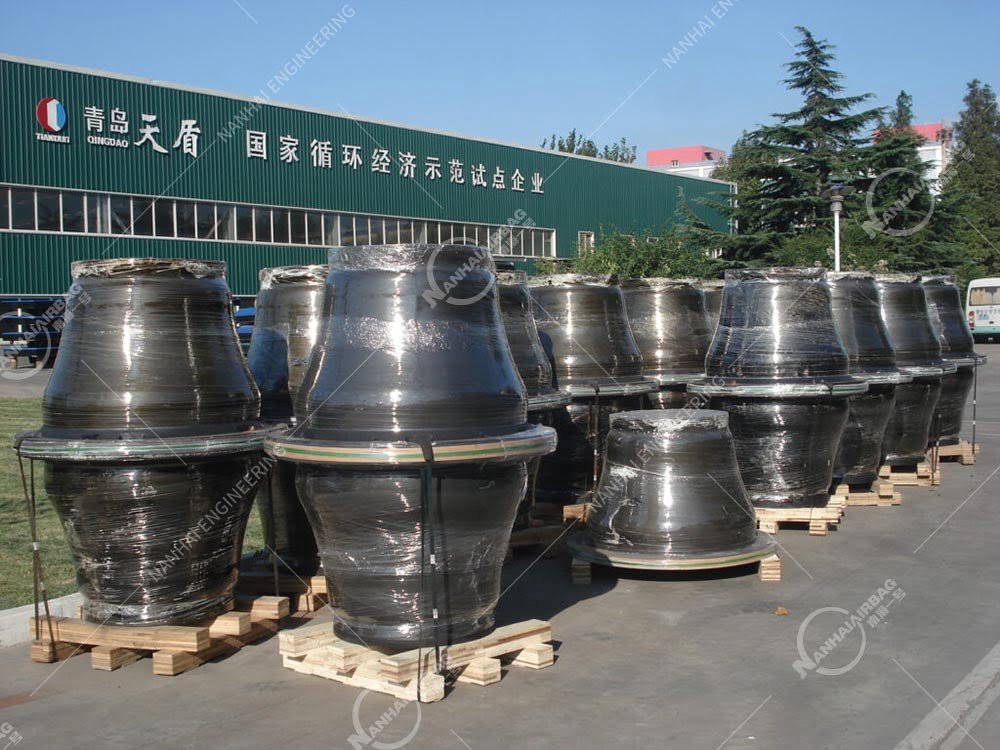

Super Cone Rubber Fenders—an evolution of the classic cell fender—combine a conical body with a reinforced front mount (often with a steel panel) to deliver industry-leading energy absorption with low reaction force, excellent angular tolerance for vessels approaching at skew, and outstanding stability under heavy compressive loads. They are the preferred choice for container terminals, oil jetties, VLCC berths, and any high-tonnage dock where standard rubber fenders simply can’t absorb the berthing energy safely.
From Cell to Super Cone: Why the Upgrade Matters
If you run a deep-water terminal, you already know the pain point: as vessel size grows and approach velocities creep up, traditional cell fenders start hitting their limits—either the reaction force gets too high (risking hull or fender damage) or you need so many units that the berth face becomes a forest of mounts.
Enter the Super Cone. It keeps the cell fender’s central anchoring principle (a thick rubber cone compressed axially onto a steel pedestal) but optimizes the geometry and adds a larger, stabilized front panel. The result?
- Higher energy absorption per unit vs. standard cell
- Lower reaction force for the same deflection
- Better performance when the ship hits at an angle (±10°–15° tolerance, depending on spec)
- Reduced shear on the anchor bolts because the conical shape self-centers
Real-World Example: Where Super Cone Earns Its Keep
Busan New Port, Container Terminal Phase 3—when the berth was upgraded for 14,000-TEU post-Panamax calls, the original cell fenders were swapped for Super Cone units. Result: ~25% higher energy absorption at the same reaction-force envelope, meaning larger ships could berth without redesigning the entire quay structure. Only the fender heads and mounting groups needed upgrading—huge capex saving vs. rebuilding the dock.
Another case: a Middle East VLCC single-point mooring (SPM) dolphin used Super Cone fenders on the breasting dolphins. Tankers there don’t always come in straight, especially with cross-currents. The Super Cone’s angular tolerance meant the fender absorbed skew impacts that would have chewed up a standard cell’s mounting bolts inside two years.
💡 Designer’s note: Super Cone fenders sit at the top of the rubber fendershierarchy alongside Cell and Cone-class units. Below them in the pyramid: W fenders → Arch → D / Square for lower-energy berths. If your berthing energy calc says “cell or higher,” Super Cone is usually worth the premium over standard cell.
5 Reasons Super Cone Rubber Fenders Dominate Heavy-Duty Berths
1. Best-in-Class Energy / Reaction Force Ratio
The conical geometry crushes more progressively than a cylinder or a rectangular block. As deflection increases, the rubber engages more volume. Translated: you get more joules absorbed before the hull sees dangerous push-back force. For large vessels with sensitive hull plating or for docks with weight-limited wharf structures, that ratio is the whole ballgame.
2. Angular Approach Tolerance
Ships don’t always kiss the dock perfectly square—currents, wind, tug timing all introduce skew. Super Cone fenders (especially with the larger frontal panel) tolerate angular compression up to ~10°–15° without catastrophic performance drop. Standard cylindrical or D fenders? They shear or roll out of the mount much earlier.
3. Front Panel = Distributed Load & Easier Maintenance
Most Super Cone units ship with a steel front panel (sometimes UHMW-PE faced to reduce hull friction). Benefits:
- Spreads hull contact over a wider patch → lower hull pressure
- Lets the fender pivot slightly on the panel to accommodate skew
- When the rubber finally wears out (10–15+ years later), you unbolt the panel, swap the cone, and reuse the panel and pedestal
4. Extreme Durability in Harsh Environments
Cones are typically molded from high-abrasion, salt/UV/ozone-resistant rubber compounds (NR/SBR/EPDM blends, 60–70 Shore A). The central anchor rod is hot-dip galvanized or stainless. Between the compound and the protected anchor path, Super Cones routinely log 15+ years in corrosive, high-cycle ports.
5. Pairs Naturally with Marine Airbags During Construction
Here’s a connection not everyone thinks about: when you’re buildingthat new VLCC jetty or container terminal, marine airbags are often used to launch the construction barges, position the precast concrete dolosse/caulissons, or refloat equipment during the build phase. Once the berth is live, Super Cone rubber fenders take over protecting the same vessels the airbags helped put into service. Two products, one project lifecycle.
Super Cone vs. Cell Fender vs. W Fender: Quick Comparison
| Feature | Super Cone | Standard Cell | W Rubber Fender |
|---|---|---|---|
| Energy absorption | ★★★★★ (highest) | ★★★★ | ★★★ |
| Reaction force (at same energy) | Low | Medium | Medium-Low |
| Angular tolerance | Excellent (10°–15°) | Good (~10°) | Moderate |
| Front panel option | Yes (standard) | Yes | No (direct hull contact) |
| Best for | VLCC, container, SPM dolphins | Medium-large terminals | Mid-size terminals, general cargo |
| Price tier | Premium | Mid-premium | Mid |
Spec Cheat Sheet: What to Specify
| Parameter | Typical Range / Notes |
|---|---|
| Model series | SC400 / SC500 / SC630 / SC800 / SC1000 / SC1200 (number ≈ cone base diameter in mm) |
| Energy absorption | ~35 kJ to 350+ kJ per unit (depends on model & deflection %) |
| Reaction force | Scales with model; super cones tuned to keep R/F ~20–30% lower than equivalent cell at same energy |
| Max deflection | Typically 52–55% of free height (check mfr curve) |
| Front panel | Steel, often with UHMW-PE facing; custom sizes per berth design |
| Anchor system | Central threaded rod + base plate + anchor bolts; HDG or SS |
| Rubber compound | NR/SBR/EPDM, 65±5 Shore A, anti-UV/ozone |
| Standards reference | PIANC 2002 / 2021 guidelines, OCIMF for SPM applications |
| Service life | 15+ years coastal with inspection |
Related Questions (People Also Ask for “Super Cone Rubber Fenders”)
❓ What’s the difference between Super Cone and Cell fenders?
Both use a conical rubber body compressed on a central anchor, but Super Cone units optimize the cone angle and front-panel geometry to deliver more energy absorption at lower reaction force, plus better angular performance. Think of Super Cone as “Cell 2.0″—same DNA, better output, slight price premium.
❓ When should I choose Super Cone over W or Arch fenders?
If your berthing energy calc puts you above what W/Arch can safely handle—typically large container ships, tankers, bulk carriers, SPM dolphins—Super Cone (or Cell) enters the conversation. Rule of thumb: approach velocity >0.4–0.5 m/s + vessel >50,000 DWT → start looking at cone-class fenders.
❓ Do Super Cone fenders need a steel front panel?
Almost always, yes—and that’s part of what makes them “super.” The panel distributes load, allows slight pivoting for skew, and protects the rubber face. Some specs add a UHMW-PE low-friction pad between panel and hull to reduce shear on the fender during surge/sway.
❓ How are Super Cone fenders installed?
They mount to a concrete or steel dolphin/wharf via a base plate and anchor bolts (often cast into the concrete). The cone sits on the central rod, the front panel bolts to the cone’s head. For SPM dolphins, the whole assembly is designed to OCIMF/mooring-system specs.
❓ Can Super Cone fenders be used with marine airbags on the same project?
Yes—different lifecycle phases. Marine airbags often handle the heavy lifting during terminal construction (launching work barges, positioning caissons). Super Cone rubber fenders then protect the completed berth. Many EPC contractors list both in the same BOQ under “marine fenders & auxiliary equipment.”
❓ How long do Super Cone fenders last and what maintenance do they need?
Expect 15+ years in normal coastal service. Maintenance is minimal: inspect annually for rubber cracks, check anchor bolt torque, verify front panel alignment, and confirm UHMW-PE facing hasn’t worn through. The rubber itself rarely fails before the dock structure does—most “failures” are mounting-bolt corrosion or panel damage from abnormal impact.
The Bottom Line
Super Cone Rubber Fenders sit at the top of the marine fenders performance curve for good reason—they solve the exact problem large terminals face: how to absorb more energy without beating up the hull or the dock. If your berth is seeing Post-Panamax containers, VLCCs, or anything with a heavy surge environment, the upgrade from standard cell to Super Cone usually pays back in extended wharf life and fewer hull-incident claims.
Next step: pull three numbers—largest vessel DWT, design approach velocity, and allowable reaction force on the wharf structure—and you can run an energy/reaction calc to see whether you’re in W/Arch territory or need to step up to Super Cone. Need a side-by-side calc between Cell and Super Cone for your berth? Bring those three numbers and we’ll show you where the breakpoint lands.
Keywords: Super Cone Rubber Fenders, marine airbags, marine fenders, rubber fenders, cell fender vs super cone, SC800 cone fender specification.
