
Super Cell Rubber Fender: The High-Performance Choice for Heavy-Duty Marine Protection
08/07/2026D Rubber Fender: The Entry-Level Workhorse Every Wharf (and Tug) Should Have
14/07/2026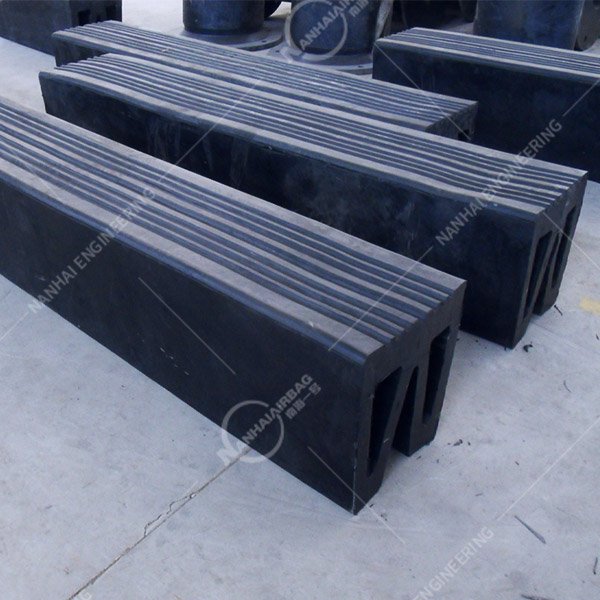
A W Rubber Fender (also called W-type fender or W-shape fender) is an extruded solid-rubber marine fender with a double-arch “W” cross-section that delivers moderate energy absorption at low reaction force. Its wide contact face spreads impact evenly along the fender line, making it especially popular for small-to-medium quay walls, barge docks, inland river terminals, and workboat piers. Compared with heavier rubber fenders like super cell or cone types, the W fender trades peak energy capacity for lower cost and easier installation—often used alongside marine airbags in shipyards where slipway launching and berth protection need to coexist.
What Exactly Isa W Fender, and Why Does the Shape Matter?
If you cut a W rubber fender crosswise, you’ll see two shallow arches sharing a central rib—hence the “W.” That geometry isn’t decorative. Each arch compresses independently under load, so as a vessel pushes in, the fender doesn’t just squash—it flexes across a wider surface.
Think of it like this: a cylindrical fender is a rolling pin; a W fender is two small shock-absorbers side by side. More contact area = lower hull pressure per square inch. For smaller vessels with thinner plates (tugs, barges, patrol boats), that difference matters.
And that’s where the story gets interesting—because once you understand the shape, the advantages practically fall out of it.
🔑 Advantage 1: Low Reaction Force Protects Lightweight Hulls
W fenders are tuned for low-to-moderate berthing energy. The double arch flattens gradually, keeping reaction force on the hull within safe limits even as compression hits 40–50%.
Example: A Yangtze River bulk terminal retrofitted its wooden-pile wharf with W-type rubber fenders (150 × 150 mm profile). Before the upgrade, small 3,000 DWT self-propelled barges were denting hull plates on old timber buffers. After switching, hull-damage claims dropped to near zero—while the fender cost was roughly one-third of a cone-fender equivalent.
🔑 Advantage 2: Simple Extrusion = Lower Unit Cost
Unlike molded fenders (cell, cone, super cell), W fenders are extruded in continuous lengths and cut to order. No expensive molds per size change.
Example: A Southeast Asian shipyard needed 120 meters of fender line for a new tug berth. Quoting SC-type super cells would’ve blown the capex. W fenders came in at ~40% of the budget, with anchor bolts pre-drilled and install finished in two days.
🔑 Advantage 3: Easy Installation & Replacement
Pre-drilled bolt holes every 300–500 mm. Mount directly to a concrete or steel wale. When one segment wears out after 8–10 years, you swap that section—not the whole run.
🔑 Advantage 4: Pairs Naturally With Marine Airbags in Shipyards
Here’s a combo you’ll see at smaller shipyards: W rubber fenders guard the permanent quay wall, while marine airbags handle the heavy lifting on the slipway (launching, landing, side-shifting). One stays put; the other moves with the job. Together they cover the full lifecycle of a vessel without doubling your fender spec.
Where W Fenders Sit in the Marine Fender Family
Quick comparison so you can see the niche:
| Fender Type | Typical Use | Energy Absorption | Price Tier |
|---|---|---|---|
| Super Cell / Cone | Container terminals, oil jetties, naval | ⭐⭐⭐⭐⭐ | $$$ |
| Arch / V-type | Medium cargo piers | ⭐⭐⭐ | $$ |
| W-type | Barge docks, inland terminals, tugs, fishing piers | ⭐⭐⭐ | $ |
| Cylindrical (GD) | Light piers, pontoon walkways | ⭐⭐ | $ |
If your biggest visitor is under ~10,000 DWT and your berthing angle is tame (≤5°), W fenders are usually the economic sweet spot among all rubber fenders on the market.
Related Questions (People Also Ask)
Q1: What’s the difference between W fender and V / Arch fender?
All three are solid extruded profiles, but the W has twoarches vs. the V/Arch’s single arch. That gives W a slightly wider contact face and lower unit reaction force, at the cost of slightly less energy per meter. V fenders are narrower and sometimes preferred when wharf space is tight.
Q2: How long do W rubber fenders last?
Typical service life is 8–12 years in normal coastal conditions, up to 15 if you add carbon-black UV-resistant compound and wash salt off periodically. Inland river use tends toward the upper end.
Q3: Can W fenders be used on a floating dock?
Yes, but they’re usually bolted to a fixed wale rather than directly to a floating pontoon (too stiff for some floating structures). For floating docks, D-type or pneumatic fenders are more common; W fenders live on the fixed quay side.
Q4: Do I need a frontal panel with a W fender?
Not always. W fenders often mount directly because the wide face already spreads friction. But if your vessels have soft hull coatings or you want to reduce shear, adding an UHMW-PE panel on top is a low-cost upgrade.
Q5: W fender vs. marine airbags—which one do I need?
They’re not either/or. Rubber fenders (W included) are mounted on the berthfor daily docking protection. Marine airbags are portableand handle launching, landing, and heavy lifting on the slipway. A complete shipyard specs both; a pure wharf project only needs fenders.
One Last Thing Before You Spec It
The W fender won’t win a beauty contest against a super cell, and it won’t handle a 200,000 DWT container ship. But for the majority of the world’s berths—inland terminals, fishing ports, tug docks, secondary oil jetties—it’s quietly doing 90% of the job at 40% of the price. If your design envelope is “moderate energy, low reaction, tight budget,” the W belongs on your shortlist.
Got a wharf project and not sure whether W, V, or cone is the right call? Tell me your max DWT and berthing angle—I’ll narrow it down.
