
W Rubber Fender: The Cost-Effective Workhorse for Small-to-Medium Berths
09/07/2026Cylindrical Rubber Fender (GD Fender): The Hanging Workhorse for Wharves, Pontoons & Barge Lines
16/07/2026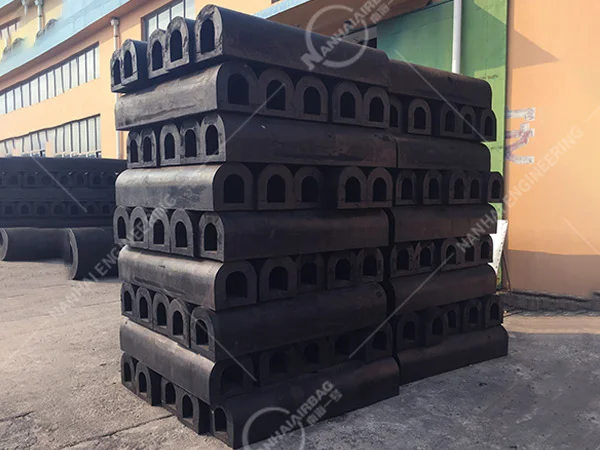
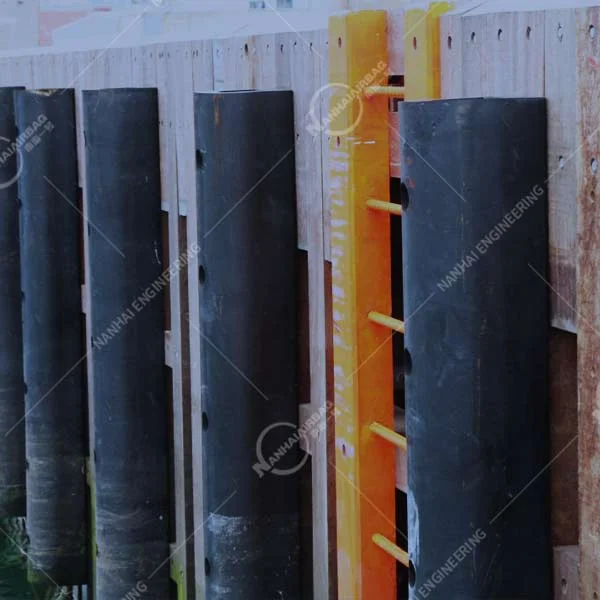
A D Rubber Fender is a solid-extruded marine fender with a D-shaped cross-section—flat on the back for mounting, curved on the front to absorb impact. It’s the most common “first spec” among rubber fenders for small-to-medium berths, tugs, workboats, and pontoon walkways, delivering reliable energy absorption at the lowest price point in the fender family. Two main variants exist: DD (double-D, solid center) for maximum durability on static wharves, and DC (D-with-central-hole, O-bore) for lighter, more flexible mounting on vessel sides. While it can’t handle the heavy energy of a super cell or even a W fender, its flat-back simplicity makes it the go-to for fishing ports, marinas, and inland waterway locks—often specified alongside marine airbags in smaller shipyards where berth protection and slipway launching share the same budget.
Why the “D” Shape? (And Why You Keep Seeing It Everywhere)
Cut a D fender in half and you’ll see it: a flat rear face, a curved impact face, and either a solid core (DD) or a cylindrical bore through the center (DC). That flat back is the whole selling point—you bolt a steel flat-bar through the bore (or straight into the back wall on larger sections), and the fender sits flush against concrete, steel wale, or even a tug’s side hull.
If W fenders are “two small shock absorbers side by side” and super cells are “engineered compression cylinders,” the D is… a bumper. Not sexy, but it works. And once you see where it shows up, you realize it’s probably the highest-volume fender shipped globally.
Let’s talk advantages—because the D earns its keep in three very specific ways.
🔑 Advantage 1: Flat-Back Mounting = 10-Minute Install
No complex brackets. No frontal panels required. Run a steel flat bar through the central bore (DD/DC both accept this), bolt it to the quay wall, done.
Example: A fishing port in Southeast Asia needed 180 meters of fender line along a new concrete wharf for 500–2,000 DWT trawlers. SC-type was overkill; W-type needed custom drilling. They went with DD200 D fenders, pre-drilled, M24 bolts, flat-bar every 400 mm. Two crews finished install in three days—including corner chamfering. Total fender cost sat at roughly $28/meter landed, less than half of what W would’ve run.
🔑 Advantage 2: DD vs. DC—You Can Tune Stiffness to the Job
This is the detail most buyers miss:
- DD (solid core): Stiffer, higher reaction force, best for fixed wharves and lock walls.
- DC (O-bore): Hollow center, more compliant, lighter weight—better when the fender mounts on the vessel(tug sides, workboat belts) and needs to flex with hull movement.
Example: A harbor tug operator specced DC250 on the port/starboard sides (needed flex during push operations) but DD300 on the permanent dock bollards where the same tug berths nightly. Same product family, two behaviors, one procurement line.
🔑 Advantage 3: Sizes from 100 mm to 500 mm—Scale It Up
The standard DD/DC range runs H×B = 100×100 all the way to 500×500 mm. Energy absorption scales from ~0.9 kN·m/m (DD100) to ~36 kN·m/m (DD500) at rated deflection—so a small fishing pier and a 10,000 DWT barge dock can both stay in the D-family, just sizing up.
🔑 Advantage 4: Pairs With Marine Airbags in Small Shipyards
Same story as the W article, but even more natural here: D fenders live on the quay wall protecting the berth; marine airbags handle the slipway launching next door. At a provincial-level shipyard doing 3,000 DWT bulk carriers, you’ll often see DD300 along the fitting-out quay + 1.5 m diameter airbags on the launch way. One stays put, one rolls—budget stays sane.
Where D Sits in the Rubber Fender Ladder
| Fender Type | Energy Absorption | Reaction Force | Typical Vessel / Berth | Price Tier |
|---|---|---|---|---|
| Super Cell / Cone | ⭐⭐⭐⭐⭐ | Low–Med | Container terminals, oil jetties, naval | $$$ |
| W-type | ⭐⭐⭐ | Low–Med | Barge docks, inland terminals, tug bows | $$ |
| D-type (DD/DC) | ⭐⭐ | Med–High | Fishing piers, marinas, tugs, pontoons, lock walls | $ |
| Cylindrical (GD) | ⭐⭐ | Low | General piers, hung via chain | $ |
Rule of thumb: if your visitor is under ~5,000 DWT and berthing energy is modest, D gets the job done. Above that, step up to W or cone.
Related Questions (People Also Ask)
Q1: What’s the difference between DD and DC D fenders?
DD has a solid D-shaped center—stiffer, higher energy absorption per meter, best for fixed wharves. DC has a cylindrical (O) bore through the center—lighter, more flexible, better for mounting on vessel sides (tugs, workboats) where the fender needs to conform during push/pull ops.
Q2: What size D fender do I need?
Standard range runs DD100 → DD500 (H = B = 100–500 mm). Rough guide: DD150–DD200 for fishing boats and small pontoons; DD250–DD300 for workboat piers and 3,000–5,000 DWT barges; DD400–DD500 for medium cargo wharves. Always check reaction force against your hull pressure allowance.
Q3: Can D fenders be used on the ship itself, not just the wharf?
Yes. DC-type in particular is commonly bolted to tug sides, pilot boat belts, and workboat hulls for ship-to-ship (STS) and ship-to-berthing (STB) protection. DD-type is more common on the fixed structure side.
Q4: How long do D rubber fenders last?
8–12 years coastal, up to 15 inland, assuming standard NR/SBR compound with carbon-black UV resistance. Inland waterway locks often see the upper end because salt exposure is lower.
Q5: D fender vs. W fender—which one?
W gives you more energy absorption per meter and lower reaction force (double-arch geometry). D is cheaper, simpler to mount, and comes in longer continuous lengths (extruded, not molded). If budget is tight and vessels are small, D wins. If energy is creeping up, step to W.
Q6: Do I need marine airbags if I already have D fenders on my quay?
They serve different jobs. Rubber fenders (D included) protect the berthduring docking. Marine airbags launch, land, and shift vessels on the slipway. A complete shipyard specs both; a pure fishing wharf only needs fenders.
Before You Lock In the Spec
The D fender won’t win on peak energy—it’s not trying to. What it istrying to do is get a fishing port, a marina finger pier, a tug side-belt, or an inland lock wall protected for the least money and the least fuss. If your design envelope is “modest energy, flat mounting surface, tight budget,” the D belongs on the shortlist—and nine times out of ten, it wins.
Sizing a D run for a fishing wharf or tug side? Drop your max vessel DWT and whether it’s wharf-mounted or hull-mounted—I’ll tell you DD vs. DC and which size to start the calc with.
