
Arch Rubber Fenders: The Definitive Guide for Marine Engineers and Port Operators
20/08/2026Cone Rubber Fenders: The High-Performance “Third Generation” of Fixed Marine Fenders
27/08/2026
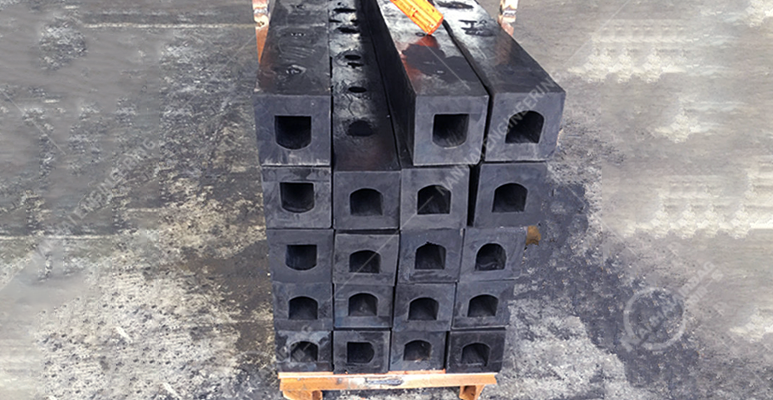
Square Rubber Fenders are extruded, square‑section rubber fenders that bolt directly to quay walls, timber whalers, steel sheet piles, or vessel hulls to absorb berthing impact while spreading load across a large, flat contact face. Compared with cylindrical fenders, the square profile gives a larger and more stable contact area, prevents “rolling” under shear, and provides higher energy absorption relative to its height. Square fenders are therefore the default choice for small‑to‑medium berths, fishing harbours, inland river terminals, tug and workboat pushes, marina finger piers, and ro‑ro ramp edges—situations where budget, simplicity, and replaceable protection matter as much as peak performance. Compliant with major classification societies (ABS, LR, BV, DNV, GL, NK, KR, IRS, CCS), square rubber fenders are a cornerstone of the broader marine fenders family, sitting alongside arch fenders, cone fenders, and floating marine airbags in a complete dock‑protection strategy.
If you are specifying rubber fenders for a municipal harbour, outfitting a tugboat’s push bow, retrofitting a timber wharf, or simply comparing square fenders against cylindrical, D‑type, or W‑type profiles, this guide gives you the engineering facts, real‑world examples, and selection checklist you need to make the right call.
What Are Square Rubber Fenders?
Square rubber fenders—also called rectangular rubber fenders or SC/SQ fenders—are solid extruded profiles with a square or rectangular outer cross‑section. Most designs incorporate an inner chamber to tune compression behaviour:
- SQD – D‑shaped inner chamber (the most common type)
- SQO – O‑shaped (circular) inner chamber
- SSQ – solid, no chamber
- SDS / SQS – square‑shaped inner chamber
Side holes or top & bottom holes are drilled for anchor bolts, allowing the fender to be bolted to virtually any substrate. Standard sizes range from 100 × 100 mm up to 500 × 500 mm (or larger, up to 600 HB / 600 × 600 mm on custom order), with lengths up to 6,000 mm before cutting. Materials are typically natural rubber (NR), SBR, EPDM, or blended compounds, with hardness tuned to the application.
💡 Square fenders are classified by major societies—ABS, LR, BV, DNV, GL, NK, KR, IRS, and CCS certification can be supplied on request, confirming the rubber compound, tensile strength, and energy‑absorption performance meet PIANC and ISO 17357 expectations.
Why Square Rubber Fenders Are the Quiet Workhorse of the Port World
Walk into a fishing harbour in Norway, a ferry landing in Southeast Asia, or a tugboat slip on the Great Lakes and you’ll see square rubber fenders everywhere. They don’t have the glamour of cone or cell fenders, but they win on practicality. Here are the six advantages that make them hard to beat.
1. Lowest Cost Per Metre in the Rubber Fenders Family
The square profile is the simplest extrusion geometry in the marine fenders lineup—no complex moulds, no internal steel, no foam core. That simplicity translates directly into the lowest price per linear metre of protection.
Example: A municipal fishing port retrofitted its ageing timber fender wall with 150 × 150 mm square rubber fenders bolted to timber backing. The simplicity of the square profile kept the fender bill a fraction of what W‑type or cell fenders would have cost—without sacrificing basic protection. For a 200‑metre finger pier, the saving versus W or cell fenders can easily run 30–50% on the fender material alone.
2. Flat Mounting Face = Dead‑Simple Installation
The rear face of a square fender is flat, which means:
- Bolt straight to timber, concrete, or steel whalers
- No complex chamfered brackets
- No welding jigs
- Easy replacement when one section wears out
Compare that to cylindrical fenders, which need half‑round cradles, or W fenders, which need aligned bolting lugs. A maintenance crew with a drill, anchor bolts, and a rubber mallet can swap a damaged section in under an hour.
3. Larger Contact Area Reduces Hull Pressure
The defining advantage over cylindrical fenders: the flat face distributes berthing force over a much larger area, significantly reducing the surface pressure on the vessel’s hull. This matters for vessels with thin or aluminium hull plating, and it minimises point‑loading damage to both hull and quay.
4. No Rolling, Even Under Heavy Shear
The flat base of a square fender prevents “rolling” or displacement under heavy shear loads—a common failure mode in horizontally mounted cylindrical fenders. This stability makes square fenders the secure choice for permanent dock installations and for push‑bow applications on tugs.
Example: A Yangtze River barge terminal uses 200 × 200 mm square fenders on its parallel berthing face. Barges slide along the wall during mooring—constant shear. After 8 years, the fenders show only surface abrasion, with zero structural failure. That’s the “boring reliability” port engineers love.
5. Tough, Abrasion‑Resistant, and Weather‑Proof
Solid extruded EPDM/SBR/natural rubber blends mean no air chamber to pop, no foam core to waterlog. They resist:
- Saltwater corrosion
- UV degradation
- Extreme temperatures (‑50 °C to +80 °C)
- Constant rubbing and scuffing from hulls
With basic maintenance, square fenders deliver 10–20 years of service life.
6. Versatile Mounting Options
Square fenders can be:
- Bolted vertically to wharf faces (most common)
- Laid horizontally as a dock‑edge bumper for finger piers and pontoon corners
- Chained or roped as a semi‑floating fender for light craft
- Doubled up (two sections) for extra stand‑off on low‑clearance docks
- Fitted with UHMW‑PE face pads to reduce friction coefficient from ~0.7 down to ~0.15 for low‑friction vessel sliding
Where Square Rubber Fenders Excel — and Where They Don’t
| ✅ Ideal Applications | ❌ Less Ideal For |
|---|---|
| Fishing harbours & small municipal wharves | VLCC / large tanker berths |
| Inland river terminals & barge docks | High‑velocity berthing (>0.5 m/s) |
| Marina finger piers & pontoon corners | Ultra‑large container terminals |
| Tug & workboat push bows | Applications needing ultra‑low reaction force |
| Ro‑ro ramp edges & dock thresholds | Deepwater jetties with extreme tidal range |
| Small jetties, terminals, shipyards |
Source: industry comparison of square vs. cylindrical vs. SC/SD fender types.
The takeaway: When you need consistent, cheap, replaceable protection in low‑to‑mid‑energy berthing scenarios, square fenders are unbeatable. For very large vessels or extreme energy demands, cone fenders, cell fenders, or floating pneumatic marine airbags take over.
Square vs. Cylindrical vs. D‑Type: How to Choose
| Feature | Square Type | Cylindrical Type | D‑Type |
|---|---|---|---|
| Contact area | Large, flat, uniform | Curved, narrower | Medium, flat back |
| Reaction force | Higher (due to flat contact) | Lower, progressive | Higher initial |
| Rolling risk | None (flat base) | High unless restrained | Low |
| Energy absorption (per height) | Higher than cylindrical | Moderate, progressive | Very high per unit size |
| Installation ease | High (bolt to flat face) | Very high (can hang) | Medium (needs alignment) |
| Cost‑efficiency | Excellent | Budget‑friendly | Mid‑range |
| Best for | General docks, tugs, barge walls | Variable‑angle, hanging applications | Compact, high‑energy spaces |
Data synthesised from Tonly, Willbrandt, and Tullyn fender engineering comparisons.
Standard Sizes & Specifications
| Type | H (mm) | W (mm) | Inner Chamber | Bolt Size |
|---|---|---|---|---|
| SQD‑1 | 100 | 100 | D‑shaped | — |
| SQD‑2 | 150 | 150 | D‑shaped | — |
| SQD‑4 | 200 | 200 | D‑shaped | — |
| SQD‑6 | 250 | 250 | D‑shaped | — |
| SQD‑8 | 300 | 300 | D‑shaped | — |
| SQD‑9 | 400 | 400 | D‑shaped | — |
| SQD‑10 | 500 | 500 | D‑shaped | — |
| 150HB | 150 | 150 | Ø75 | M22 |
| 200HB | 200 | 200 | Ø100 | M26 |
| 300HB | 300 | 300 | Ø150 | M32 |
| 500HB | 500 | 500 | Ø250 | M45 |
| 600HB | 600 | 600 | Ø300 | M52 |
Specifications from Tullyn and LW Marine product data. All dimensions nominal, subject to manufacturing tolerances.
Energy absorption scales with size: from 3.83 kJ for a 150HB fender up to 61.6 kJ for a 600HB unit. Reaction forces correspondingly range from 117 kN to 468 kN. For beyond these ratings, step up to cone, cell, or pneumatic marine fenders.
Proper Installation: The Key to a 20‑Year Service Life
A square fender is only as good as its installation. Follow this field‑tested procedure:
- Confirm the substrate. Concrete foundation strength must be ≥ C40, curing age ≥ 28 days, and surface flatness ≤ 3 mm per 2 m. For tidal areas, install during low tide; installation is prohibited when tidal difference exceeds 2 m.
- Mark and drill. Locate the fender’s longitudinal axis (tolerance ±5 mm). Mark bolt centre positions; spacing deviation between adjacent holes should not exceed ±1.5 mm.
- Prepare the embedded plate. Clean rust to Sa 2.5 cleanliness (sandblasting recommended). Apply zinc‑rich primer (dry film ≥ 80 µm). Place a 3 mm rubber pad between fender and steel plate for sealing and cushioning.
- Fix with bolts. Use stainless steel 316 expansion bolts. Tighten in three stages:
- Initial: 50% torque (≈150 N·m)
- Secondary: 80% torque (≈240 N·m)
- Final: 100% torque (≈300 N·m ±5%) Tighten diagonally for even load distribution.
- Seal. Apply polysulfide sealant (≥3 mm) on bolt heads. Fill gaps between fender and concrete with PU foam sealant to form a continuous waterproof barrier.
- Verify. Perform a static load test at 1.25 × design reaction force for 15 minutes—no displacement allowed. Measure fender compression after 7 and 30 days; deformation must not exceed 5% of free height.
Maintenance Checklist
Inspect on a quarterly basis for small ports, monthly for high‑traffic ports:
- ⚓ Check all bolts for looseness; re‑torque as needed
- ⚓ Inspect the rubber body for cracks, cuts, or excessive wear
- ⚓ Examine UHMW‑PE face pads; replace if significantly thinned
- ⚓ Verify the fender is not inclined or dented
- ⚓ Apply anti‑corrosion treatment to steel components annually
- ⚓ Clean with mild soap and water to remove salt, debris, and marine growth—avoid petroleum‑based solvents which degrade rubber
- ⚓ For surface scratches <3 mm deep, use a special rubber repair adhesive on a dry, sunny day to prevent expansion under salt spray
⚠️ Critical: Do not over‑tighten bolts—this causes local stress concentration and can shorten fender life by more than 50%. Leave ~5% allowance for thermal expansion of the rubber.
Square Rubber Fenders vs. Marine Airbags: Understanding the Difference
A question that comes up constantly in procurement: “Should I use square fenders or marine airbags?”
They serve completely different purposes:
- Square rubber fenders are fixed, compression‑type fenders bolted permanently to docks or vessel hulls for everyday berthing protection.
- Marine airbags (pneumatic inflatable fenders) are floating, portable fenders used for ship‑to‑ship transfer, emergency fendering, ship launching, or heavy‑lift operations.
Both belong to the broader marine fenders ecosystem, and a complete port strategy often uses both: square fenders for permanent quay infrastructure, and marine airbags for floating or STS operations. Square fenders are not a substitute for pneumatic marine airbags, and vice‑versa.
Related Questions People Ask About Square Rubber Fenders
These are the questions maritime engineers and procurement officers most frequently search on Google:
❓ What are square rubber fenders used for?
Square rubber fenders are used to protect ships, barges, and quay structures during berthing and mooring. Their geometry provides a large contact area that helps spread berthing forces across the hull and dock face, reducing concentrated loads. Common applications include tugs, workboats, fishing boats, pilot boats, pontoons, piers, quays, loading bays, and small jetties.
❓ How do square fenders compare to cylindrical fenders?
While cylindrical fenders are versatile and easy to install (and can be hung from chains), square fenders offer a much larger, flatter contact surface, which significantly reduces surface pressure on the vessel’s hull. The flat base prevents “rolling” under shear, making square fenders more stable for permanent installations. Square profiles also generally offer higher energy absorption relative to their height compared to hollow cylindrical designs.
❓ Are square rubber fenders suitable for tugboats?
Absolutely. Square fenders are specifically designed with heavier shoulders for use on the bow or stern of smaller tugboats as pushing fenders. Their ability to be closely fitted together minimises the risk of ropes or protrusions getting caught between adjacent sections, ensuring smooth and safe operations.
❓ What certifications should quality square fenders have?
Reputable square fenders carry certification from major classification societies—ABS, LR, BV, DNV, GL, NK, KR, IRS, and CCS. They should also comply with PIANC 2002 guidelines and ISO 17357 performance standards.
❓ Can square fenders be customised?
Yes. Manufacturers offer customisation in:
- Size (100 × 100 mm up to 600 × 600 mm or larger)
- Inner chamber profile (D‑shaped, O‑shaped, square, or solid)
- Length (up to 6,000 mm before cutting, or longer on request)
- Rubber compound (natural rubber, SBR, EPDM, NBR)
- Hardness (Shore A 50–70)
- Bolt hole patterns (side‑drilled or top/bottom‑drilled)
- Face pad options (bare rubber or UHMW‑PE for low friction)
- Colour (standard black, or non‑marking colours on request)
❓ What is the typical service life of a square rubber fender?
With correct installation and routine maintenance, square fenders deliver 10–20 years of service life. Premium fenders from formal manufacturers typically carry a 3–5 year warranty period and can operate normally for 15+ years under proper maintenance.
❓ How do I calculate the right square fender size for my berth?
The calculation follows: E = ½ × Cₘ × Cₑ × Cₛ × M × V², where Cₘ is the hydrodynamic mass coefficient, Cₑ is the eccentricity coefficient, Cₛ is the softness coefficient, M is vessel displacement, and V is berthing velocity. The resulting energy (E_N) is then matched against the rated performance data of candidate fender sizes. Alternatively, match your vessel’s weight and speed to a fender size: small boats (≤10 m) use 30–50 cm pads; medium boats (10–30 m) use 50 cm–1 m pads; large ships (≥30 m) use 1–2 m pads or multiple smaller ones.
❓ How do square fenders differ from D‑type fenders?
Compared with D fenders, square fenders are stronger and more rigid, ideal for tougher service environments. Both share similar advantages, but the square profile provides a larger contact area and is better suited for harder, stronger collisions under harsher conditions.
❓ Are square rubber fenders better than marine airbags?
No—they serve different purposes. Marine airbags (inflatable rubber cylinders) are for lifting ships during launches or repositioning, and for floating STS operations. Square rubber fenders are for protecting vessels and docks during fixed berthing. Both use tough rubber, but their roles are distinct. A complete marine fender strategy often includes both.
❓ Do square fenders need regular maintenance?
Minimal. Inspect for cracks or tears once a year (quarterly for high‑traffic ports), and replace any damaged pads. Clean with mild soap and water to remove salt or debris. Avoid petroleum‑based solvents. Apply anti‑corrosion treatment to steel bolts annually.
The Bottom Line
Square rubber fenders represent the optimal balance of cost, simplicity, and reliable performance in the marine fenders spectrum. Their flat, stable contact face, resistance to shear‑induced rolling, and low cost per metre make them the default specification for:
- 🚢 Fishing harbours and small municipal wharves
- 🚢 Inland river terminals and barge docks
- 🚢 Tug and workboat push bows
- 🚢 Marina finger piers and pontoon corners
- 🚢 Ro‑ro ramp edges and dock thresholds
- 🚢 Small jetties, shipyards, and terminal structures
For very large vessels or extreme energy demands, step up to cone fenders, cell fenders, or floating pneumatic marine airbags. But for the vast majority of everyday berthing scenarios, square rubber fenders deliver the protection you need at a price point that keeps your project on budget—with a service life of 10–20 years when properly installed.
📌 Ready to specify square fenders for your project? Gather your vessel displacement, berthing velocity, available mounting depth, and substrate type, then engage a PIANC‑compliant manufacturer for a performance‑matched recommendation. The right square fender, properly installed and maintained, will protect your vessels and your infrastructure for the next two decades.
Keywords: Square Rubber Fenders, marine fenders, rubber fenders, marine airbags, square fender, rectangular rubber fender, SC fender, SD fender, SQD fender, extruded rubber fender, tugboat push fender, low‑cost marine fender, PIANC‑compliant fender, ISO 17357 fender, UHMW‑PE faced fender, dock protection, quay fender.
