
Square Rubber Fenders: The Practical, Cost-Effective Choice for Docks, Tugs, and Workboats
25/08/2026Pneumatic Rubber Fenders: The Definitive SEO Guide to Floating Marine Impact Protection
04/09/2026
Picture a 400-meter container ship—24,000 TEU, nudging into a berth in a 25-knot crosswind. The tide’s dropping fast, the approach angle is off by 8 degrees, and the vessel is carrying more kinetic energy than a freight train at full speed. What stops that wall of steel from crushing the quay, cracking the hull, and triggering a $2M repair bill?
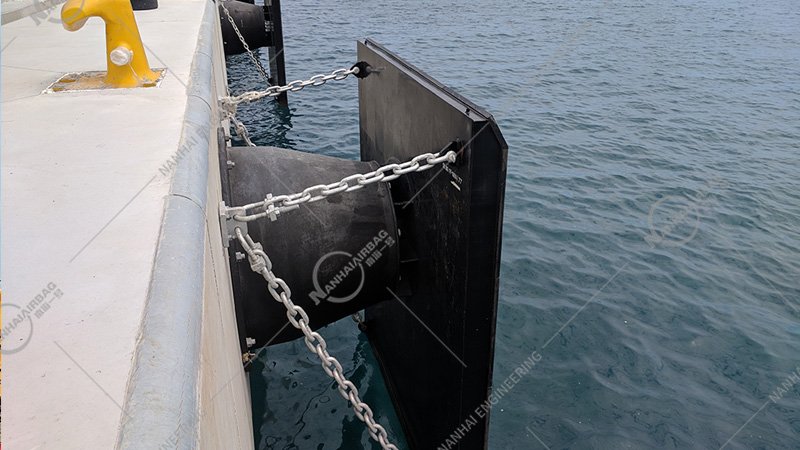
Cone rubber fenders—the “third generation” of fixed marine fenders—are the answer. They’re the high-performance evolution of cell fender designs, built to absorb enormous berthing energy while keeping reaction forces low, even when a vessel hits at an angle. If you’re running a container terminal, oil or LNG jetty, RoRo port, or any berth handling large vessels in challenging conditions, cone fenders aren’t just an upgrade—they’re the new baseline.
🎯 Featured Snippet (Google-Selectable Summary)
Cone rubber fenders are high-performance, fixed marine fenders with a conical rubber body, mounting base plate, frontal steel frame, and UHMW-PE low-friction panel, designed to absorb large amounts of berthing energy while keeping reaction forces exceptionally low. As the third generation of cell fender design, the conical geometry compresses up to 70–72% of its height, delivering a superior energy-absorption-to-reaction-force (E/R) ratio and stable performance at compression angles up to ±10° to ±15°. Unlike marine airbags—which are inflatable devices for ship launching, lifting, and salvage—cone fenders are permanently mounted rubber fenders built for continuous berthing protection, with a service life of 15–20 years in harsh marine environments. They are the preferred solution for container terminals, oil & gas berths, LNG facilities, RoRo and cruise terminals, offshore platforms, and dolphin moorings.
⚠️ Why This Is Urgent (Not “Someday” Planning)
Modern ports aren’t dealing with the same vessels they were 20 years ago. The stakes have changed:
- Bigger ships, bigger energy: Today’s ultra-large container vessels and VLCCs generate berthing energy in the thousands of kJ. A traditional cylindrical or arch fender simply can’t absorb that without transferring destructive force back to the hull and quay.
- Angled berthing is the norm, not the exception: Wind, current, and tight maneuvering mean vessels rarely hit perpendicular. Cone fenders maintain stable energy absorption up to ±10° to ±15° compression angles—something cylindrical fenders can’t do.
- Tidal ranges are unforgiving: Ports with tidal swings of 4+ meters need fenders that perform consistently across the entire tidal cycle. Cone fenders’ progressive compression curve and fatigue resistance handle this without breaking a sweat.
- The cost of getting it wrong is enormous: A single hull-plate repair from a failed berthing can run $40k–$200k. A cracked quay wall? Millions. One Scandinavian operator reported three hull-plate replacements in 18 months before switching to cone fenders.
The bottom line: if your berth handles vessels over 10,000 DWT, or if you’re seeing angled approaches, large tidal variation, or high-frequency berthing—waiting to upgrade isn’t an option. Every docking cycle without proper cone fenders is a roll of the dice.
💡 Real-world proof: After upgrading to super cone fenders, the Port of Rotterdam reported a 40% reduction in docking-related repairs and 25% faster vessel turnaround. The fenders paid for themselves in under two years.
🔑 Why Cone Fenders Outperform Every Alternative
1. The Best Energy-Absorption-to-Reaction-Force Ratio in the Industry
This is the metric that matters most. Cone fenders offer significantly higher energy absorption with lower reaction forces compared to arch, cell, or cylindrical fenders. Translation: they stop the vessel gently without hammering the quay or hull. The E/R ratio is so favorable that an SC800H cone fender can match the energy absorption of a much larger cell fender—reducing initial investment by 20–30%.
2. Up to 72% Compression Deflection
Cone fenders can compress up to 70–72% of their height—compared to 52.5% for traditional cell fenders. That extra stroke means they soak up kinetic energy over a longer, softer deceleration curve. More stroke + lower peak force = gentler braking on the vessel.
3. Angular Stability That Doesn’t Quit
Real docking isn’t perpendicular. Cone fenders maintain stable energy absorption at compression angles up to ±10° to ±15° with minimal performance loss. The conical geometry redistributes load instead of concentrating it at a corner—preventing the localized stress failures that plague other fender types.
4. Superior Shear and Torsion Resistance
The wide base and conical shape resist lateral shear forces and torsional loads—critical for berths with large tidal ranges or strong currents. You need less secondary hardware to control shear, which simplifies installation.
5. Self-Centering Geometry
Under oblique or uneven berthing forces, the conical design keeps the fender stable and properly aligned. No folding, no shearing out of position—just consistent, predictable performance.
6. 15–20 Year Service Life
Manufactured from high-quality natural rubber (NR) or EPDM compounds with UV, ozone, and saltwater resistance, cone fenders deliver 15–20 years of reliable service with minimal maintenance. That’s 3–5× longer than standard rubber fenders.
7. Zero Inflation, Zero Moving Parts
Unlike pneumatic fenders or marine airbags, cone fenders have no air pressure to monitor, no risk of puncture, and no moving parts to fail. Routine visual inspection is enough to keep them in top condition.
🆚 Cone Fenders vs. Other Marine Fenders (The Full Comparison)
| Feature | Cone Fender | Cell Fender | Cylindrical | D-Type | Pneumatic |
|---|---|---|---|---|---|
| Energy Absorption | Very High | High | Low | Low | High |
| Reaction Force | Very Low | Low | High | High | Very Low |
| Max Deflection | 70–72% | ~52.5% | ~20% | ~20% | 60–70% |
| Angular Tolerance | ±10° to ±15° | Moderate | Poor | Limited | ≤15° |
| Service Life | 15–20 yrs | 12–18 yrs | 10–15 yrs | 5–10 yrs | 10+ yrs |
| Maintenance | Low | Low | Medium | Low | High (pressure checks) |
| Best For | Large vessels, high energy | Ultra-large, offshore | Small docks | Tugs, small craft | STS, offshore |
The takeaway: Cone fenders provide the best balance of performance and durability for high-energy berthing. They outperform cell fenders in energy absorption by 25–30% while being more compact.
🌊 Cone Fenders vs. Marine Airbags — Know the Difference
This is the #1 confusion in marine procurement, so let’s be crystal clear:
| Cone Rubber Fenders | Marine Airbags | |
|---|---|---|
| Primary job | Absorb kinetic energy during berthing | Lift, float, launch, and stabilize |
| Installation | Permanently mounted on quay/dock | Temporary, under keel or beside hull |
| Core mechanism | Rubber compression & buckling deformation | Compressed air + tire-cord displacement |
| Standards | PIANC 2002/2018, ISO 17357 | ISO 14409, ISO 17682 |
| Example use | Container ship berths at a terminal | Refloat a grounded vessel, launch a ship |
They are partners, not substitutes. A modern port uses marine airbags on ship launching day to get a vessel into the water, and cone rubber fenders on the berth to protect it every single time it docks thereafter. Both are essential marine fenders—but for a working berth, you want cones, not airbags.
📋 How to Select the Right Cone Fender (No Guesswork)
Step 1: Calculate Your Berthing Energy
Consider:
- Vessel displacement (DWT): Larger ships generate more berthing energy
- Berthing velocity: Higher speed increases impact force exponentially
- Berthing angle: Affects how force is distributed
- Tidal range and clearance: Determines fender positioning
For a 10,000 DWT bulk carrier, the berthing energy can reach several hundred kJ even at moderate speed. A properly rated cone fender absorbs that without overstressing the structure.
Step 2: Pick Your Size
Cone fenders are available in heights from 300 mm to 2,000 mm. Common sizes include:
| Size | Height (mm) | Typical Application |
|---|---|---|
| SCN 300–500 | 300–500 | Small cargo terminals, select berths |
| SCN 600–800 | 600–800 | Medium container terminals, general cargo |
| SCN 1000–1250 | 1000–1250 | Large container terminals, oil berths |
| SCN 1600+ | 1600+ | Major LNG facilities, VLCC terminals |
An SC800H cone fender can match the energy absorption of an SC1000H cell fender—allowing smaller, cost-effective specs.
Step 3: Choose Your Rubber Compound
- Natural Rubber (NR) / NR-SBR blend: Standard for most applications, Shore A hardness 60–65 for optimal absorption/recoil balance
- EPDM: Extreme temperature range (-55°C to 120°C), chemical resistance for Arctic or hydrocarbon-exposed terminals
- Neoprene (CR): Aggressive chemical exposure, oil & gas facilities
Step 4: Specify Frontal Panels
For vessels over 50,000 DWT, always add a steel frontal panel with UHMW-PE facing pads. This:
- Reduces friction coefficient to 0.10–0.15 (from 0.6–0.8 for rubber-on-steel)
- Lowers hull surface pressure to under 200 kN
- Minimizes shear forces and hull paint damage
- Extends fender life by reducing wear
Step 5: Verify Certifications
Demand:
- PIANC 2002 / PIANC 2018 compliance
- ISO 17357 performance standards
- Third-party inspection (ABS, BV, LR, CCS, DNV)
- Independent compression-test reports
Step 6: Plan Installation Layout
Critical parameters:
- Fender spacing: 10–15% of design vessel’s LOA, never exceeding 3× fender face width
- Elevation: Span the tidal range; use two rows for tidal ranges >4m
- Anchor hardware: Hot-dip galvanized or stainless steel (SUS316 for offshore)
🛠️ Installation & Maintenance Essentials
Installation Best Practices
- Pre-bending for curved surfaces: Structures with curved profiles may require pre-bent fenders to avoid stress concentration
- Proper bolt torque: Use the specified grade (M16 to M30 depending on fender size)
- Align frontal panels: Ensure UHMW-PE pads face the vessel contact zone
- Support chain length: For floating docks, calibrate chain length to tidal movement
Maintenance Checklist
- ✅ Annual visual inspection for surface cracks, compression set, and bolt integrity
- ✅ Structural upkeep every 2–3 years (bolted connections, panel alignment)
- ✅ Shore A hardness test—if rubber hardens beyond spec, plan replacement
- ✅ UHMW-PE panel check—replace if friction coefficient rises above 0.2
- ✅ Clean debris from fender bases to prevent water trapping
With this regimen, quality cone fenders deliver 15–20 years of service—3–5× longer than standard rubber fenders.
❓ People Also Ask (Real Google PAAs for “Cone Rubber Fenders”)
Q: What is a cone rubber fender?
A: A cone rubber fender is a high-performance, fixed marine fender with a conical rubber body designed to absorb large amounts of berthing energy while keeping reaction forces low. It’s the third generation of cell fender design, compressing up to 70–72% of its height with stable performance at angles up to ±10° to ±15°. It consists of a cone body, mounting base plate, frontal steel frame, and UHMW-PE low-friction panel.
Q: How do cone fenders compare to cell fenders?
A: Cone fenders offer 25–30% higher energy absorption than cell fenders of the same size, compress to 72% vs. 52.5% for cells, and maintain performance at larger angular berthing (±10° to ±15° vs. moderate angles). Cone fenders have a more compact design and lower total cost of ownership over their 15–20 year lifespan, while cell fenders remain cost-effective for standard berths with moderate energy.
Q: What sizes do cone rubber fenders come in?
A: Cone fenders range from 300 mm to 2,000 mm in height. Common sizes include SCN300, SCN400, SCN500, SCN600, SCN700, SCN800, SCN1000, SCN1250, and SCN1600+. Custom sizes are available for unique berth configurations.
Q: Are cone fenders better than marine airbags for docking?
A: They serve completely different purposes. Marine airbags are inflatable, portable devices used mainly for ship launching, lifting, and salvage. Cone rubber fenders are fixed, permanent dock infrastructure designed for continuous berthing protection with high energy capacity and low reaction forces. For a working berth, you need cone fenders—not airbags.
Q: What is the typical service life of a cone rubber fender?
A: With proper installation and UHMW-PE panel maintenance, cone fenders deliver 15–20 years of service—3–5 times longer than standard rubber fenders. EPDM compound fenders in extreme conditions can exceed this range.
Q: Can cone fenders handle angled berthing?
A: Yes—this is their superpower. Cone fenders maintain stable energy absorption and structural integrity at compression angles up to ±10° to ±15°, redistributing load instead of concentrating stress at a corner. This makes them ideal for ports with wind, waves, strong currents, or frequent angled approaches.
Q: Do cone fenders work in cold weather?
A: Absolutely. High-quality cone fenders made with EPDM compounds or specialized NR/SBR blends maintain elasticity at temperatures as low as -55°C, making them suitable for Arctic and Antarctic terminals. Standard NR compounds handle -20°C to +60°C comfortably.
Q: What standards should cone fenders comply with?
A: Look for PIANC 2002 / PIANC 2018 compliance, ISO 17357 performance standards, ISO 9001 manufacturing certification, and third-party compression-test reports from surveyors like SGS, Bureau Veritas (BV), CCS, or Lloyd’s Register (LR).
Q: Why are cone fenders more expensive than other types?
A: Cone fenders have a higher upfront cost due to precision molding, premium rubber compounds, and integrated frontal systems. However, their 20+ year lifespan, minimal maintenance (1–2% annual cost vs. 5–8% for traditional fenders), and superior energy absorption deliver a total cost of ownership one-third that of drum-type fenders.
Q: Where are cone rubber fenders best used?
A: Cone fenders excel at container terminals, bulk terminals, oil & gas berths, LNG facilities, RoRo and cruise terminals, offshore platforms, dolphin moorings, and open-sea wharves with large tidal variations. They’re the preferred choice for any berth handling vessels over 10,000 DWT or experiencing angled approaches and high-frequency berthing.
🌟 Bottom Line: Don’t Let Your Berth Run Underprotected
Your port is only as safe as its weakest fender. When a 24,000-TEU container ship or an LNG carrier worth billions is bearing down on your quay, you want the most advanced energy-absorption technology between that steel and your concrete—not a legacy fender designed for 1970s vessel sizes.
Cone rubber fenders deliver the best balance of performance and durability in the marine fenders world: highest E/R ratio, up to 72% deflection, ±10° to ±15° angular tolerance, 15–20 year lifespan, and zero maintenance headaches. Pair them with marine airbags for ship launching day, and you’ve got a complete marine fenders ecosystem that protects your vessels and infrastructure across their entire lifecycle.
👉 Sizing cone fenders for your berth? Gather these five numbers first: largest vessel DWT, typical berthing velocity, maximum approach angle, tidal range, and quay structure type. Send them to a qualified marine fender engineer, and you’ll get a specification that protects your port for the next 20 years.
Got a challenging berth configuration—exposed corners, dolphin structures, or extreme tidal ranges? Drop the details below. Let’s engineer the right cone fender system together.
Keywords: cone rubber fenders · marine fenders · rubber fenders · marine airbags · super cone fenders · cell fenders · PIANC 2002 · ISO 17357 · container terminal fenders · LNG berth fenders · RoRo fenders · dolphin fenders
