
Cone Rubber Fenders: The High-Performance “Third Generation” of Fixed Marine Fenders
27/08/2026Ship Launching Airbags: The Portable, Reusable System That Replaced Million-Dollar Slipways
04/09/2026
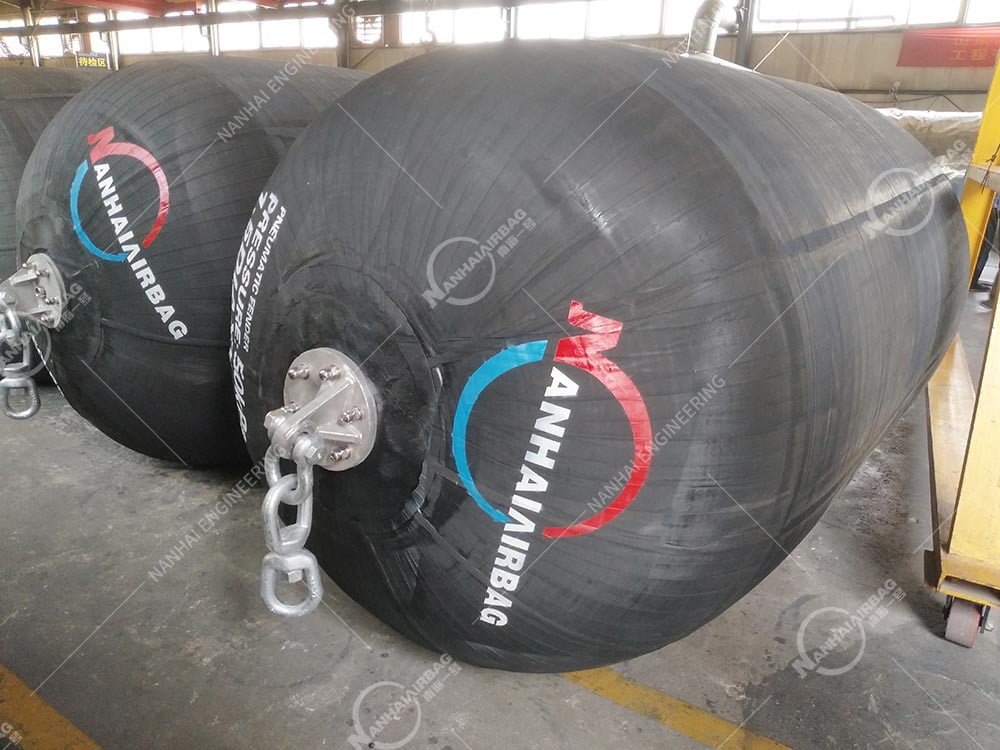
Most people picture a dock as a solid concrete wall lined with black rubber blocks. That mental model works fine — until you’re standing on the deck of a 300,000-DWT VLCC trying to pull alongside another tanker in open water with zero quay in sight. No wall. No bolts. No Super Cell units to save you.
That’s the exact gap Pneumatic Rubber Fenders were invented to fill.
And here’s the thing a lot of first-time specifiers miss: these aren’t just “inflatable bumpers.” A compliant pneumatic fender is a precision pressure vessel wrapped in the same cord-rubber laminate tech used in heavy truck tyres. Get the spec wrong and you either scuff a $200M hull or watch the unit over-deflect and bottom out. Get it right, and you’ve got a berthing buffer that rides 4-metre tides, absorbs 30,000+ kN·m of energy, and never scratches a sensitive coating.
Let’s walk through exactly how they work, where they beat every other option on the dock, and how to avoid the mistakes buyers keep making.
What’s Actually Inside a Pneumatic Rubber Fender?
Before we get to the advantages, it helps to know what you’re actually paying for. A genuine ISO 17357 pneumatic fender is built in concentric layers:
- Outer rubber cover — abrasion-, ozone-, UV-, and seawater-resistant compound (typically NR/SBR or EPDM for aggressive service)
- Synthetic tyre-cord reinforced plies — criss-crossed at engineered bias angles so the body holds internal pressure without ballooning or shearing under angular load
- Inner rubber liner — airtight seal against the compressed air chamber
- Steel end flanges — machined for the air valve, pressure relief/safety valve, and lifting eyes
- Protective system — either a chain + aircraft-tyre net (Net Type) or heavy nylon sling straps (Sling Type)
💡 Spec note: Per ISO 17357-1:2014, any pneumatic fender with a diameter of Ø2,500 mm or larger must carry an over-pressure safety valve. If a quote omits it on a big unit, the product isn’t standard-compliant — walk away.
Why Buyers Choose Pneumatic Over Other Rubber Fenders
You’ve already read our deep dives on Super Cone and Super Cell units. Those are brilliant — at a fixed wall. The moment your application leaves the concrete, pneumatics take over. Here’s the transition into the actual advantages, with field examples so you can picture the fit:
1. True Floating Performance — Tides Stop Being a Problem
Fixed marine fenders are bolted at one elevation. When the tide swings 3–5 metres, a Panamax hull can ride aboveor belowthe fender line and make contact with bare concrete. A pneumatic fender floats on the surface, tethered to the dock or the opposing vessel, and stays in the contact zone through the entire tidal cycle.
Field example: A North Sea offshore wind O&M jetty serving crew-transfer catamarans runs a 2.8 m mean tidal range with occasional 4 m springs. Fixed arch fenders kept gapping at low water. The operator swapped in Ø2,000 × L4,000 mm P50 Sling-Type pneumatics on pendulum chains — zero hull strikes across two winter storm seasons.
2. Ultra-Low Hull Pressure for Sensitive Vessels
Because the energy sink is compressed air, not solid rubber, the reaction spreads gently across the contact patch. Initial inflation at P50 (50 kPa) keeps hull face pressure in the 50–120 kPa band — gentle enough for:
- LNG membrane tankers (thin hull plating)
- Aluminum fast ferries and patrol craft
- Mega-yachts and cruise ship topsides
- FRP naval mine-countermeasure vessels
Field example: An LNG bunkering barge operator in the Mediterranean pairs Ø2,500 × L5,500 mm P50 Net-Type fenders with UHMW-faced sling cradles so the membrane hull never sees localized pressure above 90 kPa — keeping the cargo tank warranty intact through hundreds of side-by-side transfers.
3. Ship-to-Ship Transfer Is Impossible Without Them
There is no fixed structure at sea. For STS crude offload, bunker ops, navy replenishment-at-sea, and FPSO tandem loading, floating rubber fenders are not optional — they’re the only certified game in town.
A single Ø3,300 × L6,500 mm P80 unit absorbs ~30,000+ kN·m at 60% deflection. String four or six along the contact line and two VLCCs can mate in a 1.5 m swell without hull damage.
4. Deploy Anywhere, Relocate Tomorrow
No embed plates. No concrete coring. No civil works permit. Pneumatic fenders ship deflated, roll out of a container, inflate on-site with a standard air compressor, and sling onto a dolphin, a tug, or a barge. When the job’s done, deflate and stow.
That portability is exactly why marine airbags and pneumatics often show up on the same project — airbags for the launch day, pneumatics for the temporary or mobile berthing phase.
5. Shear, Angular, and Compression Tolerance in One Package
The bias-plied tyre-cord body resists:
- Axial compression up to 60% deflection (ISO GEA test)
- Shear from vessels sliding past each other on a swell
- Angular approach off the perpendicular by 10°+ without blow-out or localized cord failure
Fixed cell fenders hate angular load. Pneumatics shrug it off.
P50 vs. P80 — The Spec Decision That Trips Everyone Up
| Rating | Internal Inflation Pressure | Energy Absorption (vs. baseline) | Reaction Force on Hull | Best Application |
|---|---|---|---|---|
| P50 (Pneumatic 50) | 50 kPa | ISO baseline GEA | Lowest — safest for thin hulls | LNG, yachts, aluminum, cruise, sensitive coatings |
| P80 (Pneumatic 80) | 80 kPa | ~20–30% higher than P50 | Noticeably higher | Heavy STS, VLCC/FPSO, tight fender count, robust hulls |
⚠️ Don’t guess this one. Run the berthing energy equation (½ · Cm · Displacement · Vb², then apply PIANC correction factors) and check the hull’s allowable face pressure beforeyou default to P80 just because it “absorbs more.” Over-pressure on a membrane LNG skin is a class-action-level mistake.
How Pneumatics Sit in the Full Marine Fenders Lineup
A lot of procurement teams type “marine airbags vs pneumatic fenders” into Google and expect a winner. There isn’t one — they’re different tools in the same shed:
| Product | Mounting | Certified Berthing Energy? | Primary Job |
|---|---|---|---|
| Pneumatic Rubber Fender | Floating, tethered | ✅ ISO 17357-1:2014 GEA rated | STS, offshore, tidal docks, temporary berths |
| Super Cone Rubber Fender | Fixed to quay | ✅ PIANC 2002/2014 rated | Permanent high-traffic container/oil berths |
| Super Cell Rubber Fender | Fixed to quay/dolphin | ✅ PIANC rated, frontal-panel capable | VLCC docks, bulk terminals, naval wharves |
| Foam-Filled Fender | Floating | ✅ (lower E/volume) | STS where puncture risk is high, no blow-out concern |
| Marine Airbags | Free-floating, temporary | ❌ No berthing standard | Ship launching, slipway rolls, salvage lift, heavy float |
📌 The clean way to think about it: Marine airbags move the ship from land to water. Pneumatic rubber fenders cushion the ship once it’s floating next to something expensive. Fixed rubber fenders guard the permanent wall. A mature port runs all three in rotation.
Standard Size Reference (ISO 17357)
- Ø500 × L1,000 mm — workboats, pilot craft, small yachts
- Ø1,000 × L2,000 mm — harbor tugs, mid-size ferries
- Ø2,000 × L3,500 / L4,000 mm — Panamax feeders, Ro-Ro, crew transfer
- Ø2,500 × L4,000 / L5,500 mm — Aframax/LR2, LNG bunker barges, cruise tenders
- Ø3,300 × L6,500 mm — VLCC, ULCC, FPSO tandem, large STS strings
- Custom lengths up to L12,000 mm on request from most tier-1 makers
Net Type = chain + recycled aircraft tyres, max abrasion resistance, can mark soft paint.
Sling Type = nylon webbing cradles, hull-friendly, preferred for coated/sensitive shells.
💬 People Also Ask (Google PAA — Schema-Ready)
Q: What is the difference between a pneumatic rubber fender and a marine airbag?
A: Pneumatic rubber fenders are ISO 17357-1:2014-certified floating berthing devices that absorb ship impact energy via compressed air and carry documented Guaranteed Energy Absorption (GEA), reaction force, and hull-pressure ratings. Marine airbags are inflatable cylindrical units used for ship launching, dry-docking, salvage, and heavy lifting — they have no ISO berthing-energy certification and should never be substituted for fenders on a working berth.
Q: What does ISO 17357-1:2014 compliant mean for pneumatic fenders?
A: It’s the international performance standard covering material specs, dimensional tolerances, internal pressure classes (P50/P80), deflection testing to 60%, GEA/Reaction/Hull-Pressure performance curves, and third-party verification. A compliant unit must carry documented test data from a recognized society (BV, ABS, DNV, LR, CCS, NK, KR). Anything without that cert is an uncertified inflatable, not a marine fender.
Q: How long do pneumatic rubber fenders last?
A: 10–20 years with proper care. Key maintenance: hold internal pressure within ±5% of rated, rinse off marine growth and chemical residue after heavy use, inspect chain/tyre net or sling for corrosion and UV wear every 3–6 months, and store deflated + shaded when out of service. The rubber body itself typically outlasts two to three net/sling replacement cycles.
Q: P50 or P80 — which should I specify?
A: Choose P50 when hull pressure is the limiting factor (LNG carriers, aluminum hulls, yachts, thin-walled naval vessels). Choose P80 when you need maximum energy absorption from a limited number of fenders and the opposing hull/structure can tolerate the higher reaction force. Always confirm with a PIANC/OCIMF berthing-energy calculation before purchase.
Q: Net type or sling type pneumatic fender — which is better?
A: Net type (chain + aircraft tyre) is the heavy-duty default for rough STS, oil terminals, and abrasive service, but the tyres can scuff delicate topcoat. Sling type (nylon webbing) is gentler on hull paint and is the preferred option for LNG, cruise, yacht, and naval applications where coating integrity matters more than maximum abrasion resistance.
Q: Can pneumatic fenders be used on a fixed concrete dock instead of Super Cell or Super Cone fenders?
A: Technically yes, but it’s rarely the best call for a permanent high-traffic berth. Pneumatics need ongoing air-pressure checks, net/sling wear management, and tether maintenance — higher OPEX than bolted rubber fenders. The right use case for pneumatics on a fixed structure is extreme tidal range, seasonal berthing, or visiting oversized vessels that exceed the quay’s fixed-fender energy rating. Otherwise, spec Super Cell/Super Cone for the wall and keep pneumatics on standby.
Q: What safety features must a pneumatic rubber fender have?
A: Per ISO 17357-1:2014 — a sealed air valve, an over-pressure safety relief valve (mandatory at Ø2,500 mm and above), reinforced steel end flanges, and a protective net or sling system. Reputable makers also pressure-test every unit to 1.5× rated pressure before shipment and supply a mill/test certificate.
Buyer’s Spec Checklist
- ✅ ISO 17357-1:2014 certification with third-party society stamp (BV / ABS / DNV / LR / CCS / NK / KR)
- ✅ P50 or P80 selected against a documented berthing-energy calc
- ✅ Net Type vs. Sling Type matched to hull coating sensitivity
- ✅ Safety relief valve present on any unit ≥ Ø2,500 mm
- ✅ Galvanized or stainless chain/sling hardware for corrosion service
- ✅ Spare valve core + calibrated pressure gauge in the crate
- ✅ GEA / Reaction / Hull-Pressure performance sheet stamped by the lab — not just a catalog number
Keep Reading / Next Move
If you’re building out a full berthing system, don’t stop at one product page. The ports that actually get this right run a layered setup: Super Cell or Super Cone rubber fenders bolted to the main quay for daily traffic, pneumatic rubber fenders staged for STS and tidal-extreme visitors, and marine airbags on the hardstand for newbuild launches and salvage response. Three categories, zero overlap, total coverage.
Sizing pneumatics for an STS campaign or an offshore platform approach? Drop the two vessel DWTs, typical sea state, and available tether points — I’ll run the P50/P80 and unit-count recommendation against PIANC and OCIMF guidance.
