
Buoyancy Airbags: The Inflatable Lift System That Turns Water Into a Crane
29/10/2026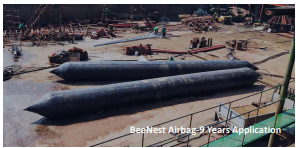
Beenest ship launching airbags are a heavy-duty, cord-reinforced marine airbag line built for one job: moving vessels safely from the build berth into the water—without concrete slipways, dry docks, or hard wooden ways. The BeeNest design adds a dedicated anti-puncture layer, high-density steel-wire cord reinforcement, and a 5-part rubber body that targets performance above standard ISO 14409 baselines, with a published safety factor around 4.5×. Yards use them for new-build launches, haul-out, caisson moves, and heavy marine transport where the slipway may be gritty, steel-edged, or remote. They are not berthing gear—unlike marine fenders or rubber fenders, which protect a hull at the dock, Beenest airbags carry the vessel’s weight and roll it into the water.
If you run a shipyard, dry-out berth, or remote marine project, launch day is where schedule, hull integrity, and liability all collide. Keep reading—because the difference between a clean float-off and a four-month repair delay is often the airbag under the keel, not the crane you don’t have.
What Makes Beenest Different From a Standard Launching Airbag?
Most launching airbags use a 3-part build: inner rubber, cord layer, outer rubber. Beenest is positioned as a 5-part composite structure:
- Anti-puncture outer shield – composite puncture-resistant patch + rubber matrix
- High-density steel-wire cord layer – disperses stress from sharp edges, plate burrs, chains
- Synthetic tire-cord reinforcement – Dtex/3 strands, higher breaking force than standard 2-strand builds
- Outer marine rubber cover – abrasion, UV, seawater, ozone resistance
- Inner airtight rubber layer – holds working pressure without creep or leaks
The headline upgrade is the anti-puncture layer. On a normal beach launch or fabricated slipway, the bag slides over rebar, weld beads, anchor chain, and broken concrete. A single puncture at the wrong moment can drop one hull zone and skew the whole launch.
Beenest is engineered so that the outer contact face absorbs and spreads that point load before it reaches the pressure-carrying cord plies.
Why Shipyards Are Switching to Beenest Airbags
1. Puncture resistance in real-world, dirty launch sites
Catalog photos show airbags on clean concrete. Real yards launch from compacted soil, rusted plate, shell beds, and temporary ramps.
Example:
A Philippine fishing-boat builder launching 50+ hulls a year kept shredding standard bags on exposed keel-block brackets. Switching to the BeeNest anti-puncture build cut mid-launch pressure loss incidents and removed the “sharp-edge panic” from every launch checklist.
2. Higher safety margin under dynamic load
Standard bags often cite a 2–3× safety factor. Beenest publishes a 4.5× design safety factor, with indicators targeted above ISO 14409 performance .
That matters because launch load is not static—there is:
- winch surge,
- slope acceleration,
- hull trim shift,
- temporary point loading as blocks clear.
A bigger margin means the bag is not running at 90% of its burst ceiling when something unexpected happens.
3. Cold-climate launches without rubber cracking
Normal rubber stiffens in low temperature, raising tear risk.
Beenest cold-rated variants are formulated for:
- standard low-temp operation around −35 °C
- extreme polar blends down to −50 °C
Example:
A Canadian or Northern European workboat yard launching in shoulder-season ice conditions gets flexibility retention instead of a brittle outer skin that cracks on first roll.
4. Reusable asset, not a one-launch consumable
Properly maintained airbags are a fleet, not a disposable.
With fresh-water rinse, dry storage, pressure-hold testing, and seam inspection, Beenest-class airbags are built for long service life across repeated cycles.
One purchase supports:
- new-build launches,
- haul-out and docking,
- hull repainting/inspection,
- caisson movement,
- salvage and refloat support.
That reuse is what turns the purchase from “launch expense” into “yard infrastructure.”
5. Cleaner build quality, better layer bonding
A subtle but important detail: Beenest production uses a talcum-powder-removal process.
Why it matters:
- traditional talc prevents layer sticking during build,
- but residual powder weakens rubber-to-cord bonding,
- and makes the finished bag look aged or contaminated.
Removing it improves interlayer adhesion and gives a cleaner, more consistent vulcanized body .
How Beenest Airbags Launch a Vessel
The operating sequence is the same proven airbag method—just on a tougher platform.
- Survey the track – clear sharp objects, check slope, verify ground bearing
- Stage deflated bags – transverse under hull, spaced by weight distribution
- Inflate gradually – calibrated compressors, working pressure typically 0.05–0.20 MPa
- Lift off blocks – hull transfers from keel blocks to airbag crown
- Release with winch control – roll down 1:70 to 1:10 slope at controlled speed
- Float-off – buoyancy sheds rear-bag load
- Recover, deflate, inspect, store
The airbag is not “bouncing” the ship. It is carrying quasi-static weight on a conforming, low-friction roller.
Beenest Airbags vs. Marine Fenders: Don’t Mix Them Up
This is the most common procurement mistake.
| Product | Job | Load type | Where it lives |
|---|---|---|---|
| Beenest ship launching airbags | Launch, roll, haul, move vessel | Quasi-static hull weight | Under the keel |
| Pneumatic / rubber fenders | Absorb berthing impact | Dynamic kinetic energy | Dock face, hull side |
| Fixed marine fenders | Protect quay/vessel in port | Impact + shear | Wharf, tug, pontoon |
A complete marine program uses both:
- marine airbags get the vessel into the water
- marine fenders / rubber fenders keep it safe at the berth
They are never interchangeable. An airbag is not a fender, and a fender cannot carry a launching load.
Typical Beenest Specifications
Based on published BeeNest product data:
| Parameter | Range |
|---|---|
| Diameter | 300 mm – 4,000 mm |
| Effective length | 3,000 mm – 33,000 mm |
| Cord plies | 3 – 20 layers depending on model |
| Safety factor | ~4.5× design margin |
| Cord type | Dtex/3 synthetic tire cord |
| Reinforcement | High-density steel-wire anti-puncture layer |
| Standards | Built to exceed ISO 14409 / ISO 17682 principles |
| Class support | CCS, BV, ABS, LR, DNV documentation on request |
| Temp range | Standard to −35 °C; polar blend to −50 °C |
A 1.5 m × 12 m, 6-ply class bag at rated pressure typically supports roughly 100–150 t per linear meter—then scale bag count and ply by vessel weight, not by diameter alone.
Sizing a Beenest Launch Set
Don’t ask “what diameter should I buy.” Ask for a launch calculation sheet.
The supplier should request:
- Vessel lightship + outfitting weight
- LOA, beam, draft, center of gravity
- Slipway slope and surface material
- Water depth at entry
- Expected temperature range
- Sharp-object exposure level
- Required class certification
The calculation must check:
- total launch weight minus buoyancy gain
- line load per airbag at working pressure
- number of bags and transverse spacing
- unsupported hull span between bags
- plate/keel bending limits
- 15–30% safety margin
⚠️ Too-wide spacing bends the hull. Too-low ply count bursts the bag. The diameter is the least important number if the ply and spacing are wrong.
Safety Practices for Every Launch
Beenest builds in margin, but the crew still runs the risk.
Before inflation:
- pressure-hold test at 1.1× working pressure
- clear track of nails, rebar, glass, shell, weld spatter
- verify cross-slope tolerance
- relief valve on every compressor
- calibrated gauges visible to controller
During launch:
- winch-controlled release, not free roll
- monitor list/trim continuously
- stop if pressure drift exceeds tolerance
- wind/current limits respected, typically avoid Beaufort 6+
Retire immediately if:
- cord exposure appears
- seam separation or bulging
- deep cut through outer + puncture layer
- valve leakage that will not seal
Maintenance and Storage
Treat Beenest airbags like certified lifting gear.
- rinse with fresh water after seawater use
- dry fully before folding
- inspect seams, valves, cord edges every launch
- log cycles and pressure-test results
- store deflated, shaded, dry, away from fuel/sharp edges
- patch minor damage only with approved rubber repair kit
With discipline, quality airbags deliver long service life across many launch cycles.
Related Questions People Ask About Beenest Ship Launching Airbags
What are Beenest ship launching airbags?
They are a branded line of puncture-resistant marine airbags used to launch, haul out, and move vessels. The build adds an anti-puncture layer and reinforced cord structure on top of standard ship-launching airbag design.
Are Beenest airbags better than normal marine airbags?
For harsh slipways, sharp debris, heavy loads, or cold climates, yes. The 5-part body, steel-wire puncture layer, and higher safety factor give more margin than basic 3-layer bags.
Are Beenest airbags the same as marine fenders?
No. Marine fenders and rubber fenders protect against docking impact. Beenest airbags carry the vessel’s weight during launch and movement.
What standards do they meet?
Built to align with ISO 14409:2011 and ISO 17682:2013 principles, with class documentation such as CCS, BV, ABS, LR, and DNV available depending on project requirements.
How much weight can they launch?
Depends on diameter, length, ply count, and working pressure. A mid-size 1.5 m × 12 m, 6-ply bag handles roughly 100–150 t/m; full vessel launches use a calculated fleet of bags.
Can Beenest airbags be used in cold weather?
Yes. Cold-rated compounds are formulated for around −35 °C, with polar blends down to −50 °C for Northern European, Russian, and Canadian operations.
How long do they last?
Service life depends on use frequency, abrasion, storage, and inspection discipline. With proper care, quality airbag fleets deliver years of repeatable service across many cycles.
Can they be used for salvage?
Launching bags can support haul-out and refloat work, but underwater salvage often needs buoyancy/salvage-specific bag configurations. Confirm the design before substituting.
How many airbags do I need?
Not a fixed number—based on vessel weight, contact length, slope, and hull bending limits. Always request a calculation sheet, not just a bag count.
Are they worth the upgrade cost?
If your site has sharp surfaces, heavy vessels, cold temps, or high launch frequency, the puncture resistance and safety margin usually pay back fast in avoided delays and bag replacements.
Bottom Line
Beenest ship launching airbags take a proven marine method—launch with air—and harden it for the conditions yards actually face: gritty slipways, steel edges, cold weather, heavy hulls, and zero tolerance for a failed launch.
You get:
- puncture-resistant 5-part construction,
- higher safety margin than standard bags,
- cold-climate flexibility,
- reusable multi-job value,
- and ISO-aligned engineering with class-support options.
Just keep the roles clear: marine airbags move the ship; marine fenders and rubber fenders protect it once it’s in service. Specify Beenest for the launch, and you protect the vessel from the first minute it leaves the blocks.
👉 Next step: pull your vessel weight, LOA/beam, slipway material, slope, and temperature range, then request a Beenest layout sheet with ply count, pressure, bag count, and unsupported-span check. That one calculation is worth more than any catalog photo.
Running a gritty beach launch or a cold-climate yard? Tell me the hull size and slipway condition—let’s size the right Beenest set instead of guessing.
Keywords used
Beenest ship launching airbags · marine airbags · ship launching airbags · marine fenders · rubber fenders · anti-puncture airbags · ISO 14409 airbags · vessel launch · haul-out · caisson moving · marine salvage
