
Beenest Ship Launching Airbags: Puncture-Resistant Launch Power for Modern Shipyards
03/11/2026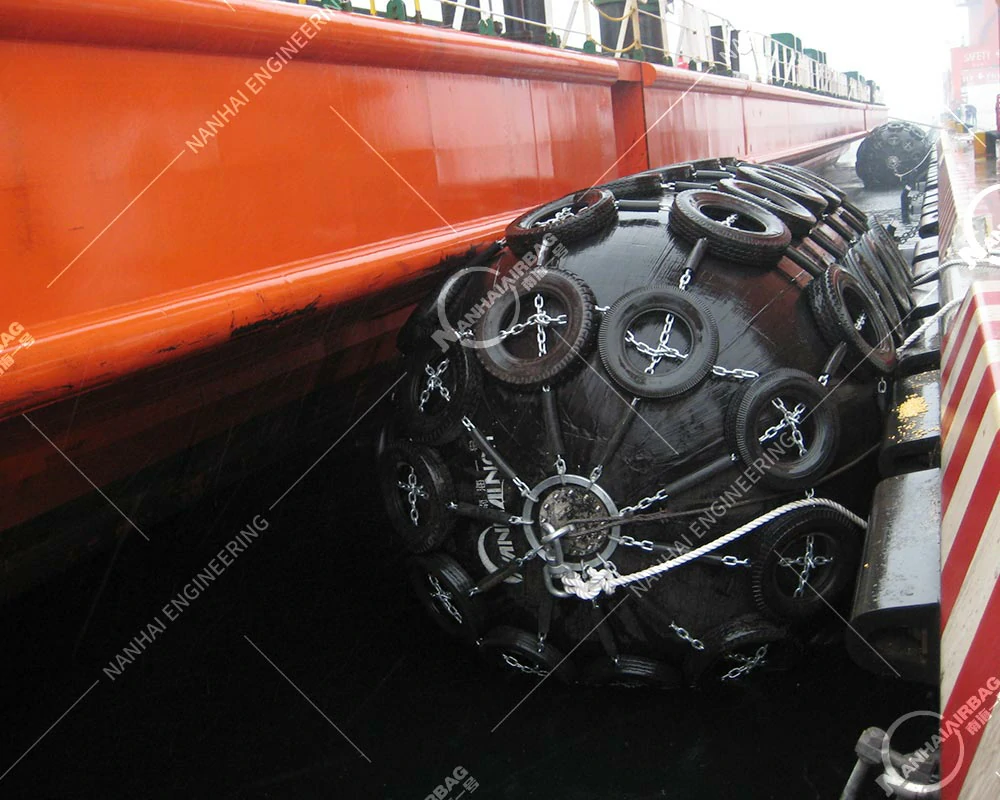

A Yokohama fender—also called a Yokohama-type pneumatic rubber fender—is a floating, air-filled marine fender that absorbs berthing impact using compressed air instead of solid rubber compression. Developed by The Yokohama Rubber Co. in 1958, the name is now used generically for any floating pneumatic fender built to ISO 17357-1:2014. It delivers high energy absorption with low, progressive reaction force, tracks tide and vessel movement, and is the global standard for ship-to-ship (STS) transfer, tidal ship-to-dock (STD) berthing, LNG/crude offloading, FPSO operations, and naval berthing. Unlike marine airbags, which launch or lift a vessel, Yokohama fenders are continuous berthing buffers in the marine fenders family—and unlike solid rubber fenders, they float, deflect softly, and protect sensitive hulls from point loads.
If you manage a terminal, STS operation, or offshore mooring, the berthing moment is where millions of dollars of hull and quay structure meet in a few seconds. Keep reading—because specifying the wrong fender here doesn’t just scratch paint. It can overstress a thin hull, overload a dolphin, or fail an OCIMF/SIGTTO hull-pressure limit.
What Is a Yokohama Fender, Exactly?
“Yokohama fender” is both a brand legacy and a product class.
- Original: Yokohama Rubber’s 1958 pneumatic fender, built from tire-cord and rubber fuel-tank technology
- Generic today: “Yokohama-type pneumatic rubber fender” = any floating air-filled fender meeting ISO 17357-1:2014
- Technical term: floating pneumatic rubber fender
The core idea is simple: instead of crushing solid rubber, you compress sealed air inside a reinforced rubber skin. The hull feels a progressive cushion, not a hard wall.
Internal construction (ISO 17357-1 four-layer build)
- Outer rubber – abrasion, UV, ozone, seawater resistance
- Synthetic tire-cord plies – nylon/polyester reinforcement, the burst-resistant skeleton
- Inner rubber liner – airtight, leak-resistant sealing layer
- End flanges + safety relief valve – inflation, pressure control, auto-release on over-compression (mandatory on fenders ≥ Ø2500 mm)
The body is vulcanized seamless. Chains, slings, or pendants attach to the flanges—never to the rubber skin.
Why Yokohama Fenders Dominate Heavy Berthing
Here’s where the product earns its reputation. The advantages aren’t cosmetic—they change how a terminal handles large vessels.
1. Low reaction force protects sensitive hulls
Solid cone or cell fenders get stiff fast as they compress. A Yokohama fender’s air spring stays soft early, then ramps up gradually.
At the ISO test point of 60% deflection, a 2500 × 5500 mm P50 fender absorbs about 943 kJ while keeping reaction near 2019 kN .
Example:
An LNG carrier or aluminum-hulled cruise ship has strict allowable hull pressure. A pneumatic fender spreads load across a wide contact patch instead of creating local stress points that can buckle plating.
2. It floats—and tracks the tide automatically
Fixed rubber fenders bolt to the quay. When the water level drops, they stop protecting the lower hull.
A Yokohama fender sits at the waterline. As tide, swell, trim, and draft change, it stays in the contact zone.
Example:
A tidal terminal with a 6-meter range can berth the same vessel at high and low water without repositioning hardware. The fender rises and falls with the hull.
3. Angled berthing doesn’t kill performance
Real berthing is rarely perfectly square. Vessels come in skewed, rolling, and pitching.
Yokohama-type pneumatic fenders maintain energy absorption under inclined compression—Yokohama’s own data cites stable performance up to ~15° inclination, while solid fenders lose efficiency and need oversizing .
Example:
In a cross-current STS transfer, the fender compresses asymmetrically without bottoming out or throwing a hard reaction spike back into the hull.
4. Soft entry, stable under overload
The force-deflection curve is nonlinear: easy at first contact, stronger only as needed.
That means:
- less hull rebound,
- lower mooring-line shock,
- safer behavior in swell and surge,
- predictable performance even if the vessel approaches harder than planned.
Example:
A supply vessel drifting into an offshore platform in 1.5 m swell gets absorbed gradually instead of bouncing off a rigid cell fender.
5. Portable, deflatable, redeployable
When deflated, a Yokohama fender folds down for container shipping—cutting transport volume and freight cost dramatically versus foam or solid units .
That makes it ideal for:
- project-based STS operations,
- emergency lay-by fenders,
- charter fleets,
- salvage cushioning,
- terminals that don’t want permanent fender lines.
Types of Yokohama Fenders
Type I – Chain & Tire Net (CTN)
Heavy galvanized chain or wire mesh with tires/rubber sleeves wrapped around the body.
- ✅ Maximum abrasion resistance
- ✅ Protects rubber skin from sharp quay debris
- ✅ Default for VLCC/LNG STS, oil terminals, rough seas
- ⚠️ Can leave tire marks on hulls
Sizes commonly from Ø500 mm up to Ø4500 mm .
Type II – Sling Type
No hard net. Thick outer rubber with integral lifting slings or eyes.
- ✅ Lightweight, fast to deploy
- ✅ Non-marking options available
- ✅ Ideal for yachts, cruise, naval, calm-water temporary berthing
- ⚠️ Less abuse-tolerant than CTN
Hydro-Pneumatic Variant
Part air, part water ballast (~60–70% water). Held submerged for low-freeboard contact.
- Submarine tendering
- Naval sub-surface ops
- Special low-hull-pressure applications
Always custom-engineered, never off-the-shelf guesswork.
P50 vs. P80: Same Size, Two Personalities
| Rating | Initial pressure | Reaction force | Energy absorption | Best use |
|---|---|---|---|---|
| P50 | 50 kPa | Lower | Standard | LNG, aluminum hulls, yachts, naval, sensitive structures |
| P80 | 80 kPa | Higher | ~1.3–1.5× P50 | VLCC STS, high approach speed, limited fender count |
⚠️ Never inflate a P50 body to 80 kPa. Cord angle, end-ring rating, and safety factor differ between classes .
Typical Sizes & Performance (ISO 17357-1, 60% deflection)
| Size (D × L) | P50 GEA | P50 Reaction | P80 GEA | P80 Reaction |
|---|---|---|---|---|
| 1000 × 1500 mm | 32 kJ | 182 kN | 45 kJ | 239 kN |
| 1500 × 3000 mm | 153 kJ | 579 kN | 214 kJ | 761 kN |
| 2000 × 3500 mm | 308 kJ | 875 kN | 430 kJ | 1150 kN |
| 2500 × 5500 mm | 943 kJ | 2019 kN | 1317 kJ | 2653 kN |
| 3300 × 6500 mm | 1814 kJ | 3015 kN | 2532 kJ | 3961 kN |
Tolerance typically ±10%; always use the supplier’s certified curve for design.
Yokohama Fender vs. Other Marine Protection Gear
This is the comparison every procurement team needs before checkout.
| Product | Job | Load type | Floats? | Key strength |
|---|---|---|---|---|
| Yokohama / pneumatic fender | Berthing impact buffer | Dynamic kinetic energy | Yes | Low reaction, tidal tracking |
| Solid rubber fenders (cone/cell/arch) | Fixed quay protection | Impact + compression | No | Zero maintenance, high traffic |
| Foam-filled fender | Floating buffer, no pressure upkeep | Impact | Yes | Puncture-proof, unsinkable |
| Marine airbags | Launch, haul-out, lift, salvage | Quasi-static weight/buoyancy | When inflated | Moves the vessel, not cushions it |
A complete marine program often uses all of them:
- marine airbags get the hull into the water,
- Yokohama fenders protect it during STS/STD contact,
- fixed rubber fenders guard the quay face.
They are never interchangeable. An airbag is not a berthing fender, and a pneumatic fender is not a launch roller .
Where Yokohama Fenders Are Used
- Ship-to-ship crude, product, and LNG transfers
- Ship-to-dock berthing at tidal wharves
- VLCC / ULCC / container terminal approaches
- FPSO, FSU, FLNG offloading
- SPM and CBM buoy moorings
- Naval berthing and submarine tendering
- Offshore wind CTV/SOV side protection
- Emergency lay-by and salvage cushioning
How to Specify a Yokohama Fender (Without Getting Burned)
A vague PO line like “supply 3 m fender” is how terminals end up with the wrong reaction force.
Minimum compliant specification
Yokohama-type pneumatic rubber fender, ISO 17357-1:2014, P50, Ø3300 × L6500 mm, Type I chain-tire-net, with safety relief valve, class-society prototype test report, and traceable serial marking.
What the supplier must confirm
- Berthing energy:
E = ½ Mₑ V² × Cₑ × C_m × C_s × C_c(PIANC method) - Allowable hull pressure limit
- GEA at 60% deflection with margin
- P50 vs P80 by hull sensitivity
- Net vs sling by abrasion + marking risk
- Cord specification and vulcanization method
- Third-party class report (ABS / BV / DNV / CCS / LR)
- Relief valve on fenders ≥ Ø2500 mm
- ISO marking: standard, size, pressure grade, serial number
⚠️ PIANC does not “certify” fenders—any “PIANC-certified” label is marketing noise. Require ISO 17357-1 compliance + class test data instead.
Installation & Maintenance
A Yokohama fender is low-maintenance—not no-maintenance.
Monthly
- Check pressure with calibrated gauge (sunlight can raise reading 10–15%)
- Never exceed rated pressure
Every 3–6 months
- Inspect chain net, tire wear, sling eyes, shackles
- Look for cuts >1 cm, exposed cord, valve leaks
- Rinse salt off with fresh water
Storage
- Deflate partially if idle long-term
- Keep shaded, dry, away from ozone/heat/fuel
Typical service life: 6–10+ years with disciplined pressure and net care .
Related Questions People Ask About Yokohama Fenders
What is a Yokohama fender?
A floating pneumatic rubber fender that uses compressed air to absorb berthing impact. “Yokohama” refers to the original brand; “Yokohama-type” is now a generic class built to ISO 17357-1:2014.
Are Yokohama fenders the same as pneumatic fenders?
Yes. Yokohama fender, Yokohama-type fender, and floating pneumatic rubber fender describe the same product category.
What’s the difference between P50 and P80?
Same physical size, different initial pressure. P50 = 50 kPa, softer, lower reaction. P80 = 80 kPa, higher energy absorption but higher hull load. Choice depends on vessel mass, approach speed, and allowable hull pressure.
Are Yokohama fenders better than solid rubber fenders?
For STS, tidal berths, and sensitive hulls—yes. They give lower reaction force and track water level. For permanent high-traffic quays with stable water, fixed cone/cell rubber fenders may be simpler and maintenance-free.
Can marine airbags replace Yokohama fenders?
No. Marine airbags launch, haul, lift, or refloat vessels. Yokohama fenders cushion berthing impact. Different geometry, safety factor, and duty cycle.
What size Yokohama fender do I need?
Based on berthing energy, not just vessel tonnage. A 10k DWT vessel might use 2.0 × 4.0 m; an 80k–200k DWT tanker often needs 3.3 × 6.5 m or larger. Always run the PIANC energy calculation.
Do Yokohama fenders need a safety valve?
Fenders ≥ Ø2500 mm must have a relief valve. It releases excess pressure during accidental over-compression to prevent rupture.
How long do Yokohama fenders last?
Typically 6–10+ years with correct pressure management, net inspection, and storage discipline.
Net type or sling type—which should I choose?
CTN for heavy STS, oil terminals, rough abrasion. Sling type for yachts, cruise, naval, and clean hull contact where marking must be avoided.
Are they ISO certified?
Reputable units are manufactured and tested to ISO 17357-1:2014, with optional class approvals. Ask for prototype test reports, not just a label.
Bottom Line
A Yokohama fender is the safest way to turn a high-energy berthing event into a controlled, low-pressure cushion. It combines:
- air-spring energy absorption,
- floating tidal tracking,
- angled-impact tolerance,
- portable redeployment,
- and certified ISO 17357 performance.
Pair it correctly with your operation: use marine airbags to move the vessel, Yokohama pneumatic fenders to protect it at the berth, and fixed rubber fenders where the quay needs permanent armor. Specifying all three by job—not by price—is what keeps a terminal safe from first approach to final mooring.
👉 Next step: pull your largest regular vessel’s displacement, approach velocity, allowable hull pressure, and tidal range. Then request a Yokohama fender calculation sheet with P50/P80 GEA, reaction force, and net/sling configuration—not just a diameter quote.
Running STS transfers or a high-tidal terminal? Tell me the vessel class and water-range—let’s size the right pneumatic layout instead of copying last year’s fender spec.
Keywords used
Yokohama fender · Yokohama-type pneumatic fender · marine fenders · rubber fenders · marine airbags · floating pneumatic rubber fender · ISO 17357-1:2014 · P50 P80 fender · ship-to-ship fender · STS berthing · chain tire net fender
