
Donut Fenders: The 360° Floating Ring That Turns a Pile Into a Self-Guiding Berth
12/11/2026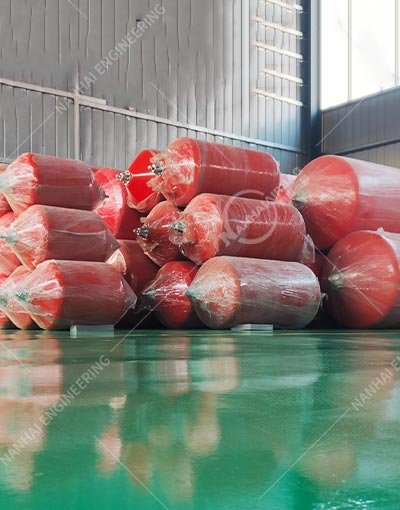
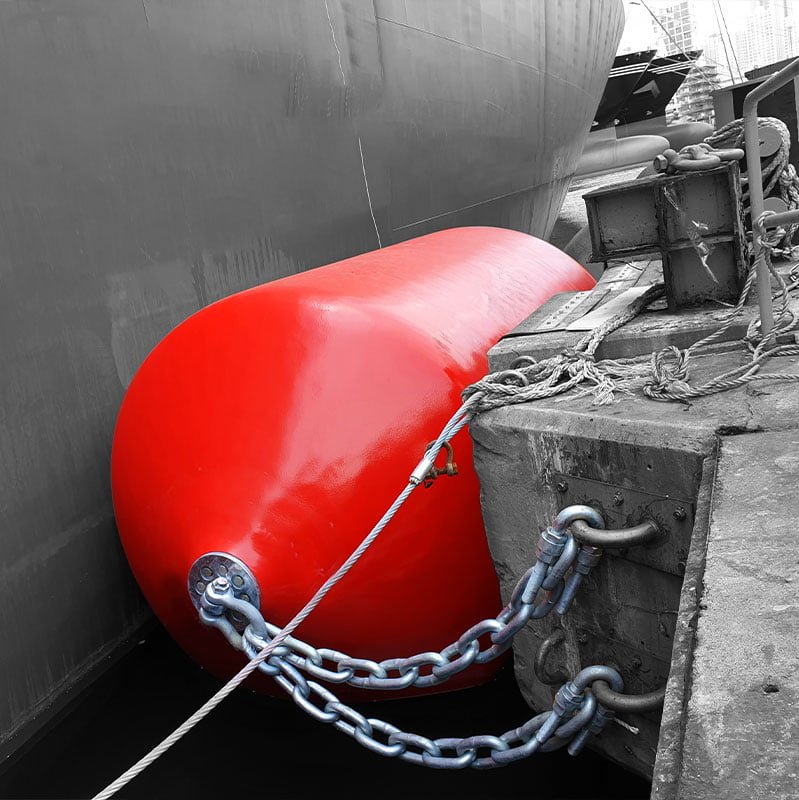
A foam filled fender is a floating marine fender built from a closed-cell EVA or cross-linked PE foam core, wrapped in a filament-reinforced polyurethane or polyurea skin. It absorbs berthing impact through foam compression—not compressed air—so it cannot deflate, burst, or sink even if the outer skin is cut. Foam fenders deliver high energy absorption with moderate-to-low reaction force, float with the tide, and need almost no daily maintenance, making them the default choice for offshore platforms, FPSO boat landings, tidal jetties, ferry terminals, cruise piers, naval berths, and debris-heavy commercial ports. Unlike marine airbags, which launch or lift a vessel, and unlike fixed rubber fenders, which bolt to a quay face, foam filled fenders are floating buffers in the marine fenders family that keep working through puncture, swell, and unattended service.
If your berth has a big tidal swing, no staff for pressure checks, sharp debris in the water, or a hull you can’t afford to scratch, the “cheapest fender” is rarely the lowest-risk fender. Keep reading—because the real question isn’t which fender is cheapest to buy, it’s which fender is still working at 2 a.m. during a storm with a 60,000-DWT tanker leaning into it.
What Is a Foam Filled Fender?
A foam filled fender—also called a solid foam fender or floating foam fender—is a sealed, buoyant impact buffer. No valve, no air chamber, no pressure log.
Three-layer construction
- Closed-cell foam core – EVA or cross-linked PE; each cell is independently sealed, so water can’t migrate in
- Filament reinforcement – nylon/polyester/glass-fiber layer between foam and skin to stop peeling under shear
- Polyurea or PU elastomer skin – seamless sprayed shell, 6–8 mm typical, UV/abrasion/fuel resistant, often non-marking
Inside larger units, a central steel mandrel or tension chain carries hanging loads while the foam handles compression only.
Common shapes
- Cylindrical (most common)
- Donut / torus
- Rectangular block
- Spherical / corner
- Custom boat-landing profiles
Standard sizes run from Ø300 mm to Ø4500 mm, lengths 1000–9000 mm .
Why Foam Fenders Win in Harsh Real-World Berths
The advantages aren’t marketing fluff—they show up the first time something goes wrong.
1. Punctured skin ≠ failed fender
A pneumatic fender that gets holed in an STS transfer loses pressure and forces an emergency breakaway. A foam fender just… keeps working.
The closed-cell core stays dry, buoyant, and energy-absorbing until you patch it at your convenience.
Example:
An OSV bumping an FPSO boat-landing in a debris field catches a welded burr on the fender skin. With a pneumatic, that’s a deflated unit and a crane recovery job. With foam, the transfer continues, and the skin gets repaired dockside next week.
2. Zero inflation, zero pressure roster
No gauge calibration. No relief-valve testing. No “is the fender still at 50 kPa?” walkaround.
That matters most in three places:
- Offshore platforms where a pressure check means a helicopter-delivered technician
- Remote jetties with no permanent staff
- Naval bases counting 10–15 year lifecycle man-hours, not just capex
Foam fenders are inspected visually—typically quarterly or per traffic level—not pressure-monitored weekly .
3. Floats with the tide, automatically
Like pneumatic fenders, foam fenders hang at the waterline and ride tidal change. Unlike pneumatics, their performance doesn’t drift with temperature or altitude because there’s no gas law involved .
Example:
A river terminal with 4–6 m tidal range can protect the same pile line at high and low water with one set of chain-suspended foam fenders—no adjustable brackets, no stacked fixed courses.
4. Non-marking contact for white hulls
Polyurea/PU skins can be formulated non-marking, which is why cruise lines, yacht marinas, and naval docks specify them.
Example:
A $200M expedition cruise hull against a netless foam fender leaves no black scuff, no tire imprint—just a clean rebound.
5. Predictable, progressive reaction curve
Foam compression is nearly linear: reaction force rises smoothly with deflection, no sharp knee at 50% like a pneumatic .
That gives operators:
- wider berthing tolerance,
- fewer shock loads on aging wharves,
- lower peak stress on thin hull plating.
6. Long service life, low lifecycle cost
Typical service life: 10–15 years with basic inspection .
Upfront cost is higher than pneumatic (often ~2–3× same size), but total cost of ownership usually wins in harsh service because there are no:
- spare fender rotations,
- patch crews,
- deflation-driven emergency berthings,
- pressure-test labor.
Foam Filled Fenders vs. Pneumatic vs. Solid Rubber
This is the table every port engineer actually needs.
| Factor | Foam filled | Pneumatic (Yokohama) | Solid rubber |
|---|---|---|---|
| Energy medium | Closed-cell foam | Compressed air | Rubber compression |
| Deflation risk | None | Yes | N/A |
| Sink if damaged | No (unsinkable) | Possible | No |
| Maintenance | Minimal | Pressure checks | Minimal |
| Reaction force | Moderate, controllable | Very low | Higher |
| Tidal tracking | Floats | Floats | Fixed |
| Upfront cost | Higher | Medium | Lower |
| Lifecycle cost | Often lower in harsh service | Rises with repairs | Low if structure is robust |
| Best for | Offshore, tidal, debris, unattended | STS, LNG, low hull pressure | Fixed quay walls, high traffic |
Rule of thumb: pneumatic = portable and softest reaction; foam = abuse-tolerant and maintenance-light; rubber = fixed quay workhorse .
Where Foam Filled Fenders Are Specified
- Ship-to-ship transfer – LNG lightering, crude/product STS, bulk side-by-side
- Offshore – FPSO/FSO boat landings, SPM buoys, wind OSSP access
- Naval & coast guard – destroyer piers, sub pontoons, replenishment berths
- Cruise & ferry – finger piers, Ro-Ro ramps, double-ended ferry dolphins
- Tidal ports – open-pile jetties, river terminals, fishing harbors
- Industrial – debris-heavy bulk terminals, lock entrances, salvage cushioning
Example:
A Ro-Ro ferry berthing 20+ times a day chews through pneumatic skins fast. Foam fenders on the ramp corners take the cyclic abuse without a pressure-maintenance program.
How a Foam Fender Absorbs Energy
A vessel arrives with kinetic energy:
E = ½ × Mₑ × V²
The foam fender converts that into controlled compression of the closed-cell core. At ~60% deflection (the PIANC/ASTM F2192 test point), a well-built unit:
- absorbs high impact energy,
- develops progressive reaction force,
- rebounds to ≥90% of original diameter within 24 hours .
No air spring, no temperature correction, no altitude sensitivity.
Sizing: Never by Diameter Alone
The #1 procurement mistake is specifying “a 2-meter foam fender” without an energy calc.
Step 1 – Calculate berthing energy (PIANC method)
E = ½ × M × V² × Cₑ × C_m × C_s × C_c
Where:
- M = effective displacement
- V = approach velocity
- Cₑ = eccentricity
- C_m = added mass
- C_s = softness
- C_c = configuration
Step 2 – Match rated energy at 60% deflection
With a 1.1–1.25 safety margin.
Step 3 – Check reaction force
Must stay under:
- hull panel allowable pressure (PIANC WG211 suggests <200 kN/m² for most vessels)
- dolphin/wharf structure limits
Step 4 – Confirm density grade
Foam density typically 58–95+ kg/m³. Higher density = more energy, more reaction. Tune, don’t default .
⚠️ A Ø2000 mm foam fender might cover 100–500 kNm depending on length and density—always use the certified curve, not a catalog photo.
Installation Options
| Method | Use case |
|---|---|
| Chain-suspended | Tidal berths, dolphins, vertical quay faces |
| Rope/tail tether | STS, temporary, free-floating buffer |
| Bolted brackets | Fixed structures, minimal tide |
| Free-floating | Salvage, lay-by, open-water cushioning |
Key detail: align load path through the mandrel/flange. Misalignment tears the skin at the end fitting—the most common “invisible” failure mode .
Maintenance: Light, but Not Zero
Foam fenders are low-maintenance, not no-maintenance.
Inspect quarterly (or per traffic):
- skin cuts, abrasion, exposed foam
- flange/connection integrity (shear is the killer)
- chain/net/shackle wear
- residual set after compression
- UV/chafe on polyurea surface
Repair:
- minor skin cut → PU/polyurea patch
- deep core exposure → re-skin section
- flange shear → return to maker
Typical 10–15 year life assumes this discipline .
Related Questions People Ask About Foam Filled Fenders
What is a foam filled fender?
A floating marine fender with a closed-cell foam core and reinforced PU/polyurea skin. It absorbs berthing impact through foam compression and cannot deflate.
Do foam fenders sink if punctured?
No. The closed-cell core stays buoyant and keeps absorbing energy even with a skin cut.
Are foam fenders better than pneumatic fenders?
Not universally. Foam wins for offshore, tidal, debris-heavy, and unattended berths. Pneumatic wins for very low reaction force and portable STS where hull pressure limits are tight.
How long do foam filled fenders last?
Typically 10–15 years in normal port service with inspection and minor repair.
What’s the difference between foam and rubber fenders?
Solid rubber fenders bolt to a wall and have higher reaction force; foam fenders float, track tide, and need no inflation. Rubber is cheaper for fixed high-traffic quays.
Can foam fenders handle large tankers?
Yes—if sized by berthing energy, not diameter. VLCC-class STS can use Ø3300 mm+ foam units with high-density cores.
Do they need air pressure?
No. That’s the whole point. No valves, no gauges, no inflation schedule.
What skin is best: polyurea or rubber?
Polyurea is seamless, lighter, UV-stable—best for offshore and clean hulls. Rubber skin is more elastic and colder-climate friendly but has seams.
How do I specify one in a PO?
Include: diameter × length, foam density, skin type/thickness, reinforcement grade, net type (netless/chain/rope), energy curve at 60% deflection, reaction force, PIANC-based calculation, and class docs (ABS/BV/CCS/DNV).
Are foam fenders good for cyclic swell conditions?
With care. Continuous permanent-mooring swell can cause foam creep; specify high-density core and analyze cyclic load before assuming “maintenance-free” means “infinite duty.”
Bottom Line
Foam filled fenders are the lowest-drama protection device in the marine fenders catalog. They trade a higher upfront price for:
- no deflation risk,
- no pressure maintenance,
- unsinkable performance,
- tidal-independent floating,
- non-marking hull contact,
- and 10–15 year service life in brutal environments.
Specify them as part of a complete system:
- marine airbags get the vessel into the water,
- foam filled fenders protect it at exposed, tidal, offshore, and high-cycle berths,
- pneumatic fenders handle low-reaction STS when portability matters,
- fixed rubber fenders armor the permanent quay face.
The berth that matches fender type to duty—not price per unit—is the one still operating cleanly a decade later.
👉 Next step: pull your largest vessel’s displacement, approach velocity, tidal range, and allowable hull pressure. Then request a foam fender calculation sheet with density grade, energy curve at 60% deflection, and reaction-force check—not just a diameter and a quote.
Running an offshore boat-landing, a high-tidal jetty, or a ferry ramp with 20 berthings a day? Tell me the site conditions—let’s size the right foam core instead of over-buying pneumatic units you’ll be patching all winter.
Keywords used
foam filled fenders · solid foam fender · floating foam fender · marine fenders · rubber fenders · marine airbags · closed-cell foam core · polyurea fender · PIANC WG211 · offshore boat landing · STS berthing · tidal berth protection
