
Pneumatic Rubber Fenders: The Floating Air-Spring Shield for Ship-to-Ship and Tidal Berthing
10/11/2026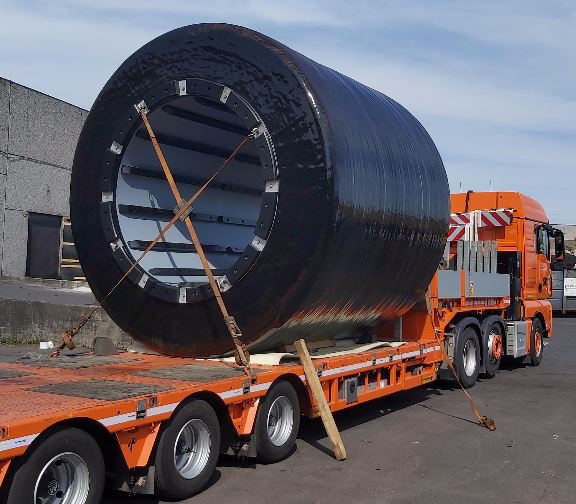
A donut fender—also called a torus fender or floating donut fender—is a ring-shaped marine fender with a hollow center that slips over a monopile, dolphin, or guide pile. Most modern donut fenders are foam-filled: a closed-cell EVA/PE core, a polyurea/polyurethane skin, and an internal steel sleeve with low-friction UHMW-PE bearings. The ring floats with the tide, rotates 360° as a vessel makes contact, and absorbs berthing energy from any angle while gently guiding the hull into position. Used on turning dolphins, lead-in jetties, bridge piers, lock entrances, ferry berths, and offshore rig access structures, donut fenders deliver omnidirectional protection with almost no maintenance. Unlike marine airbags, which launch or lift a vessel, and unlike fixed rubber fenders, which bolt to a quay face, donut fenders live on the pile and move with the water.
If your berth relies on vertical piles, tight turning basins, or a tidal range that makes fixed fenders useless for half the day, keep reading. The problem usually isn’t “not enough fenders”—it’s that the fenders can’t rotate, can’t float, and can’t guide the vessel. A donut fender fixes all three at once.
What Is a Donut Fender?
A donut fender is exactly what the name implies: a large, buoyant ring with a hole in the middle.
Instead of bolting a fender to a wall, you slide the donut over a vertical pile. The vessel never touches the steel pile—it touches the rotating foam ring around it.
Common constructions
| Type | Core / build | Best for |
|---|---|---|
| Foam-filled donut | Closed-cell EVA/PE foam + PU skin + steel core | Offshore, dolphins, tidal berths, maintenance-free sites |
| Solid rubber donut | Molded rubber, no bore movement | Small craft piles, marinas, light berthing |
| Pneumatic donut | Air-filled reinforced rubber | Specialty STS/pile applications needing low reaction |
The foam-filled version is the industry default for commercial projects because it cannot deflate, cannot sink, and needs no pressure monitoring.
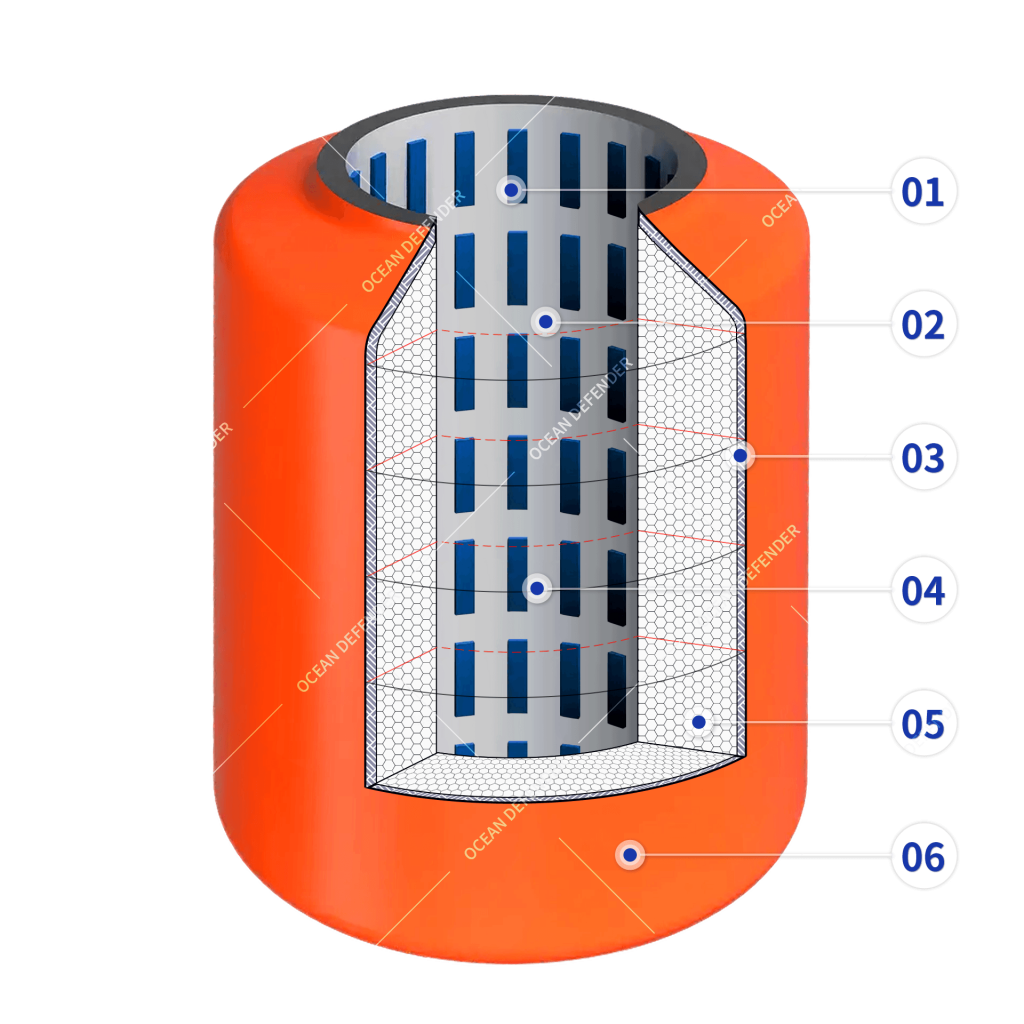
How it’s built (foam donut)
- Closed-cell foam core – unsinkable, water-resistant, progressive compression
- Nylon-reinforced elastomer skin – PU/polyurea spray, abrasion/UV/oil resistant
- Internal steel tube/sleeve – carries load, keeps shape
- UHMW-PE bearing pads – low-friction rotation around the pile
- Retaining collars/stop rings – control vertical travel on the pile
Why Donut Fenders Win on Pile-Supported Berths
Here’s where the ring shape earns its keep. The advantages aren’t decoration—they change how a vessel behaves in a confined channel.
1. 360° protection from any approach angle
A fixed fender protects one face. A donut protects all faces.
As the hull contacts the ring, the donut rotates to meet the load. Impact from the north, south, east, or a sweeping angle all get absorbed equally.
Example:
A ferry backing into a narrow approach dolphin rarely comes in straight. A donut fender rotates with the hull, spreads the load around the ring, and stops the vessel from catching a corner of a fixed block.
2. It floats with the tide—automatically
Fixed rubber fenders are mounted at one elevation. When the tide drops, the lower hull is exposed.
A donut fender rides the waterline. As the tide rises and falls, the ring stays in the active contact zone with zero adjustment.
Example:
A river terminal with a 4–6 m tidal swing can protect the same pile at high and low water with one donut instead of stacking three fixed fender courses.
3. Low shear forces protect the pile and the hull
Because the donut rotates instead of digging in, shear load transfers into smooth bearing motion, not friction tearing.
That means:
- less abrasive wear on the hull,
- less chafe on the pile,
- lower reaction spikes,
- longer life for both structure and fender.
Example:
A supply vessel sliding along a guide pile at an offshore rig doesn’t “scrape”—the donut turns with it, like a bearing wrapped in foam.
4. It guides the vessel, not just cushions it
Most fenders are passive. Donut fenders are semi-active.
The rotation gently redirects the hull toward its intended path. That’s why they’re specified at:
- turning dolphins,
- lead-in jetties,
- lock entrances,
- narrow channels,
- bridge-pier protection,
- submarine/access jetties.
Example:
In a restricted turning basin, a donut on a central pile helps a tug-spin maneuver stay controlled instead of letting the hull glance off a hard corner.
5. Maintenance-free by design
No air valve. No inflation schedule. No burst risk.
Foam donuts are inspected occasionally—not serviced weekly.
- skin check once or twice a season,
- verify rotation and vertical travel,
- check bearing pads if equipped,
- confirm stop collars are secure.
That makes them ideal for remote jetties, offshore platforms, and automated terminals where nobody wants a midnight pressure check.
Typical Sizes & Performance
Donut fenders are sized by outer diameter (OD), pile bore, and energy class.
Common foam-donut range:
| Fender OD | Max pile Ø | Std. energy (kNm) | Reaction (kN) |
|---|---|---|---|
| 1270 mm | 610 mm | ~7.2 | ~116 |
| 1780 mm | 914 mm | ~14.1 | ~162 |
| 2290 mm | 1219 mm | ~23.6 | ~210 |
| 2790 mm | 1524 mm | ~35.3 | ~256 |
| 3300 mm | 1829 mm | ~49.5 | ~304 |
| 4220 mm | 2388 mm | ~81.3 | ~389 |
Values are representative standard-capacity figures at design deflection; suppliers provide low/standard/high capacity curves per PIANC WG211 methodology.
Custom sizes, counterweights, mooring crowns, rubbing strips, and high-visibility skins are all common add-ons.
Donut Fenders vs. Other Marine Protection Gear
This is the comparison that prevents a mis-specified berth.
| Product | Job | Moves with tide? | Rotates? | Key strength |
|---|---|---|---|---|
| Donut fender | Pile/dolphin protection + guidance | Yes, floats | Yes, 360° | Omnidirectional, low shear |
| Fixed rubber fenders | Quay wall protection | No | No | Cheap, robust, high-traffic walls |
| Pneumatic rubber fenders | STS / floating berthing buffer | Yes, hangs/floats | Limited | Low reaction, high energy |
| Foam cylindrical fender | Floating quay/STS buffer | Yes, suspended | No | Unsinkable, zero inflation |
| Marine airbags | Launch, haul-out, lift, salvage | When inflated | No | Moves the vessel’s weight |
A smart terminal uses all of them by role:
- marine airbags get the vessel built and launched,
- donut fenders protect the piles it threads between,
- pneumatic or foam fenders cushion open-water STS contact,
- fixed rubber fenders armor the main quay face.
They are never interchangeable.
Where Donut Fenders Are Used
- Turning dolphins and breasting dolphins
- Lead-in jetties and narrow channel markers
- Bridge piers and abutments
- Lock entrances and gate structures
- Ferry terminals with tidal variation
- Offshore rig access piles
- Submarine jetties
- Monopile wind / offshore structures
- Corner protection on finger piers
- Pipeline terminal guide piles
They shine anywhere the vessel approaches from changing angles and the water level won’t sit still.
How to Specify a Donut Fender
A donut is not “one size fits the pile.” You need a real berthing calculation.
Minimum specification line
Foam-filled donut fender, closed-cell EVA/PE core, PU/polyurea skin, internal steel sleeve with UHMW-PE bearings; OD [X] mm, pile bore [Y] mm, standard-capacity class per PIANC WG211, with retaining collars and project color.
What the supplier must confirm
- Pile diameter – bore clearance for rotation
- Vessel displacement + approach velocity – berthing energy
E = ½ Mₑ V² × Cₑ × C_m × C_s × C_c - Tidal range – vertical travel of the donut on the pile
- Energy class – low / standard / high capacity curve
- Reaction force – within pile and hull-panel limits
- Foam density & skin hardness – tuned to impact severity
- Bearing system – UHMW-PE, nylon, or teflon pads
- Counterweight option – if submerged or partial-draft contact needed
- Stop collars / mooring crown – control travel and add functionality
⚠️ The most common error: sizing by outer diameter only. A big donut on a mismatched pile either binds, rides too high, or can’t rotate under load.
Installation: Surprisingly Simple
- Pile is cleaned, coated/protected, and surveyed for straightness
- Donut is lifted over the pile top
- Lowered onto the pile—no bolting, no welding
- Bearings/grease path checked
- Stop collars fitted above and below travel range
- Fender self-positions with tide from day one
Compared with building a fixed fender gallery on a tidal dolphin, install cost and schedule drop sharply.
Maintenance
Donut fenders are among the lowest-maintenance products in the marine fenders category.
Routine (1–2×/year or per traffic level):
- inspect skin for cuts, abrasion, UV cracking
- confirm free rotation by hand or during berthing
- check vertical travel and collar security
- verify bearing pads if accessible
- rinse debris, fuel residue, barnacle growth
Replace if:
- foam core exposed over large area,
- steel sleeve corrosion,
- permanent flat-spot deformation,
- bearing seizure.
Typical service life: 10+ years in many commercial installations with basic inspection.
Related Questions People Ask About Donut Fenders
What is a donut fender?
A ring-shaped floating fender that slides over a monopile or dolphin. It absorbs berthing impact from any angle, rotates with the vessel, and rises/falls with the tide.
Are donut fenders the same as torus fenders?
Yes. “Torus fender” and “donut fender” describe the same toroidal shape. Most commercial units today are foam-filled floating donuts.
What are donut fenders made of?
Usually a closed-cell foam core (EVA or cross-linked PE), a polyurea/PU skin, an internal steel sleeve, and low-friction bearing pads. Solid rubber and pneumatic versions also exist.
Do donut fenders sink if damaged?
Foam-filled donuts do not. The closed-cell core is unsinkable even if the skin is cut. That’s a key advantage over air-filled pneumatic fenders.
Are donut fenders better than fixed rubber fenders?
For piles, dolphins, and tidal sites—yes. They protect all sides, float with tide, and guide the vessel. Fixed rubber fenders are better for straight quay walls with stable water levels.
Can donut fenders be used for ship-to-ship transfer?
Not typically. STS usually uses pneumatic or foam cylindrical fenders. Donuts are purpose-built for pile/dolphin protection and guided berthing.
How do I size a donut fender?
By berthing energy, pile diameter, tidal range, and required reaction force—using the PIANC WG211 method, not diameter alone.
Do donut fenders need air pressure?
Foam donuts: no. Solid rubber donuts: no. Pneumatic donuts: yes. The foam version is popular precisely because it needs no inflation.
What size pile can they fit?
Common range: pile Ø 610 mm up to ~2388 mm, with fender OD from ~1270 mm to 4220 mm. Custom sizes are available.
How long do donut fenders last?
With proper materials and inspection, 10+ years is typical. Internal bearings can be designed for 20+ year service life in low-maintenance installations.
Bottom Line
Donut fenders solve a problem fixed fenders can’t: they protect a pile from every direction, float with the tide, rotate with the hull, and guide the vessel instead of just blocking it.
You get:
- 360° omnidirectional impact protection,
- automatic tidal tracking,
- low shear and low hull marking,
- unsinkable foam construction,
- and near-zero maintenance.
Specify them correctly inside a complete marine system:
- marine airbags to launch and move the vessel,
- donut fenders to protect piles, dolphins, and guide structures,
- pneumatic/foam fenders for open-water berthing,
- fixed rubber fenders for the quay face.
The berth that gets this mix right doesn’t just avoid damage—it berths faster, with less tug effort and lower lifecycle cost.
👉 Next step: measure your pile diameter, tidal range, and largest regular vessel’s approach energy. Then request a donut fender calculation sheet with OD, bore, capacity class, and bearing spec—not just a “ring that fits the pile.”
Working on a turning dolphin, bridge pier, or offshore access pile? Tell me the pile size and tide range—let’s size the right donut instead of over-building a fixed fender gallery.
Keywords used
donut fenders · torus fender · floating donut fender · foam-filled donut fender · marine fenders · rubber fenders · marine airbags · monopile fender · dolphin fender · PIANC WG211 · offshore berthing · turning dolphin
