
Foam Filled Fenders: The Unsinkable Floating Buffer Built for Harsh Berths
17/11/2026
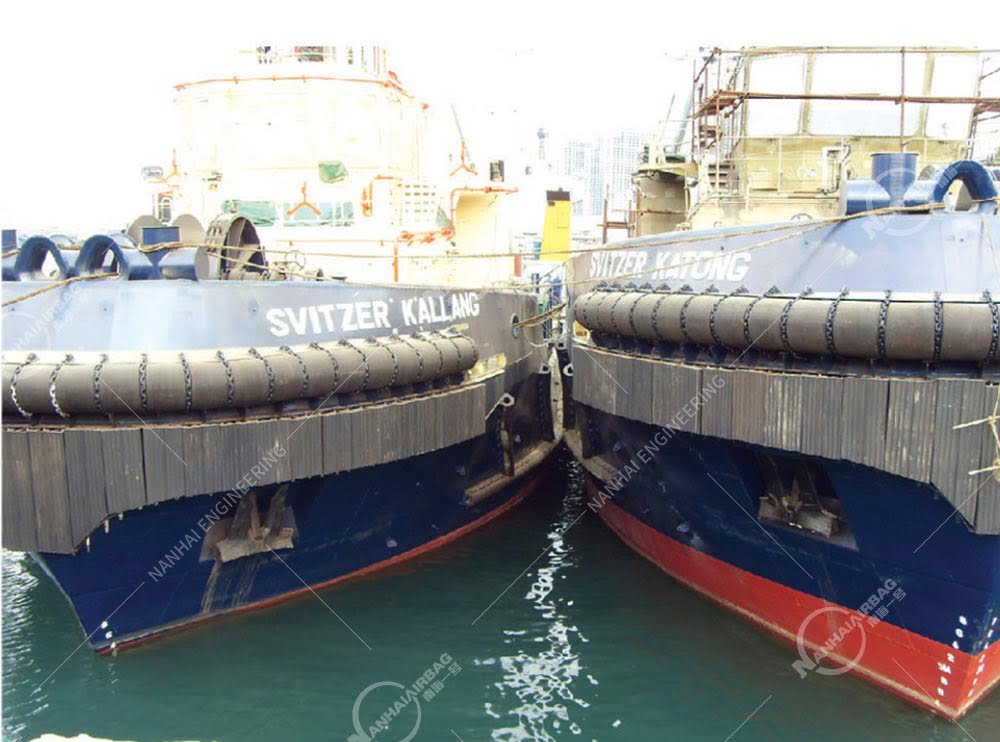
Tugboat fenders are heavy-duty marine fenders mounted directly to a tug’s hull—bow, stern, sides, and push knees—to absorb impact, resist shear, and grip during pushing, escorting, and ship-assist work. Unlike fixed quay fenders, they must survive constant angled contact, sliding friction, and repeated compression while the tug applies thrust. The most common profiles are W fenders, M fenders, D fenders, square/rectangular rubber fenders, and purpose-built push-knee systems, often paired with UHMW-PE wear faces for low friction. Tugboat fenders are part of the marine fenders family—distinct from marine airbags, which launch or refloat a vessel, and from stationary rubber fenders, which protect the dock rather than the working hull.
If you operate tugs, you already know the truth: a tug’s fenders take more abuse in one week than a quay wall sees in a year. The hull isn’t just “berthing”—it’s grinding, pushing, holding, and pivoting against another ship in wind, current, and swell. Keep reading, because the wrong fender profile doesn’t just wear out fast—it can rip off, damage the other vessel, or transfer shock straight into thin tug plating.
What Are Tugboat Fenders?
Tugboat fenders are not one product. They’re a system engineered around how a tug actually works:
- Bow fenders – first contact during push-and-hold
- Stern fenders – escort contact, braking, and nudging
- Side fenders – alongside work, lock walls, pier edges
- Push knees / push bars – focused high-load contact zones
- Sheer strakes and rubbing bands – continuous hull protection
They’re usually made from marine-grade rubber compounds (NR, SBR, EPDM blends) with additives for UV, ozone, oil, and low-temperature performance. Higher-duty tugs add a UHMW-PE face pad to cut friction during sliding contact.
Why Tug Fendering Is a Different Problem
A dock fender sits still and waits for one impact. A tug fender is alive all shift.
Think of a 30 m ship-assist tug holding a 60,000 DWT bulk carrier alongside in a cross-current. The tug’s bow is:
- compressed,
- sheared sideways,
- rubbed along the hull,
- and pushed harder as the mate adds throttle.
A marina fender would roll, scuff, or tear. A tug needs geometry, not just rubber thickness.
Key Advantages of Purpose-Built Tugboat Fenders
1. W and M Profiles Follow the Hull Curve
Flat square fenders leave gaps on a raked bow. Round fenders roll out of position.
W fenders have twin flexible legs that wrap a curved bow or stern.
M fenders add an extra contact lobe for higher energy absorption in push duty.
Example:
A ship-assist tug with a flared bow can run a continuous W-fender line that stays in contact from stem to amidships, instead of leaving exposed steel between straight fender sections.
2. Grooved Face = Grip Under Thrust
Tug fenders aren’t only shock absorbers—they’re friction devices.
A grooved rubber face or UHMW-PE pad helps the tug “hold” the other hull instead of skating off it when thrust builds.
Example:
A harbor tug pushing a barge upstream keeps continuous face contact. The grooved W or M profile reduces slip better than a smooth cylindrical fender.
3. Lower Reaction Force Than Solid Blocks
Square and solid rectangular fenders are tough, but they get stiff fast. In push work, that stiffness transfers shock into the tug’s frames.
W/M/D profiles compress progressively:
- soft initial contact,
- rising energy absorption,
- controlled rebound,
- less peak load into the hull.
Example:
A compact tractor tug with thin plating uses M-fender push knees to absorb berthing energy without cracking welds at the bracket line.
4. Shear Resistance for Sideways Loads
Tug contact is rarely head-on. The fender must resist lateral shear as the hull slides.
Profiles with a wide base and bore-mounted pins handle this better than glued-on strips.
Example:
A staggered D-fender run along a tug side takes lock-wall brushing and quay corner scrapes without tearing at the root.
5. Modular Replacement Keeps the Boat Working
A tug can’t sit in yard for a week because one fender section shredded.
Bolt-through or pin-mounted profiles let crews swap a 1 m section overnight.
Example:
A ferry-tug operator uses 200×200 SC square fenders on the aft quarter and W fenders on the bow—when a section wears, they replace one length, not the whole run.
Tugboat Fender Types Compared
| Profile | Best location | Strength | Limitation |
|---|---|---|---|
| W fender | Bow, stern push | Curves to hull, high energy, good grip | Needs correct bore/pin mounting |
| M fender | Heavy push knees, escorts | More contact lobes, higher absorption | Bulkier, higher cost |
| D fender | Sides, sheer strake, quay-style contact | Simple, compact, easy fit | Less energy than W/M in push duty |
| Square / SC | Push bars, workboat edges, low-cost zones | Tough, cheap, easy replace | Stiff reaction, poor curve fit |
| Cylindrical | Temporary side protection, STS support | Multi-angle contact | Can roll/slip under thrust |
| Push knee (custom) | Dedicated tractor/ASD tugs | Engineered for max thrust load | Custom fab, higher engineering |
| Foam/pneumatic (special) | Offshore escort, delicate hulls | Low reaction, floating buffer | Higher cost, more maintenance |
Tugboat Fenders vs. Marine Airbags vs. Fixed Rubber Fenders
This is the spec confusion that wastes procurement time.
| Product | Job | Where it lives | Load type |
|---|---|---|---|
| Tugboat fenders | Protect the working tug hull during push/assist | Bolted to tug bow/stern/sides | Dynamic + shear, repeated |
| Marine airbags | Launch, haul-out, refloat, heavy move | Under hull or in water | Quasi-static weight/buoyancy |
| Fixed rubber fenders | Protect quay, pontoon, bridge pier | Bolted to dock structure | Berthing impact only |
A complete operation uses all three:
- marine airbags build and refloat the tug,
- tugboat fenders keep it alive on the job,
- fixed rubber fenders protect the berth when it ties up.
They are never interchangeable.
How to Specify Tugboat Fenders
Don’t order “W fenders for a tug.” Give the supplier a working brief.
Minimum spec inputs
- Tug type – ASD, tractor, conventional, escort, harbor, offshore
- LOA, beam, bow rake angle
- Push duty – typical target vessel size and contact duration
- Hull plating thickness – determines acceptable reaction force
- Mounting zone – bow/stern/side/push knee
- Profile preference – W / M / D / square / custom
- Face option – grooved rubber or UHMW-PE pad
- Environment – temp range, oil exposure, UV, ice
- Replacement plan – pin/bolt sections vs welded continuous run
Sizing logic
Tug fenders aren’t sized by vessel DWT alone—they’re sized by:
- contact pressure,
- push duration,
- angle of attack,
- and how much reaction the hull structure can take.
A 25 m tug may need a bigger fender package than a 40 m tug doing light harbor work, simply because the smaller hull has less stiffness.
Installation Best Practices
A great fender fails fast if the backing is wrong.
Do this:
- Use backing plates on thin plating
- Match bore size to guide rods/pins
- Support fender ends to prevent root tearing
- Align grooves outward toward contact
- Pre-curve gently—don’t force tight radii
- Torque bolts evenly; over-tightening crushes the rubber
- On push knees, integrate fender into the steel structure, not as an afterthought
Avoid this:
- Gluing fenders with no mechanical fix
- Leaving gaps on a raked bow
- Mixing hard and soft compounds without load analysis
- Using pneumatic fenders as primary push gear in heavy tow
Maintenance: Keep the Tug Earning
Tug fenders are tough, but not “fit and forget.”
Weekly / per rotation:
- Check pins, bolts, brackets
- Look for cuts at leg roots and groove edges
- Inspect UHMW-PE pads for wear-through
- Clear debris, line, and shackles trapped behind fenders
Monthly:
- Measure compression set on high-use sections
- Check for rubber hardening or cracking
- Verify push-knee structure alignment
Replace when:
- Cord/reinforcement is exposed
- Permanent flat spot forms
- Bolts pull out repeatedly
- Fender no longer maintains hull contact on curve
Unlike marine airbags, there’s no air pressure to monitor—just mechanical wear.
Where Tugboat Fenders Earn Their Money
- Ship-assist in harbors and rivers
- Escort tugs in channels and ice
- Push boats on inland waterways
- Barge handling and towing
- Offshore supply and standby vessels
- Cruise-ship maneuvering in tight ports
- Lock transits and bridge-pier work
- Salvage tugs working grounded hulls
Example:
An escort tug in a tidal channel uses M-fender push knees plus side D-runs. During a 40-knot overtaking assist, the fender system absorbs angled shear while the skeg and z-drives do the steering—no hull damage, no lost thrust.
Related Questions People Ask About Tugboat Fenders
What are the best fenders for a tugboat?
It depends on duty. W and M fenders are best for bow/stern push work; D fenders suit sides; square/SC fenders work on push bars and low-cost zones. Heavy tugs often use custom push knees with UHMW-PE faces.
Are W fenders better than M fenders for tugs?
W fenders are lighter and follow curves well. M fenders give higher energy absorption and more contact surface for hard push duty. M profiles are common on ASD and escort tugs; W profiles are popular on conventional harbor tugs.
Do tugboats use pneumatic fenders?
Sometimes for offshore escort or delicate hull contact, but not as primary push gear. Pneumatic fenders are better for floating STS cushioning. Solid rubber profiles handle shear and thrust better on working tugs.
Can marine airbags be used as tug fenders?
No. Marine airbags launch, haul-out, or refloat vessels. They aren’t built for continuous shear, rubbing, and bracket mounting like tugboat fenders.
How are tug fenders mounted?
Usually with steel pins through the bore, bolt plates, or brackets welded to the hull. Push knees are often integrated into the tug structure during build.
What is a push knee fender?
A reinforced fendering system on the bow or stern of a tug, shaped to transmit pushing force into the hull structure while absorbing impact and reducing slip.
Do tug fenders need UHMW-PE faces?
Not always, but they help when the tug slides along another hull. The low-friction pad reduces rubber wear and hull scuffing during push-and-hold operations.
How long do tugboat fenders last?
It depends on traffic, compound quality, and mounting. Well-specified W/M systems can last years in commercial service with section replacement instead of full re-fits.
How do I stop tug fenders from tearing at the ends?
Support the ends, use correct bore pins, avoid forcing tight curves, and spec a profile matched to the hull radius. Root tearing usually means under-supported legs or wrong mounting hardware.
Are tug fenders the same as marine fenders?
Yes—tugboat fenders are a specialized sub-category of marine fenders. The difference is application: working-vessel contact instead of stationary quay protection.
Bottom Line
Tugboat fenders are not “extra rubber on the hull”—they’re a performance system. The right profile lets a tug push harder, hold longer, slide safely, and survive thousands of contacts without damaging its own structure or the vessel alongside.
Get the combination right:
- W/M fenders for curved bow/stern push,
- D fenders for sides and sheer lines,
- square/SC for push bars and budget zones,
- UHMW-PE faces for sliding contact,
- custom push knees for high-thrust tugs.
And keep the roles clear across your fleet:
- marine airbags move and refloat the vessel,
- tugboat fenders protect it while it works,
- fixed rubber fenders protect the berth it returns to.
👉 Next step: sketch your tug’s bow rake, push-knee line, and side contact zones. Then request a fender layout—not a price list—with W/M/D profiles, bore mounting, UHMW-PE options, and reaction-force limits matched to your hull plating.
Running ship-assist, escort, or push-boat duty? Tell me your tug length, target vessel size, and contact angle—let’s spec a fender system that holds thrust instead of fighting it.
Keywords used
tugboat fenders · marine fenders · rubber fenders · marine airbags · W fenders · M fenders · D fenders · push knee fenders · tug push fenders · ship-assist fenders · UHMW-PE fender face · harbor tug protection
