
Tugboat Fenders: The Front-Line Armor That Lets a Tug Push, Hold, and Rub Without Damage
19/11/2026
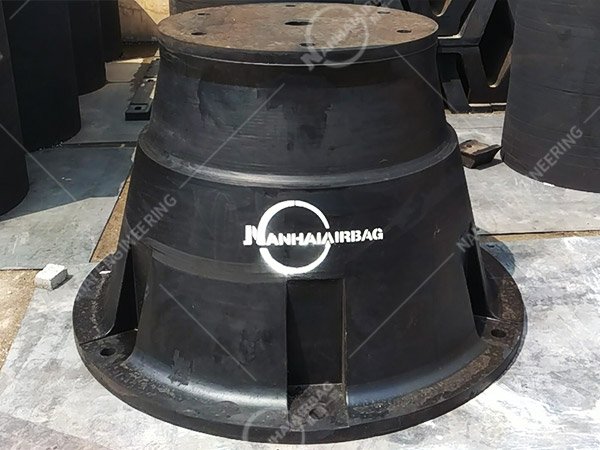
Super cone rubber fenders are the latest generation of cell-type marine fenders, built with a tapered conical rubber body, a fully rubber-embedded mounting flange, and a steel frontal panel faced with UHMW-PE. The conical geometry delivers an exceptionally high energy-absorption-to-reaction-force ratio, keeps performance unchanged at berthing angles up to 10°, and resists vertical and horizontal shear without extra chains. Standard heights run from 300 mm to 2,000 mm, with optional overload stoppers to protect against over-compression. Used on container terminals, LNG and oil jetties, bulk berths, Ro-Ro and cruise ports, and navy facilities, super cone fenders are the go-to choice when vessel size, approach energy, and hull sensitivity leave older cylindrical or arch rubber fenders behind. Unlike marine airbags, which launch, refloat, or lift vessels, super cone fenders are permanent quay-mounted marine fenders engineered for decades of daily berthing .
If your terminal is handling 50,000 DWT and up, crosswinds above 20 knots, or LNG carriers with thin hull plating, the fender decision is no longer about price per unit — it’s about reaction force, hull pressure, and what happens on the tenth typhoon season. Keep reading, because the difference between a super cone and a conventional cell fender is measured in cracked concrete, hull repairs, and years of service life.
What Is a Super Cone Rubber Fender?
A super cone fender is a third-generation evolution of the cell fender. Where a standard cell fender uses a fairly uniform cylindrical cavity, the super cone tapers — narrow at the tip, wide at the base.
That single geometric change does three things at once:
- Progressive stiffness — soft at first contact, firming up as compression deepens
- Large usable deflection — up to 70–72.5% of free height in super-cone designs, versus ~52.5–55% for standard rated deflection points
- Angular stability — no measurable loss of energy absorption or reaction-force control up to about 10° of skew berthing
The body is molded from marine-grade NR/SBR (and EPDM for cold or hydrocarbon service), with the mounting flange fully embedded in rubber so the anchor bolts never see direct hull impact. Most units ship with a watertight steel frontal frame; adding UHMW-PE pads drops the hull friction coefficient below 0.2, which is what protects both the ship’s coating and the rubber face .
Why Super Cone Fenders Outperform Older Profiles
1. Double the energy absorption in the same envelope
A super cone of a given height absorbs roughly twice the energy of a same-spec super cell fender, which means a smaller cone can replace a larger cell at equal reaction force .
Example:
An 800H super cone can do the work of a 1000H drum fender. On a brownfield quay with limited pedestal space, that’s the difference between fitting the fender line and rebuilding the dolphin.
2. Low reaction force protects both hull and wharf
The conical force-deflection curve stays flat early and ramps late. At the same absorbed energy, super cones typically run 20–30% lower reaction force than equivalent cell fenders.
Example:
An LNG import terminal pairs oversized UHMW-PE frontal panels with super cones to keep hull surface pressure below ~25 t/m² (≈245 kN/m²), protecting thin-walled membrane tanks that would dent against a stiffer profile.
3. Angular berthing doesn’t punish you
Real berths are rarely square hits. Wind, current, and tug timing produce skew.
Super cones hold performance to ~10° of inclination with no derating .
Example:
A container terminal in a typhoon belt where vessels arrive at 20+ knot crosswinds swaps cylindrical fenders for SCN units. After three storm seasons and 2,000+ berthings, no fender failures and no new concrete cracks .
4. Shear stability without extra hardware
The wide, rubber-embedded base resists vertical and horizontal shear geometrically. Shear chains are optional, not mandatory — a big saving in open-pile jetties and SPM dolphins .
5. Ice and debris shed instead of prying
The smooth sloping face has no crevices for ice to wedge into. That’s why super cones originated in Scandinavian, Canadian, and Russian ice ports and remain the default for locks, dams, and debris-heavy waterways .
6. Replaceable front panel = longer system life
When the rubber eventually ages out (commonly 15–20+ years), you unbolt the frontal frame, swap the cone, and reuse the panel and anchor assembly. Lifecycle cost drops sharply versus fenders where the whole unit is scrap.
Super Cone vs. Cell vs. W vs. Arch
| Factor | Super Cone | Standard Cell | W Rubber | Arch (A/SA) |
|---|---|---|---|---|
| Energy absorption | ★★★★★ | ★★★★ | ★★★ | ★★★ |
| Reaction force at same energy | Lowest | Medium | Med-low | Medium |
| Max useful deflection | 70–72.5% | ~52.5–55% | ~50% | ~50% |
| Angular tolerance | ≤10° no derate | ~10° | Moderate | Moderate |
| Frontal panel | Standard | Optional | Rare | Optional |
| Shear stability | Excellent | Good | Fair | Fair |
| Best for | VLCC, LNG, containers, SPM | Large general terminals | Mid-size, workboats | Small–medium quays |
| Cost tier | Premium | Mid-premium | Mid | Low-mid |
Rule of thumb: once your berthing calculation pushes past roughly 50,000 DWT or approach velocity above 0.4–0.5 m/s, super cone (or cell) enters the conversation. Below that, W or arch is usually more economical.
Standard Sizes & Performance Data
Representative SCN-series data at rated deflection (tolerance ±10%, always confirm with the manufacturer’s certified curve) :
| Model | Height H (mm) | Base Ø (mm) | P0 Energy @52.5% (kN·m) | P0 Reaction (kN) | P2 Energy @55% (kN·m) | P2 Reaction (kN) |
|---|---|---|---|---|---|---|
| SCN600H | 600 | 900 | 48 | 185 | 62 | 175 |
| SCN700H | 700 | 1050 | 134 | 360 | 172 | 360 |
| SCN800H | 800 | 1200 | 196 | 450 | 336 | 570 |
| SCN900H | 900 | 1350 | 282 | 590 | 482 | 740 |
| SCN1000H | 1000 | 1500 | 380 | 730 | 650 | 1160 |
| SCN1100H | 1100 | 1650 | 664 | 890 | 858 | 1400 |
| SCN1200H | 1200 | 1800 | 650 | 1040 | 1097 | 1300 |
| SCN1300H | 1300 | 1950 | 827 | 1240 | 1399 | 1560 |
Reaction classes: P0 (standard), P1 (high reaction), P2 (super-high reaction). Same outside envelope, different rubber compound and wall geometry — pick by allowed reaction force, not by diameter.
Alternative catalogs quote at 70% and 72.5% deflection (e.g., CT1300H at 72.5% reaches ~1,640 kN·m / 2,312 kN in the RS grade) . Never mix deflection conventions in one spec sheet — that’s the most common procurement error in super cone orders.
Where Super Cone Fenders Belong
- Container terminals — 400 m vessels, high-cycle berthing, crosswind exposure
- LNG & oil jetties — low hull-pressure requirement, EPDM compound for hydrocarbon resistance
- Bulk & general cargo — high mass, moderate velocity, big energy numbers
- Ro-Ro & cruise — varied hull forms, sensitive coatings, UHMW-PE non-marking face
- Navy & coast guard — shock-limited structures, long service intervals
- Ice ports & river locks — sloping face sheds ice, low-temp EPDM stays flexible to −55 °C
- SPM / CALM buoys — designed to OCIMF mooring criteria
- Offshore wind monopiles — service-vessel collision protection
How to Specify a Super Cone Fender
A PO that says “supply super cone fenders” is how you end up with the wrong reaction class. Minimum spec inputs:
- Berthing energy — PIANC method:
E = ½ × Mₑ × V² × Cₑ × C_m × C_s × C_c, with a 1.1–1.25 safety factor - Allowable reaction force — wharf structure limit AND hull-panel limit (PIANC WG211 suggests <200 kN/m² for most hulls; LNG often tighter)
- Reaction class — P0 / P1 / P2
- Height & flange Ø — SCN600H through SCN1300H standard; custom to 2000 mm
- Frontal panel — steel frame, watertight, UHMW-PE faced; panel size set by hull-pressure calc
- Rubber compound — NR/SBR standard; EPDM for ice, LNG, or hydrocarbon splash
- Overload stopper — yes/no
- Anchor system — central threaded rod (HDG or SS316), base plate, cast-in bolts
- Certification — PIANC 2002/2021 guidelines, GB/T 21537-2021, T/CRIA 18001-2018, third-party compression/shear/salt-spray reports
⚠️ PIANC writes design guidelines, not product certificates. Ask for ISO/PIANC-referenced performance curves plus class or third-party test reports — not a “PIANC certified” stamp.
Installation & Maintenance
Installation basics
- Base plate cast into concrete or bolted to steel dolphin; central anchor rod tensioned to spec
- Frontal panel hung to allow slight pivot under skew
- UHMW-PE pads bolted (not glued) so they can be replaced individually
- Shear chains only where open-pile flexibility demands them
- Overload stoppers fitted on high-cycle berths
Inspection rhythm
- Quarterly: panel bolts, UHMW-PE wear, rubber cracking at the flange root, anchor rod corrosion
- Annually: measure permanent set, check rebound, verify overload stopper clearance
- After any abnormal impact: full compression-rebound test before returning to service
Service life: 15–20+ years is normal for a well-specified super cone with a maintained frontal panel; replacing only the rubber body at end of life keeps the civil works untouched .
Super Cone Fenders vs. Marine Airbags vs. Other Rubber Fenders
These three products get confused constantly in procurement. They are not substitutes.
| Product | Job | Mounted where | Load type |
|---|---|---|---|
| Super cone rubber fenders | Permanent berth impact absorption | Quay / dolphin / SPM | Dynamic berthing energy |
| Marine airbags | Ship launching, haul-out, refloat, salvage | Under hull, temporary | Quasi-static weight & buoyancy |
| Pneumatic / foam fenders | Floating STS or tidal buffer | Hung or free-floating | Dynamic, mobile |
| W / D / square rubber fenders | Workboat, tug, small-craft contact | Hull-mounted or light quay | Repeated low-energy contact |
A complete port program uses all of them:
- marine airbags during construction and dredging phases, to launch barges and refloat equipment,
- super cone rubber fenders once the berth is live, for daily high-energy berthing,
- pneumatic or foam marine fenders for ship-to-ship transfer,
- W/D rubber fenders on service boats and tug faces.
One project lifecycle, four different tools. Specifying a marine airbag where a super cone belongs — or vice versa — is the fastest way to fail a berthing calculation.
Related Questions People Ask About Super Cone Rubber Fenders
What is a super cone rubber fender?
A conical, hollow rubber fender with a rubber-embedded mounting flange and a steel frontal panel. It’s the third-generation evolution of the cell fender, offering higher energy absorption at lower reaction force .
How is a super cone different from a standard cell fender?
Same DNA, better output. The tapered body gives deeper usable deflection (up to ~70–72.5% vs ~52.5–55%), unchanged performance at 10° skew, and a wider, more shear-stable base .
What sizes are available?
Standard heights 300–2,000 mm. Common models: SCN/CT 600H, 700H, 800H, 900H, 1000H, 1100H, 1200H, 1300H, 1400H. Custom flange diameters and bolt patterns are normal .
Do super cone fenders need a frontal panel?
Almost always yes. The steel panel (usually UHMW-PE faced) spreads hull contact, drops surface pressure below 200 kN/m², allows slight pivot under skew, and protects the rubber face .
Can super cones handle angled berthing?
Yes — up to about 10° of inclination with no measurable derating in energy absorption or reaction force .
Are they suitable for LNG terminals?
Yes, and widely used. Specify EPDM compound for hydrocarbon resistance and oversize the UHMW-PE panel to hold hull pressure under ~25 t/m².
How long do they last?
15–20+ years with periodic inspection and a maintained frontal panel. The rubber body is replaceable without touching the civil works .
Can marine airbags replace super cone fenders?
No. Marine airbags launch, haul out, and refloat vessels. Super cone fenders are permanent quay-mounted berthing buffers. Different duty, different standards, different lifecycle .
Do super cones work in ice?
Yes — that’s their origin. The smooth sloping face sheds ice instead of trapping it, and low-temperature EPDM compounds stay flexible to about −55 °C .
Can I retrofit super cones onto an existing quay?
Usually yes, if the embedded anchor bolts and pedestal are structurally sound. The flange pattern is often adaptable; a civil survey decides.
What certifications should I require?
PIANC 2002/2021-referenced performance curves, GB/T 21537-2021 or equivalent national standard, T/CRIA 18001-2018, plus third-party compression-rebound, salt-spray, and abrasion reports per batch .
Bottom Line
Super cone rubber fenders are the default answer when berthing energy is high, hull pressure limits are tight, and the terminal needs 15–20 years of daily service without rebuilding the dolphin. You get:
- roughly double the energy absorption of a same-size cell fender,
- 20–30% lower reaction force at equal energy,
- no performance loss to 10° skew,
- inherent shear stability,
- ice and debris shedding,
- and a replaceable rubber body behind a reusable frontal panel.
Build the full system around them:
- marine airbags for launch, refloat, and salvage during the project phase,
- super cone rubber fenders for the permanent berth,
- pneumatic or foam marine fenders for STS and tidal work,
- W/D/square rubber fenders on the service fleet.
👉 Next step: pull your largest regular vessel’s displacement, design approach velocity, allowable hull pressure, and tidal range. Then request a super cone calculation sheet with P0/P1/P2 curves at a single agreed deflection convention — not a catalog page and a per-unit price.
Running an LNG jetty, a typhoon-exposed container terminal, or an ice-port retrofit? Tell me the vessel class and the civil constraints — let’s size the cone class instead of over-building the dolphin.
Keywords used
super cone rubber fenders · super cone fender · SCN fender · cell fender replacement · marine fenders · rubber fenders · marine airbags · UHMW-PE frontal panel · PIANC berthing energy · low hull pressure fender · LNG terminal fenders · container terminal fendering · overload stopper fender
