
How to Choose Cell Rubber Fenders: Ultimate Guide for Maritime Safety & Efficiency
31/03/2026Ship Launching Airbags: The Modern Solution for Safe & Cost-Effective Vessel Launching
07/04/2026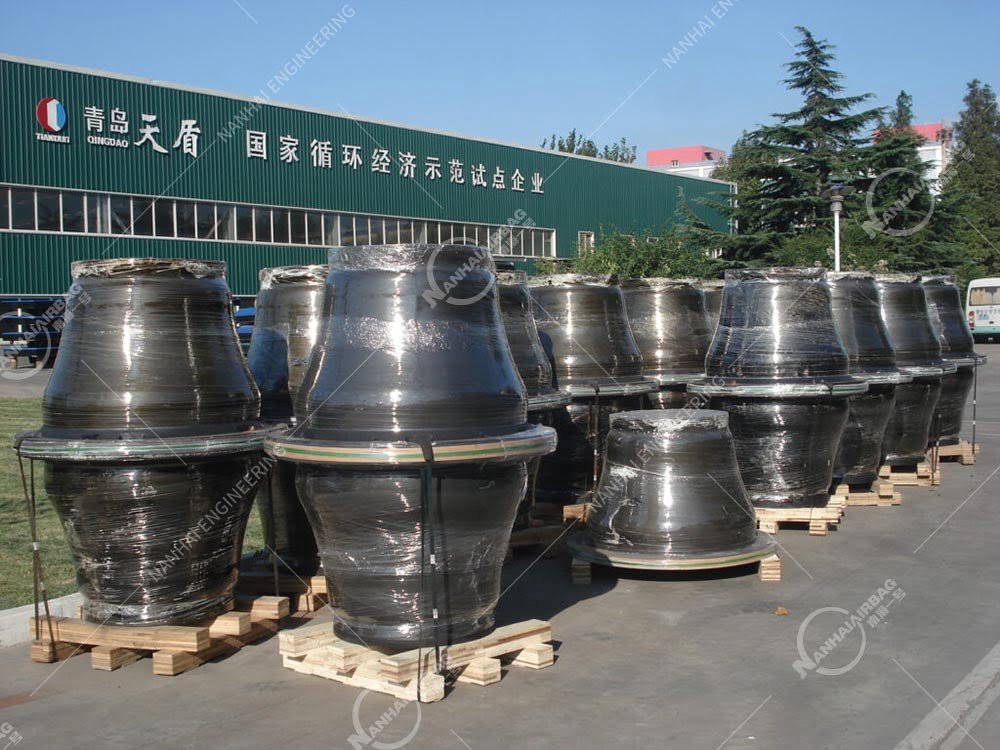

Super Cone Rubber Fenders represent the third-generation evolution of cell-type marine fenders, engineered to deliver exceptional energy absorption with remarkably low reaction forces. Featuring a conical geometric design that maintains stability under large compression angles and provides superior shear resistance, these fenders distribute internal stresses evenly across the entire body for enhanced durability. Compared to traditional super cell rubber fenders of the same size, Super Cone fenders can absorb nearly double the energy while allowing smaller specifications to replace larger drum-type units—significantly reducing dock construction costs. Certified to standards like PIANC and GB/T 21537-2021, they are the preferred choice for container terminals, oil & LNG facilities, RoRo ports, and general cargo berths worldwide.
Why Super Cone Fenders Are Revolutionizing Port Safety & Efficiency
Imagine a docking system that cuts repair costs by 40% while extending service life beyond 20 years. That’s the reality with Super Cone Rubber Fenders. Unlike conventional marine airbags or drum-type rubber fenders, the conical design ensures stable performance even under severe angular berthing (up to 10°), making them ideal for challenging port environments. For example, the JCO2500H—the world’s largest Super Cone fender weighing 18.5 tons—was deployed in Malaysia’s 275kV transmission line project to protect ring beams from heavy vessel impacts .
Key Advantages with Real-World Proof:
- Higher Energy Absorption: An 800H cone fender can match the energy absorption of a 1000H drum fender, reducing initial investment by 20–30% while maintaining performance .
- Lower Hull Pressure: Integrated steel front panels with UHMW-PE facing keep surface pressure below 25 t/m², critical for protecting large vessels like LNG carriers .
- Extended Lifespan: With no direct hull contact and corrosion-resistant sealed structures, maintenance costs drop to 1–2% annually, versus 5–8% for traditional fenders .
5 Critical Factors for Selecting the Right Super Cone Fender
1. Performance Specifications
Super Cone fenders like the CT1300H absorb up to 1,399 kN·m of energy with a reaction force of 2,184 kN at 72% compression . Always match fender size to vessel displacement and berthing velocity using PIANC guidelines.
2. Material & Construction Quality
Premium blends of natural rubber (NR) and styrene-butadiene rubber (SBR) ensure <5% ash content, outperforming cheaper mixes with fillers like clay or calcium carbonate that degrade faster .
3. Installation & Accessories
- Front Panels: Steel frames with UHMW-PE facing reduce friction coefficients to <0.2, minimizing shear forces during berthing .
- Chains & Hardware: Use Grade SUS316 stainless steel for corrosive environments like offshore terminals.
4. Certifications & Compliance
- PIANC 2002: Validates energy absorption and reaction force stability.
- GB/T 21537-2021: China’s national standard for cone rubber fenders .
- T/CRIA 18001-2018: Industry association standard ensuring manufacturing consistency .
5. Total Cost of Ownership (TCO)
While Super Cone fenders have higher upfront costs, their 20+ year lifespan and minimal maintenance deliver a TCO one-third that of drum-type fenders .
Real-World Applications: Where Super Cone Fenders Excel
- Container Terminals: Handle 400m-long vessels with CT1000H+ fenders, absorbing impacts during high-wind berthing.
- LNG & Oil Terminals: EPDM-coated fenders resist hydrocarbon exposure while maintaining -55°C flexibility.
- RoRo & Cruise Ports: Angular stability accommodates ferries and cruise ships with varied hull shapes.
- Offshore Wind Monopiles: JCO series fenders protect turbine foundations from service vessel collisions.
FAQs: Answering Your Top Super Cone Fender Questions
Q1: How do Super Cone fenders compare to marine airbags?
A: Marine airbags are primarily for vessel launching/salvage, while Super Cone fenders are permanent marine fenders designed for continuous berthing protection with higher energy capacity and lower reaction forces .
Q2: What’s the typical service life of a Super Cone fender?
A: With proper installation and UHMW-PE panel maintenance, expect 15–25 years of service—3–5 times longer than standard rubber fenders .
Q3: Can Super Cone fenders handle ice-class vessels?
A: Yes. Specialized compounds maintain elasticity at -55°C, making them suitable for Arctic terminals .
Q4: Are there size limitations for Super Cone fenders?
A: Standard heights range from 600mm to 3,000mm, with custom designs like the JCO2500H (2,500mm height) available for mega-projects .
Q5: How do I verify fender performance claims?
A: Request third-party test reports per PIANC 2002 or ISO 17357, and check ash content (<5%) to ensure material quality .
Pro Tips for Maximizing Your Super Cone Fender Investment
- Partner with Certified Suppliers: Choose manufacturers like Trelleborg, JIER Marine, or Liaoning Qingyuan with documented project experience .
- Implement Predictive Maintenance: Use strain gauges and regular UHMW-PE wear checks to prevent unexpected failures.
- Train Port Crews: Simulate angular berthing scenarios to optimize fender utilization.
By prioritizing energy-to-reaction force ratios, material purity, and lifecycle cost analysis, Super Cone Rubber Fenders transform port safety from a reactive expense into a strategic advantage. For tailored solutions, consult PIANC-certified engineers and request on-site performance demonstrations.
Keywords: marine airbags, marine fenders, rubber fenders, Super Cone fender selection, PIANC 2002 compliance, cone rubber fender installation, port collision protection.
