
W Type Rubber Fenders: The Ultimate Protection for Tugs and Heavy-Duty Vessels
09/04/2026Cylindrical Rubber Fenders: The Time-Tested Workhorse of Marine Protection
16/04/2026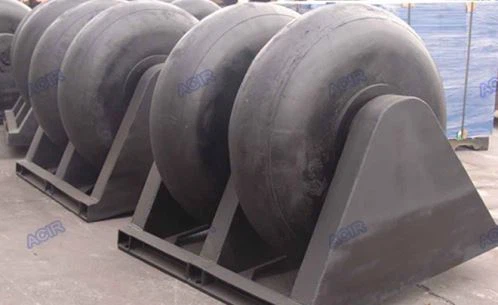

In today’s high-traffic maritime environments, where vessels must navigate tight spaces and complex docking maneuvers, traditional fendering systems often fall short. Roller Rubber Fenders have emerged as the intelligent choice for ports, shipyards, and terminals seeking to enhance safety, reduce maintenance costs, and improve operational efficiency. Unlike conventional static fenders, these innovative systems combine the energy absorption of rubber with the movement flexibility of mechanical systems—creating a solution that guides vessels smoothly while protecting both hulls and infrastructure from costly collision damage.
The Engineering Innovation Behind Roller Fenders
Roller Rubber Fenders (also known as turn cell fenders) are advanced marine fenders featuring a cylindrical rubber body mounted on a rotating shaft within a steel frame. This unique design allows the fender to roll along with vessel movement during berthing, significantly reducing friction and shear forces while effectively absorbing kinetic energy. Engineered for complex docking scenarios, they excel in narrow channels, lock entrances, dry docks, and port corners where precise vessel alignment is critical. With energy absorption exceeding 90% for medium-sized vessels and reaction forces up to 40% lower than traditional fenders, roller systems protect both vessel hull coatings and dock structures. Their modular construction enables easy maintenance and replacement of individual rollers without disrupting port operations, while marine-grade materials ensure durability in temperatures ranging from -30°C to +70°C. As a specialized category within rubber fenders, they complement other marine protection solutions like marine airbags (used for ship launching/salvage) by focusing on guided impact mitigation in confined spaces.
Why Roller Rubber Fenders Are Transforming Maritime Operations
1. Smoother, Safer Berthing with Reduced Friction
The rotating mechanism minimizes direct contact between vessel and dock, allowing ships to roll along the quay surface instead of scraping against it.
Example: A major ferry terminal in Japan reported a 60% reduction in minor hull damages after installing roller fenders, with ferries docking more smoothly and requiring less tug assistance .
2. Exceptional Performance in Tight Spaces
Roller fenders are specifically designed for narrow entrances, lock corners, and restricted channels where vessels must maneuver at angles.
Example: In dry docks and shipbuilding facilities, roller fenders prevent hull damage during precise positioning of vessels in confined spaces .
3. High Energy Absorption with Low Reaction Force
The combination of rubber compression and rolling motion distributes impact energy evenly, reducing stress concentrations on both vessel and infrastructure.
Example: Laboratory testing confirms that roller fenders can absorb over 90% of impact energy from medium-sized ferries and larger vessels while minimizing localized stress .
4. Long Service Life with Minimal Maintenance
Sealed bearings and wear-resistant components reduce maintenance frequency, with modular designs allowing individual roller replacement.
Example: Roller fenders at a high-traffic container port in Australia maintained structural integrity despite heavy daily use and extreme weather, with a reported service life of 15-25 years .
5. Cost-Effective Long-Term Investment
Although initial costs may be higher than traditional fenders, roller systems provide significant savings through reduced hull damage, lower maintenance, and extended operational lifespan.
Example: Port operators have documented 40-65% reductions in repair costs and extended dry-dock intervals after switching to roller fender systems .
6. Versatile Applications Across Maritime Sectors
- Ferry terminals and Ro-Ro berths: Enable smooth, frequent docking operations
- Commercial ports and harbors: Protect large container ships and cargo vessels
- Bridge piers and offshore platforms: Absorb lateral and vertical impact forces
- Marinas and yacht berths: Prevent hull scuffs on luxury vessels
Engage: Is Your Current Fender System Causing Unnecessary Friction and Damage?
Imagine your vessel approaching a narrow lock entrance with strong cross-currents. Traditional fixed fenders create resistance, potentially causing hull abrasion and requiring additional tug assistance—but roller fenders allow the ship to glide smoothly into position, reducing wear and improving safety. How much could your operation save in reduced maintenance, fuel costs, and downtime with this innovative technology? Explore the technical specifications and real-world case studies below to discover why leading ports worldwide are making the switch.
Related Questions (FAQs)
- What are Roller Rubber Fenders? They are marine fenders with rotating cylindrical rubber wheels mounted on steel frames, designed to roll with vessel movement during berthing to reduce friction and absorb impact energy .
- How do roller fenders differ from traditional rubber fenders? Roller fenders provide rotating motion that reduces friction and guides vessels, while traditional fenders rely on static compression. Roller systems excel in tight spaces and angular berthing scenarios .
- Where are roller fenders typically used? Common applications include ferry terminals, Ro-Ro berths, lock entrances, dry docks, narrow channels, port corners, and offshore platforms .
- What are the main advantages of roller fenders? Key benefits include reduced hull friction, excellent performance in confined spaces, high energy absorption with low reaction force, minimal maintenance, and long service life .
- Can roller fenders handle large vessels? Yes, they are designed for vessels ranging from small ferries to ultra-large container ships (ULCVs exceeding 18,000 TEU), with customizable dimensions and energy absorption capacities .
- How long do roller fenders last? With proper installation and maintenance, roller fenders typically last 15-25 years, even in harsh marine environments .
- Are roller fenders suitable for extreme weather conditions? Yes, marine-grade rubber and corrosion-resistant steel components withstand UV radiation, saltwater exposure, and temperatures from -30°C to +70°C .
- How do roller fenders compare to marine airbags? Marine airbags are primarily used for ship launching, lifting, and salvage operations, while roller fenders are permanent installations for berthing protection. Both fall under the broader category of marine fenders but serve different purposes .
Final Thoughts
Roller Rubber Fenders represent a significant advancement in maritime safety technology, addressing the limitations of traditional fendering systems in complex docking environments. By combining the energy absorption of rubber fenders with the guided movement of mechanical systems, they offer ports and terminals a smarter solution for protecting assets and improving operational efficiency. While marine airbags serve specialized lifting applications, roller fenders excel in daily berthing operations—particularly in confined spaces where precision matters most. For facility managers seeking to reduce maintenance costs, minimize vessel damage, and enhance docking safety, investing in roller technology delivers measurable returns across the entire operation.
Keywords emphasized: marine airbags, marine fenders, rubber fenders, roller rubber fenders, turn cell fenders, berthing protection, dock fenders.
