
Tug Boat Fenders: The Only Thing Between Your Tug and a $40k Hull Repair
18/08/2026Square Rubber Fenders: The Practical, Cost-Effective Choice for Docks, Tugs, and Workboats
25/08/2026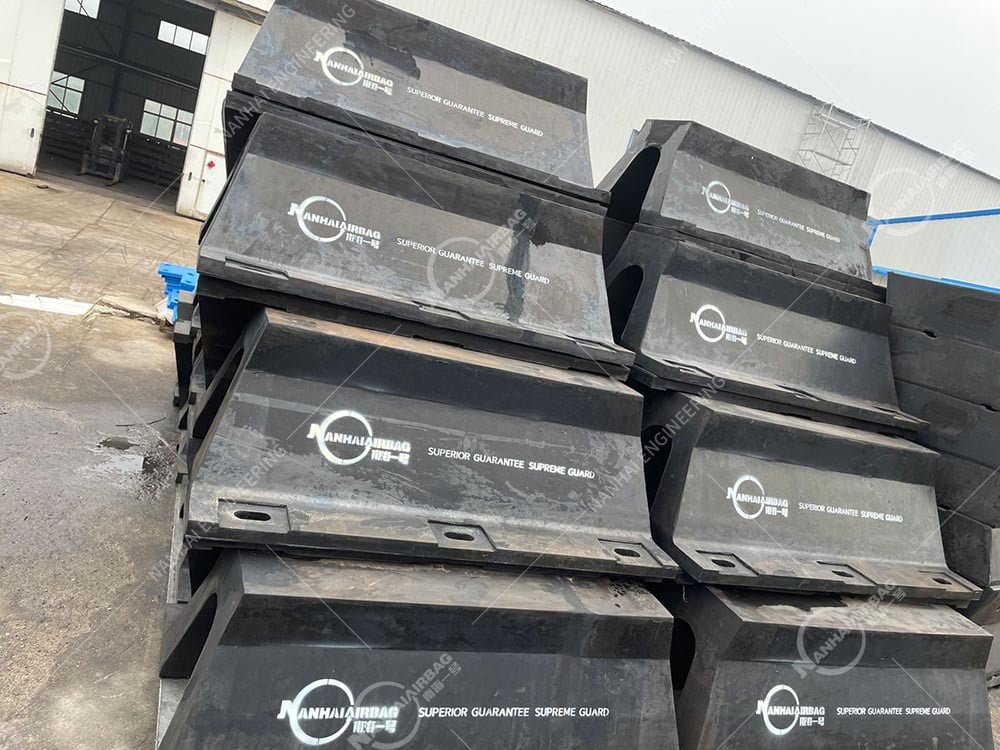

Arch Rubber Fenders are V-shaped, compression-moulded marine fenders engineered to absorb berthing energy while exerting low reaction force on both the vessel hull and the dock structure. Because the arch geometry distributes stress evenly and delivers high energy absorption per unit of rubber, they have become the preferred rubber fender solution for small-to-medium vessel berths, RoRo terminals, tug and barge docks, and any location where mounting space is limited. Compliant with PIANC 2002, ISO 17357 and major classification societies (BV, ABS, DNV, CCS, LR), arch fenders bridge the gap between general-purpose marine fenders and high-end cone or cell fender systems.
If you are specifying marine fenders for a new quay, retrofitting an ageing berth, or comparing arch fenders against cylindrical, cone, or pneumatic marine fenders, this guide walks you through everything you need to know—from how arch fenders work, to why they outperform cylindrical fenders on a weight-for-weight basis, to installation best practices that extend service life to 10–20 years.
What Are Arch Rubber Fenders?
Arch rubber fenders—sometimes called V-fenders or super arch (SA) fenders—are solid rubber fenders with a curved, arch-shaped cross-section. They are vulcanised onto a steel mounting plate with pre-drilled bolt holes, allowing them to be bolted directly to concrete quay walls, steel sheet piles, jetties, or vessel hulls.
When a vessel makes contact during berthing, the arch compresses—typically deflecting up to 50–60% of its height—and converts the kinetic energy of the moving ship into elastic deformation. The energy is dissipated as heat within the rubber, while the reaction force transmitted back to the hull is kept deliberately low to avoid damage to the vessel’s side plating.
This mechanism places arch fenders in the broader family of marine fenders used across commercial ports, naval bases, offshore platforms, and inland waterways—alongside cylindrical fenders, cone fenders, cell fenders, and floating pneumatic marine airbags.
Key Specifications at a Glance
| Parameter | Typical Range |
|---|---|
| Height (H) | 200 mm – 1,000 mm |
| Length | 1,000 – 3,500 mm (customisable) |
| Rubber hardness | Shore A 50 – 70 |
| Material | Natural rubber (NR), SBR, EPDM, or NBR blends |
| Tensile strength | ≥ 16 MPa |
| Operating temperature | -50 °C to +80 °C |
| Certifications | PIANC 2002, ISO 17357, BV, ABS, DNV, CCS, LR |
| Service life | 10 – 20 years with proper maintenance |
Source data compiled from marine fender manufacturers and PIANC-compliant test protocols.
Why Arch Rubber Fenders Outperform Other Rubber Fenders
The transition from cylindrical to arch fenders was driven by a simple engineering reality: cylindrical fenders waste rubber. Under the same unit weight of rubber, an arch fender absorbs 3.5× more energy than a cylindrical fender and 2.3× more than a D-type fender. That efficiency advantage translates directly into lower material cost, less dock space occupied, and better protection per dollar spent.
Advantage 1: High Energy Absorption, Low Reaction Force
The arch profile is optimised so that compression spreads stress across the entire rubber body rather than concentrating it at a single point. This yields a favourable energy-to-reaction-force ratio, which is critical for vessels with high allowable hull pressures.
💡 Example: At a container feeder berth in Southeast Asia, switching from horizontally mounted cylindrical fenders to SA300H arch fenders reduced peak hull pressure by 28% while increasing energy absorption capacity by 40%—allowing the terminal to accept larger vessels without reinforcing the quay wall.
Advantage 2: Superior Shear Resistance
Arch fenders exhibit excellent shear resistance in the longitudinal direction. This matters when vessels surge alongside a dock due to tide, wind, or wave action. The arch shape, combined with optional chain restraints, keeps the fender stable and prevents rollover—a common failure mode in horizontally mounted cylindrical fenders.
Advantage 3: Space-Efficient, Compact Design
Because arch fenders pack more energy absorption per kilogram of rubber, they are physically smaller than the cylindrical alternative for the same performance. This makes them ideal for:
- Small ports and river terminals where quay wall depth is limited
- Tourist vessel docks and marinas where aesthetics and space matter
- Harbour corners that need specialised angular protection
- Retrofit projects where the existing quay cannot accommodate larger fender profiles
Advantage 4: Versatile Mounting Options
Arch fenders can be installed:
- Vertically on quay walls for standard berths
- Horizontally for low-profile applications
- With UHMW-PE face pads to reduce friction coefficient from ~0.7 (rubber-on-steel) down to ~0.15
- With steel front panels for heavy-duty container terminals
- In custom lengths with bevelled, straight, or chamfered ends to match structural ribs
Advantage 5: Low Maintenance, Long Service Life
Once properly installed, arch fenders require only periodic inspection of bolt tension, front-panel condition, and rubber surface integrity. With annual anti-corrosion treatment on steel components and timely replacement of worn UHMW-PE pads, service life of 10–20 years is standard.
Advantage 6: Cost-Effectiveness Over Total Ownership
While the initial unit cost may be higher than a basic cylindrical fender, the total cost of ownership favours arch fenders:
- ✅ Less rubber required for equivalent performance
- ✅ Reduced quay wall reinforcement needs
- ✅ Lower vessel repair costs from reduced hull pressure
- ✅ Minimal maintenance labour
- ✅ 10–20 year replacement cycle
Where Arch Rubber Fenders Deliver the Best ROI
To make the advantages concrete, here are the applications where arch fenders consistently prove their value:
🚢 RoRo (Roll-on/Roll-off) Berths — The low reaction force protects both the ramp and the vessel hull during the angled approach typical of RoRo operations.
🚢 General Cargo Terminals — Versatile enough to handle diverse vessel sizes and berthing angles, with the ability to pair with UHMW-PE panels for low-friction performance.
🚢 Workboat Harbours & Tug Berths — Compact design fits the limited space available on workboat pontoons; shear resistance handles the pushing and towing loads tugs generate.
🚢 Barge Terminals — Excellent for inland waterways where barges berth frequently and need consistent, reliable cushioning.
🚢 Passenger Vessel & Cruise Terminals — Non-marking UHMW-PE face pads protect yacht and cruise ship hull paint from black rubber transfer.
🚢 Container Feeder Berths — SA600H through SA1000H models handle the higher energy demands of 1,000–3,000 TEU feeders without requiring the footprint of a cone fender system.
How Do Arch Fenders Compare to Other Marine Fenders?
Understanding where arch fenders sit in the pecking order helps you specify the right product:
| Fender Type | Energy Absorption | Reaction Force | Shear Resistance | Best For |
|---|---|---|---|---|
| Arch (V-type) | High (deflection-based) | Low | Excellent | General docks, corners, small-to-medium vessels |
| Cylindrical | Moderate | Low (progressive) | Poor (can roll) | General-purpose, variable angles |
| Cone | Very High | Low | Moderate | Large ports, high-energy berths |
| Cell | High | Very Low | Good | Offshore platforms, mega-vessels |
| Pneumatic (marine airbags) | Very High | Very Low | N/A (floating) | Ship-to-ship transfer, fender boats |
Data synthesised from PIANC 2002 performance curves and manufacturer specifications.
The takeaway: When you need high energy absorption, low reaction force, and excellent shear resistance in a compact footprint, arch fenders are unbeatable. When you’re dealing with very large vessels or extreme energy demands, cone or cell fenders—or floating marine fenders such as pneumatic marine airbags—take over.
Proper Installation: The Key to 20-Year Service Life
Even the best arch fender will fail prematurely if installed incorrectly. Follow this field-proven procedure:
- Prepare the substrate — Ensure the concrete or steel surface is clean, level, and free of obstacles. Embedded anchor bolts must be aligned to the fender’s hole pattern.
- Lift safely — Pass soft slings, textile woven belts, or hemp rope through the mounting holes. Never use wire rope or bare metal chains for lifting—they will damage the rubber.
- Position and align — Lower the fender to the exact anchor location on the dock. The endpoint of the fender should fall on an internal structural rib of the hull or quay (ribs, rubber fender ribs) for maximum support.
- Insert and tighten — Place washers into the mounting holes corresponding to the embedded dock anchors and tighten with bolts. Tighten all bolts to the specified torque. If any bolt holes are misaligned, do not force them—adjust the anchor or consult the manufacturer.
- End treatment — Both ends of the arch fender should have sealing plates and be bevelled, with a height-to-width ratio greater than 3:1. The doubler plate should be partially relaxed and strengthened at the end.
- Stagger the seams — The seams of the hull shell, the doubler plates of the fenders, and the butt joints of rubber fenders should be staggered by at least 100 mm to avoid stress concentration.
- Final cleanup — Remove all installation marks, smudges, or debris from the fender surface.
Ongoing Maintenance Checklist
Perform these inspections every 6–12 months:
- ⚓ Check all foot bolts and front-panel fastening bolts; re-torque as needed
- ⚓ Inspect the rubber body for cuts, cracks, or heavy abrasion
- ⚓ Examine the UHMW-PE face pad for wear; replace if significantly thinned
- ⚓ Verify the front panel is not inclined or dented
- ⚓ Apply anti-corrosion treatment to steel components annually
- ⚓ Check the concrete substrate around the fender for cracks
⚠️ Critical: If you find heavy cutting on the rubber body or significant inclination of the front panel, contact the manufacturer immediately. Do not continue operating the berth until the fender is repaired or replaced.
Related Questions People Ask About Arch Rubber Fenders
These are the questions maritime engineers and procurement officers most frequently search on Google:
❓ What is the difference between arch fenders and cylindrical fenders?
Arch fenders deliver 3.5× more energy absorption per unit weight of rubber compared to cylindrical fenders, offer superior shear resistance, and occupy less space. Cylindrical fenders remain a good general-purpose choice for variable berthing angles but require more rubber to achieve the same performance and are prone to rolling if not properly restrained.
❓ Are arch rubber fenders suitable for large vessels?
Arch fenders are primarily designed for small to medium-sized vessels (up to ~3,000 TEU feeders, tugs, barges, RoRo ships, and cruise vessels). For very large vessels such as VLCCs, ultra-large container ships, or Capesize bulk carriers, cone fenders, cell fenders, or floating pneumatic marine airbags are recommended due to their higher energy absorption capacity.
❓ What standards do arch rubber fenders comply with?
Quality arch fenders are manufactured and tested to PIANC 2002, BS 6349, ASTM FZ192-05, and ISO 17357 standards. They typically carry certification from major classification societies including Bureau Veritas (BV), ABS, DNV, CCS, LR, and GL. Always request the certification documentation when procuring.
❓ Can arch fenders be customised?
Yes. Reputable manufacturers offer customisation in height (200–1,000 mm), length (1,000–3,500 mm or longer), rubber compound (natural rubber, SBR, EPDM, NBR), hardness (Shore A 50–70), end profile (bevelled, straight, or mixed), bolt hole patterns, and front-panel configuration (bare rubber, steel panel, or UHMW-PE face pad).
❓ How long do arch rubber fenders last?
With correct installation and routine maintenance, arch fenders deliver 10–20 years of service life. The rubber body itself can last 15+ years; the UHMW-PE face pads typically need replacement every 5–8 years depending on traffic intensity.
❓ What is the difference between DA and SA type arch fenders?
DA (Double Arch) fenders have a simpler, older profile, while SA (Super Arch) fenders feature an optimised geometry that increases energy absorption and improves the energy-to-reaction-force ratio. SA fenders are the modern standard and are recommended for new installations.
❓ How do I calculate the right arch fender size for my berth?
The calculation follows: E = ½ × Cₘ × Cₑ × Cₛ × M × V², where Cₘ is the hydrodynamic mass coefficient, Cₑ is the eccentricity coefficient, Cₛ is the softness coefficient, M is vessel displacement, and V is berthing velocity. The resulting energy (E_N) is then matched against the rated performance data of candidate fender sizes. Most manufacturers provide selection software or technical support to perform this calculation for your specific berth.
❓ Are arch fenders better than marine airbags?
They serve different purposes. Arch rubber fenders are fixed, compression-type fenders bolted to docks or hulls for everyday berthing. Marine airbags (pneumatic fenders) are floating, inflatable fenders used for ship-to-ship transfer, emergency fendering, or as supplementary protection. For a permanent berth infrastructure, arch fenders are the cost-effective choice; for floating or STS operations, marine airbags are superior.
Selecting the Right Arch Fender: A Decision Framework
Before you request a quote, gather this information to ensure you get the optimal specification:
- Vessel characteristics — Maximum displacement, hull shape, allowable hull pressure
- Berthing conditions — Approach velocity, angle, tidal range, surge potential
- Environmental factors — Temperature extremes, UV exposure, seawater chemistry, ice presence
- Spatial constraints — Available mounting depth, quay wall type, clearance requirements
- Performance targets — Required energy absorption (kJ), maximum acceptable reaction force (kN)
- Configuration preferences — Bare rubber, steel front panel, or UHMW-PE face pad
- Length and quantity — Total linear metres needed, number of fender units
- Certification requirements — Which classification society approvals are mandatory
Share these details with your fender manufacturer, and they can model the berth performance and recommend the exact SA model (SA200H through SA1000H) that meets your needs at the lowest total cost of ownership.
The Bottom Line
Arch rubber fenders represent the sweet spot in the marine fender spectrum: they deliver cone-fender-level energy absorption in a compact, cost-effective package that thrives in space-constrained, small-to-medium vessel applications. Their V-shaped geometry, excellent shear resistance, low reaction force, and 10–20 year service life make them the default choice for RoRo terminals, workboat harbours, barge berths, passenger vessel docks, and general cargo terminals worldwide.
Whether you’re building a new quay, retrofitting an ageing berth, or simply replacing worn rubber fenders, arch fenders deserve serious consideration. Combined with complementary marine protection products—from cylindrical fenders for general-purpose use to pneumatic marine airbags for ship-to-ship operations—they form the backbone of a resilient, future-proof marine fender strategy.
📌 Ready to specify arch fenders for your project? Compile your vessel data, berthing conditions, and spatial constraints, then engage a PIANC-compliant manufacturer for a performance-matched recommendation. The right arch fender, properly installed, will protect your vessels and your infrastructure for the next two decades.
Keywords: Arch Rubber Fenders, marine fenders, rubber fenders, marine airbags, V-fenders, super arch fenders, SA fenders, PIANC 2002 compliant fenders, low reaction force fenders, high energy absorption fenders, RoRo berth fenders, tug berth fenders, UHMW-PE faced fenders, marine docking protection.
