
Pneumatic Rubber Fenders: The Complete Guide to Floating, Low-Reaction Marine Protection
17/09/2026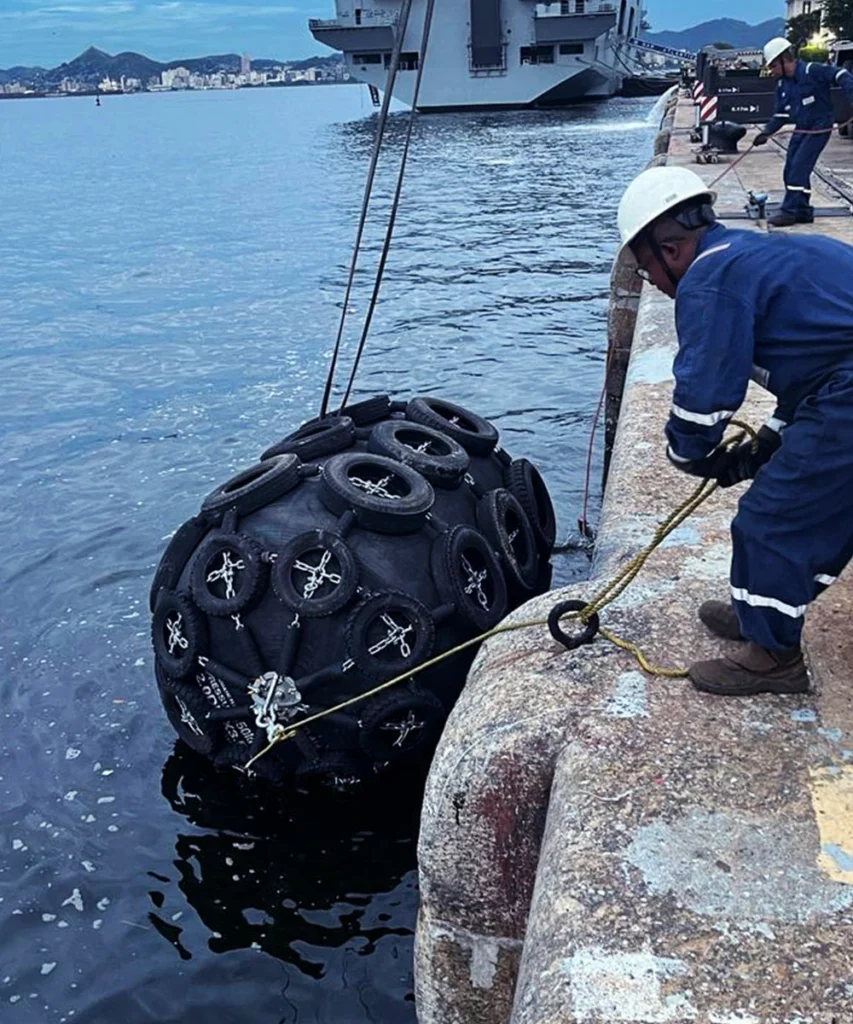
A Yokohama fender—also called a Yokohama-type pneumatic rubber fender—is an air-filled, floating marine fender that absorbs berthing impact by compressing trapped air inside a reinforced rubber body. Originally developed by The Yokohama Rubber Co. in 1958, it is now the global benchmark for ship-to-ship (STS) transfer and tidal ship-to-dock operations, with performance governed by ISO 17357-1:2014.
If you specify, buy, or operate marine fenders, this guide will help you understand why “Yokohama type” is not just a brand name—and how to choose the right pneumatic fender instead of confusing it with foam fenders or marine airbags.
What Is a Yokohama Fender?
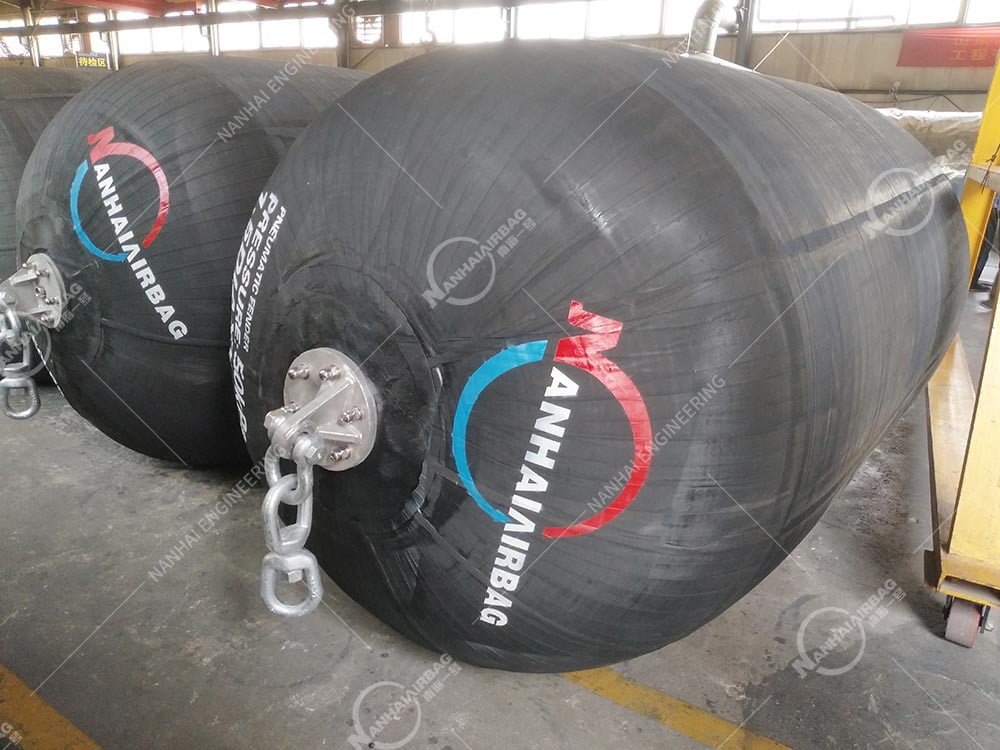
A Yokohama fender is a cylindrical, seam-free buffer made from synthetic-tire-cord-reinforced rubber layers with compressed air inside. It floats at the waterline, tracks tide and swell, and acts as a shock absorber between:
- Ship and ship (STS transfer)
- Ship and quay, jetty, or dolphin (STD)
- Vessel and offshore structure (FPSO, SPM, wind farm SOV)
The key difference from solid rubber fenders: it does not rely on rubber stiffness alone. It uses an air-spring principle—the vessel’s kinetic energy is converted into uniform air compression plus elastic cord-layer strain, then released as the fender rebounds.
💡 Why the name stuck: Yokohama Rubber pioneered the design using automobile tire and rubber aircraft-fuel-tank technology. Today, “Yokohama fender,” “Yokohama type,” and “pneumatic rubber fender” are used interchangeably—but in a purchase spec, always require ISO 17357-1:2014, not just the words “Yokohama type.”
How a Yokohama Pneumatic Fender Works
Here’s the step-by-step impact cycle:
- Approach – The fender floats at the hull contact point, tethered by slings or a chain-tire net.
- Compression – The hull presses the reinforced rubber body, typically up to 60% deflection (the ISO test point).
- Air pressure rises uniformly – No local buckling; energy spreads across the whole fender.
- Energy conversion – Kinetic energy becomes compressed-air pressure + elastic strain in the nylon/polyester cord layers.
- Low reaction force – The hull feels a soft, progressive cushion instead of a hard wall.
- Rebound – When the vessel backs off, the air re-expands and the fender recovers shape—ready for the next impact.
This “soft entry” force-deflection curve is the reason pneumatic marine fenders are preferred for sensitive hulls: LNG carriers, aluminum crews, cruise ships, and naval vessels.
Internal Structure (ISO 17357-1)
| Layer | Material | Function |
|---|---|---|
| Outer rubber | NR/SBR blend | Abrasion, UV, seawater, ozone resistance |
| Cord reinforcement | Cross-plied synthetic tire cord | Burst-proof “skeleton” that holds pressure |
| Inner rubber | Airtight liner | Seals compressed air |
| End flange + valve | Steel + safety relief valve | Inflation, pressure control, over-pressure release (mandatory ≥ Ø2500 mm) |
Why Engineers Choose Yokohama Fenders: Advantages With Real Examples
Let’s move from theory to deck-level reality.
✅ High Energy Absorption, Low Reaction Force
Solid rubber fenders push back with material stiffness. A Yokohama fender pushes back with gas compressibility.
Example: During an LNG ship-to-ship transfer, a low initial pressure (P50) pneumatic fender absorbs large berthing energy while keeping hull pressure inside class-society limits—critical when the cargo system cannot tolerate structural stress.
✅ Floats and Tracks the Tide
Fixed cone or cell fenders are bolted to the quay and can’t move with water level. A floating pneumatic fender rises and falls with draft and tide.
Example: A tidal harbor in Southeast Asia replaced fixed rubber fenders on a marginal berth with sling-type Yokohama fenders. Berthing windows expanded because the fender stayed in the hull contact zone through full tidal range—no manual repositioning.
✅ Portable and Re-Deployable
Deflate it, pack it, ship it, reinflate it.
Example: A salvage contractor uses Ø1500–2000 mm pneumatic fenders on one project, deflates them for containerized transport, then redeploys the same units at a different site. Compare that to bulky foam-filled fenders or rolled marine airbags, which serve different jobs (more below).
✅ Proven at Super-Vessel Scale
Yokohama-type pneumatic fenders are used worldwide on VLCCs, ULCCs, Q-Max gas carriers, bulk carriers, FPSOs, and FLNG terminals—with more than 60,000 units supplied globally since the original design.
Net Type vs. Sling Type vs. Hydro-Pneumatic
Choosing the wrong variant is the #1 spec mistake buyers make.
🔰 Type I – Net Type (Chain & Tire Net)
- Chain/wire net with used tires or rubber sleeves
- Best for: VLCC/LNG STS, permanent berths, rough seas, high-abrasion terminals
- Advantage: Longest abrasion life, hardest impact tolerance
🔰 Type II – Sling Type (No Hard Net)
- Thick outer rubber + integral lifting slings
- Best for: Yachts, cruise ships, naval, calm-water temporary berthing
- Advantage: Lightweight, fast deploy, non-marking options
🌊 Hydro-Pneumatic (Subclass)
- Part air, part water ballast, held vertically submerged
- Best for: Submarines, low-freeboard hull contact, specialized naval ops
P50 vs. P80 (Same Size, Different Tune)
| Rating | Initial pressure | Energy absorption | Reaction force | Typical use |
|---|---|---|---|---|
| P50 | 50 kPa | Baseline | Lowest | Standard STS, sensitive hulls |
| P80 | 80 kPa | ~30–50% higher | Higher | VLCC STS, high approach energy |
⚠️ Never inflate a P50-rated body to 80 kPa. Cord angle and end-ring safety factors differ. Match pressure class to the vessel’s allowable hull pressure—not just to “more energy.”
Yokohama Fender vs. Foam Fender vs. Marine Airbags
This is where most Google searchers get lost. Let’s separate the categories clearly.
Pneumatic (Yokohama) Fender
- Medium: Compressed air
- Floats? Yes
- Puncture risk? Yes—deflates if skin/valve fails
- Maintenance: Monthly pressure checks, valve inspection
- Best for: STS, tidal docks, portable operations, low hull pressure
Foam-Filled Fender
- Medium: Closed-cell foam core (no air)
- Floats? Yes, unsinkable even when cut
- Puncture risk? None—keeps working if skin is damaged
- Maintenance: Mostly visual inspection
- Best for: Offshore platforms, high-traffic berths, unattended sites, yacht marinas
- Trade-off: Higher upfront cost, heavier, slightly higher reaction force
Marine Airbags
- Purpose: Ship launching, dry-dock hauling, heavy-load relocation, salvage buoyancy
- Not a berthing fender. Airbags are handling and lift tools, not continuous impact buffers between hull and structure.
- Keyword clarity: Both marine airbags and pneumatic fenders use reinforced rubber + compressed air, but they are not interchangeable. Specifying an airbag for STS berthing is a safety error.
📌 Rule of thumb: Pneumatic wins on portability + low hull pressure. Foam wins on abuse tolerance + zero maintenance. Airbags are for moving ships, not cushioning them.
Where Yokohama Fenders Are Used
- Ship-to-ship crude, product, and LNG transfers
- Tidal ship-to-dock berthing and marginal wharves
- FPSO / FSU offloading
- Single-point mooring (SPM) and CBM buoy operations
- Naval berthing and submarine tendering
- Offshore wind CTV and SOV side protection
- Emergency lay-by and salvage cushioning
How to Specify a Yokohama Fender (So You Don’t Get the Wrong Unit)
A compliant purchase line should look like this:
Yokohama-type pneumatic rubber fender, ISO 17357-1:2014, P50, Ø3300 × L6500 mm, Type I chain-tire-net, with safety relief valve, class-society prototype test report, and traceable serial marking.
Checklist before you buy
- ✅ Compute berthing energy:
E = ½ Mₑ V² × Cₑ × C_m × C_s × C_c(PIANC method) - ✅ Match GEA at 60% deflection to calculated energy
- ✅ Confirm allowable hull pressure vs. P50/P80 reaction force
- ✅ Verify cord specification and vulcanization method
- ✅ Require third-party class report (ABS / BV / DNV / CCS / LR)
- ✅ Check relief valve on fenders ≥ Ø2500 mm
Maintenance: The Part Nobody Markets But Everyone Pays For
A Yokohama fender is low-maintenance—not no-maintenance.
Monthly
- Check pressure with a calibrated gauge (sunlight can heat air +10–15%)
- Never exceed rated pressure
Every 3–6 months
- Inspect chain net, tire wear, sling eyes, shackles
- Look for cuts, abrasion, valve seal leaks
- Wash salt off with fresh water
Storage
- Deflate slightly if idle for long periods
- Keep shaded, dry, away from ozone/heat sources
Typical service life: 6–10+ years with correct pressure management and net maintenance.
Frequently Asked Questions (People Also Ask)
Is a Yokohama fender the same as a pneumatic rubber fender?
Yes. “Yokohama fender” and “Yokohama type” are industry names for floating pneumatic rubber fenders. The technical/standard term is pneumatic rubber fender, and performance should be verified against ISO 17357-1:2014 regardless of brand.
Why is it called “Yokohama type”?
Because The Yokohama Rubber Co. commercialized the first compressed-air marine fender in 1958 using tire-cord and rubber fuel-tank technology. The name became generic shorthand for the whole product class.
What’s the difference between P50 and P80 Yokohama fenders?
Same physical size, different initial inflation pressure. P50 = 50 kPa (softer, lower reaction force). P80 = 80 kPa (higher energy absorption, higher reaction force). You choose based on vessel mass, approach speed, and allowable hull pressure—not price.
Are Yokohama fenders better than foam fenders?
Neither is “better”—they solve different problems. Pneumatic/Yokohama fenders give lower hull pressure and easy relocation. Foam-filled fenders are unsinkable, puncture-proof, and nearly maintenance-free. For LNG/STS with strict hull-pressure limits, pneumatic is often preferred; for offshore/unattended abuse, foam usually wins.
Can marine airbags be used instead of Yokohama fenders?
No. Marine airbags are launching and heavy-load-handling tools. Yokohama marine fenders are continuous berthing buffers. Different geometry, different safety factors, different job.
What size Yokohama fender do I need?
Don’t size by vessel length alone. Calculate berthing energy using displacement, approach velocity, and berthing coefficients (PIANC WG-211 / ISO 17357), then match the fender’s Guaranteed Energy Absorption (GEA) at 60% deflection. Common range: Ø500 × L1000 mm up to Ø4500 × L12000 mm.
Do Yokohama fenders work in rough weather?
Yes—especially net-type units in STS configurations. Their air-spring behavior maintains predictable energy absorption under cyclic wave loading better than solid rubber, and they adapt to tidal movement. However, the rubber body still needs inspection; punctures require spare units or repair.
Key Takeaways
Yokohama fenders remain the global standard for floating, low-reaction berthing protection because they combine:
- Air-spring energy absorption
- Tide-tracking buoyancy
- Portability across projects
- ISO 17357-1:2014 verifiability
- Proven performance from yachts to VLCCs
Just remember the three-way distinction every procurement team should memorize:
Pneumatic Yokohama fenders cushion. Foam fenders endure. Marine airbags move.
Specify by energy, hull pressure, and operating environment—not by the catchiest name on the quote sheet.
