
Square Rubber Fenders: The Rigid, Flat-Face Profile for Tough Everyday Berthing
29/09/2026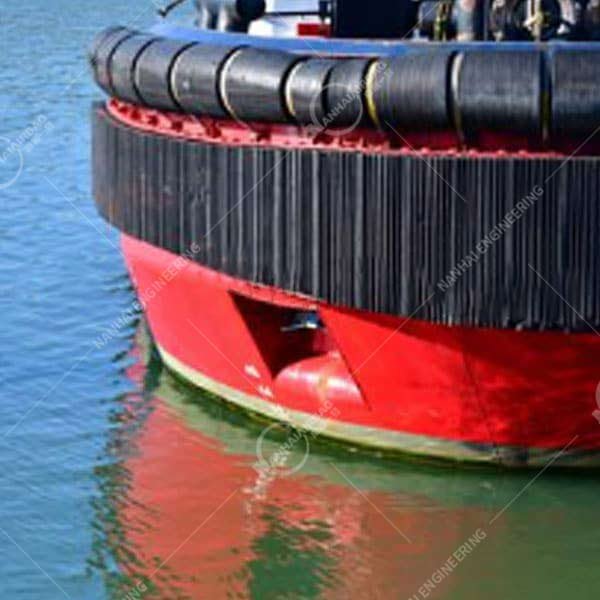
A tug doesn’t berth gently. It pushes, leans, rubs, pivots, and takes the reaction load the big ship isn’t allowed to feel. The hull it protects might be a 200,000 DWT tanker with coating-sensitive plating; the structure it protects might be its own deckhouse, bulwark, and crew.
That contact interface is the tug fender system — and it’s one of the most misunderstood line items in a tug spec.
Buyers ask “which fender is best?” The better question is: where does the tug contact, how hard, at what angle, and against what hull? Answer that, and the profile chooses itself: cylindrical for the bow pushing a flared stem, W or M for heavy escort duty, block for swell and grip, D or square for side belting, pneumatic or foam for temporary floating cushioning when rigged alongside.
This guide is written for tug owners, naval architects, port engineers, and procurement. It covers the tug fender types that actually matter, how to place them, how PIANC 2024 changes the sizing conversation, and the Google-search FAQs buyers type before requesting quotes.
📌 Google-Selected Summary (Key Takeaway)
Tug boat fenders are vessel-mounted rubber fenders and, in some operations, rigged floating marine fenders that protect the tug, the assisted ship, and nearby structures during pushing, escorting, towing, and berthing. Fixed tug fendering is usually extruded or molded rubber — cylindrical, W, M, block/cube, D, square, or composite profiles — mounted on the bow, sides, stern, or corners and chosen by contact type, not by boat length alone.Rubber tug fenders deploy instantly and need almost no handling, but they provide limited energy absorption beyond removing steel-to-steel contact; pneumatic or foam fenders absorb far more energy but must be rigged, monitored, and recovered.Modern fender selection should follow PIANC Fender Guidelines 2024 (WG 211), which replaces the old WG 33/2002 approach, uses site-specific berthing velocities, lower angles, multiple-contact scenarios, and treats the fender plus supporting structure as one system.Tug fenders are not marine airbags: airbags launch, haul out, refloat, or stabilize a vessel; tug fenders absorb contact energy during assist and berthing. A complete operation may use both — airbags in the yard, fenders on the hull — but they are never interchangeable.
Why Tug Fendering Is Harder Than Dock Fendering
Quay fenders sit still. The water level moves, the ship moves, but the fender is bolted to concrete or steel.
A tug fender moves with the boat, contacts at changing angles, slides under shear, and often works against a much larger ship whose hull curvature changes from flat side to raked bow flare. The U.S. Navy towing manual puts it plainly: rubber fenders on tugs are part of the structure — they take no time to deploy but provide little energy absorption beyond eliminating steel-to-steel contact. Pneumatic and foam fenders absorb much more, but they need rigging, handling, support slings, pressure checks, and recovery.
That single sentence explains every tug fender mistake:
- Specifying a dock fender profile for a pushing bow
- Assuming “rubber = safe” and ignoring reaction force on the assisted hull
- Putting side-belting D fenders where a cylindrical push fender belongs
- Forgetting freeboard mismatch — the fender rolls up and pops onto the lower deck
- Ignoring friction heating when tug and ship roll out of phase
- Loading unsupported shell plating because the fender landed between frames
💡 Mental model: A tug fender isn’t a bumper. It’s a controlled-energy contact pad that also has to grip, conform to hull curvature, survive shear, and not walk up the ship’s side.
Transition: From “Fit Some Rubber” to “Engineer the Contact”
Most tugs leave the builder with some fendering — often D strip on the sides and maybe a cylindrical or tyre at the bow. That’s enough for sheltered harbor work. But the moment the duty steps up — escorting a tanker, pushing a flared container-ship stem, working swell, or holding alongside a soft-shelled LNG carrier — the fender system has to be chosen deliberately.
Here’s how the advantages break down by duty, with the examples that matter.
The Tug Fender Types That Actually Get Specified
1. Cylindrical Fenders — Bow and Stern Push Work
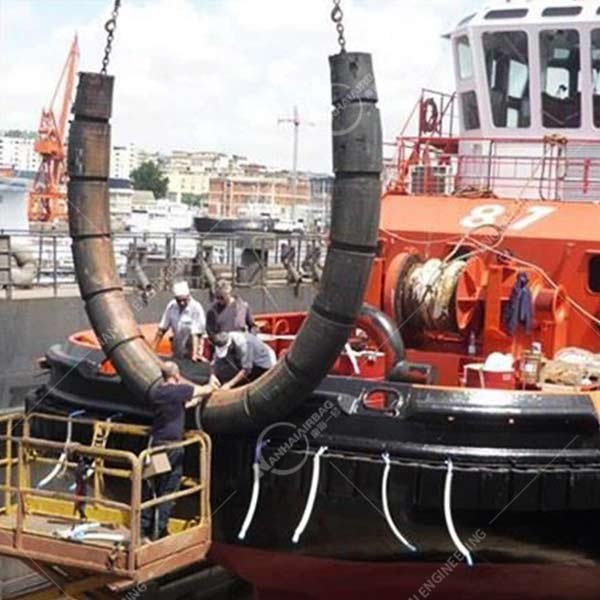
The default pushing fender. Mounted longitudinally, often with a central chain in the bore and circumferential straps or chains recessed in grooves.
Why it wins: Round profile conforms to flared bows and flat sides alike. It rolls slightly under contact, distributes load, and wears evenly if you can rotate it.
Example: A tractor tug escorting a post-Panamax container ship. The bow meets a raked stem flare. A flat block would point-load the flare; a cylindrical fender presents a round contact line that tracks the curvature. Trelleborg notes cylindrical fenders are fitted bow and stern for pushing against flared hulls in open conditions, with diameters up to about 100 cm.
Best for: Harbor tugs, escort tugs, STS support, pushing against variable hull shapes.
2. W Fenders — Extreme-Duty Push and Escort
Deep “W” profile with wide contact face and grooves for grip. Conforms around tight hull radii.
Why it wins: Spreads contact pressure, grips during shear, and handles high-energy push without rolling out as easily as a cylinder.
Example: An ocean-going escort tug holding a tanker in a strong quartering sea. The hull tries to pivot; the W profile stays engaged, the grooves resist sliding, and the wide face keeps pressure off the tanker’s shell.
Best for: Escort tugs, large harbor tugs, exposed coastal work, high-energy push.
3. M Fenders — Push/Pull with Strong Attachment
Triple-leg profile, large flexible contact face, grooved for grip.
Why it wins: The legs give a secure mount and the face conforms to curvature. Relative low weight helps tug stability versus a bigger solid block.
Example: A 2,000-ton ASD tug pushing barges and nudging tankers. M-fenders on bow and quarter give a wide, grippy contact patch and a strong mechanical lock to the bulwark.
Best for: Bow/stern pushing, combined push-pull, tugs that work mixed hull types.
4. Block / Cube Fenders — Swell, Grip, Low Hull Pressure
Large contact area, grooved or flat face, optionally composite with UHMW-PE.
Why it wins: Big footprint = lower hull pressure. Grooves add grip in swell. UHMW-PE face cuts friction when the ship slides.
Example: A tug standing by a soft-shelled product tanker in a rolling harbor entrance. A hard cylindrical contact could point-load the shell; a block fender spreads the load and resists riding up.
Best for: Heavy swell, storm standby, low hull-pressure requirements, ice or low-friction duty with UHMW-PE face.
5. D and Square Fenders — Side Belting
Low-profile extruded profiles for the hull sides. D is compact; square is more rigid and abrasion-resistant.
Why it wins: Cheap, continuous, easy to bolt or bracket, protects the hull during escort alongside and coming to a dock.
Example: A harbor tug that spends its day nosing against ship sides, pontoon edges, and quay walls. D fendering along the sheerline absorbs the daily rub; it’s field-cuttable and individually replaceable.
Best for: Side belting, escort alongside, finger protection, workboats, pilot boats.
6. Composite Fenders — When Friction Control Matters
Rubber body with UHMW-PE or nylon facing.
Why it wins: Rubber absorbs; plastic face slides. Reduces hull marking and frictional heating during out-of-phase roll.
Best for: Ice-class tugs, low-marking duty, long side-by-side contact.
7. Pneumatic or Foam Fenders — Rigged, Not Built-In
Not vessel-mounted fendering in the structural sense, but part of the tug’s fender kit.
- Pneumatic: very low hull pressure, floating, deflatable for storage, needs pressure checks.
- Foam filled: unsinkable, low upkeep, larger and heavier, no deflation risk.
Example: A salvage or standby tug working a disabled ship in open water. No fixed bow fender can bridge the gap and tide swing — you hang pneumatic or foam fenders on pendants between tug and casualty.
Best for: STS, temporary berthing, salvage, large tidal range, when low reaction force matters more than instant deployment.
Quick Selection Matrix
| Tug duty | Primary fender | Why |
|---|---|---|
| General harbor towing | Cylindrical | Versatile, multi-directional, cost-effective |
| Heavy escort, ocean-going | W-type | High energy absorption, hull-conformant |
| Push-pull work | M-type | Wide face, triple-leg mount, low hull pressure |
| Swell / storm standby | Block | Large contact, grip, low hull pressure |
| Side escort / daily rub | D or square | Compact, cheap, replaceable |
| Low friction / ice / marking | Composite with UHMW-PE | Slides, protects shell |
| Open-water STS / salvage | Pneumatic or foam | Floating, low reaction, rigged |
| Emergency only | Tyres on chains | Tough, cheap, rapid deployment |
Many tugs run a layered system: cylindrical or W/M at bow and stern for push, D or square along the sides for escort, block or composite at corners for swell contact, and pneumatic/foam in the locker for abnormal jobs.
The Physics Buyers Skip: Energy, Reaction, and Contact Pressure
A fender’s job is not “stop the boat.” It’s to lengthen the deceleration time and keep reaction force under the limit of both the tug structure and the assisted vessel’s hull.
PIANC 2024 frames fender selection as a chain:
- Requirements — vessel, site, duty, allowable reaction
- Fender type — cylindrical, W, M, block, pneumatic, etc.
- Base performance — catalog data at standard test conditions
- Characteristic performance — adjusted for velocity, temperature, angle, multiple contact
- Design performance — partial safety factors applied
- Verification — energy and reaction checked against hull and structure
The old WG 33/2002 numbers are not directly swap-in. WG 211 uses higher velocities, lower berthing angles, and multiple fender contacts, and puts more safety in the rubber than in the supporting structure.
Practical takeaways for tug specs:
- Don’t size from boat length. Size from contact energy: relative mass, approach or push speed, angle, and how many fenders actually touch.
- Check reaction force, not just energy absorption. A W fender that eats energy but spikes reaction can dent a soft tanker shell.
- Apply correction factors. Temperature changes rubber hardness; angle changes effective stiffness; multiple contacts share load but not perfectly.
- Watch hull structure. The Navy manual warns against landing fenders on large areas of shell plating not backed by frames, especially in quartering seas.
- Integrate the mount. The bracket, chain, backing plate, and bulwark are part of the fender system. A great profile on a weak mount fails.
Placement: Bow, Sides, Stern, Corners
Bow
Primary push contact. Cylindrical for general work; W or M for heavy escort. Pre-curve to the stem. Make sure the fender stays engaged as the ship’s flare opens up.
Sides
Escort and alongside duty. D, square, or composite belting. Use transition blocks where side belting meets bow/stern fendering so there’s no hard edge.
Stern
Often cylindrical or whichever profile matches the aft contact. Stern contact matters when backing down, holding position, or working a ship’s quarter.
Corners and Bulwark Tops
Block or composite. These take skew contact and prevent the hull edge from chewing the ship’s side.
Subsurface
Navy guidance notes tugs working alongside submarines should have subsurface fenders.If your duty includes subs or deep freeboard mismatch, specify accordingly.
Rubber vs. Pneumatic vs. Foam on a Tug
| Feature | Rubber tug fender | Pneumatic fender | Foam filled fender |
|---|---|---|---|
| Deployment | Instant, mounted | Rigged, slung, tensioned | Rigged, slung |
| Energy absorption | Low–moderate | High, low reaction | High, low–moderate reaction |
| Maintenance | Low; visual + bolts | Pressure checks, valves, patches | Low; skin inspection |
| Deflation risk | None | Yes | None |
| Best use | Daily push/escort/belt | STS, salvage, low hull pressure | Harsh floating duty, low upkeep |
| Standoff | Low | High | High |
Rule: built-in rubber for the work you do every minute; pneumatic/foam for the abnormal job where low reaction and floating contact beat instant availability.
Tug Fenders vs. Marine Airbags — Settle It Clearly
This confuses procurement because both are “rubber marine products.”
| Tug boat fenders | Marine airbags | |
|---|---|---|
| Job | Absorb contact energy during assist/berth | Lift, launch, haul out, refloat, stabilize |
| Mount | Hull-mounted or rigged alongside | Temporary, under keel or beside hull |
| Mechanism | Rubber compression / air-foam compression | Compressed air + cord-reinforced rubber |
| Standard frame | PIANC fender guidance, ISO 17357 for pneumatic | ISO 14409, ISO 17682 |
| Example | Tug pushes a tanker onto its berth | Refloat a grounded tug or launch a workboat |
You don’t substitute one for the other. A shipyard might use marine airbags to launch or haul a tug, then fit rubber fenders to protect it in service. Both sit in the marine fender ecosystem, but the physics are opposite.
Installation Details That Prevent Early Failure
① Mount to Structure, Not Just Plate
Backing plates, welded bases, or chain systems must load the bulwark/web frame. Through-bolting into thin plate invites tear-out.
② Chain Tension Within Range
For cylindrical fenders with central chain, keep tension even. Navy practice mentions ±5% chain tension deviation as a check.Loose chain lets the fender rotate out; over-tight crushes the rubber.
③ Pre-Curve to Hull Radius
Extruded fenders can wrap radiused hulls if the inside radius is large enough — commonly at least about 4× the fender outside diameter for cylindrical types; tighter radii need molded or pre-curved units.
④ Don’t Create Hard Edges
Transition blocks between side belting and bow/stern fendering prevent a raised lip that scuffs paint or loads one spot.
⑤ Alignment With Framing
Avoid landing the fender where the assisted ship has unsupported shell plating. Quartering seas amplify pivot-and-slam loads.
⑥ Hardware for Saltwater
Galvanized or stainless; isolate dissimilar metals where practical. Check chain, shackles, turnbuckles, and bolts on a schedule tied to duty.
Maintenance: What Actually Catches Failures
Rubber tug fenders are low maintenance, not no maintenance.
Visual checks: cuts, abrasion through to reinforcement, ozone cracking, delamination, permanent compression set, lost elasticity.
Mounting checks: bolt torque, chain stretch, shackle wear, weld cracks at brackets, backing-plate corrosion.
Pneumatic kit checks: pressure, valve/safety relief, chain/net corrosion, sling condition.
Replacement triggers: cracks deeper than about ¼ inch / 6 mm, permanent sagging, core exposure, loss of rebound, mount movement.
Typical rubber fender service life is often quoted around 10–15 years with basic care, while good port fendering can target 15–20 years; poor compound or abuse shortens it sharply.Pneumatic fenders commonly 10–15 years with proper management.
PIANC 2024: What Changed for Tug Fender Specs
If your specification still says “PIANC 2002,” update it.
WG 211 is not a minor revision. It supersedes WG 33, adds manufacturing and testing detail, and changes the design logic:
- Site-specific data first. Talk to pilots, harbourmasters, tug masters. Generic tables over-size fenders.
- Higher approach velocities, lower angles, multiple contacts.
- More safety in the rubber, less in the civil structure — so fender quality and test data matter more.
- Correction factors explicit: velocity, temperature, angle, multiple-contact.
- Testing moved into the main body. Real-condition performance, not just zero-angle slow compression in a lab.
- Transition period for old catalogs ended 1 May 2026.
What to ask suppliers now: base performance curve, temperature correction, angular performance, multiple-contact data, partial safety factors, material formulation, and test reports — not just a deflection table.
FAQ — Questions People Actually Search for “Tug Boat Fenders”
❓ What are tug boat fenders?
Tug boat fenders are vessel-mounted rubber fenders and sometimes rigged floating marine fenders that protect the tug, the assisted ship, and nearby structures during pushing, escorting, towing, and berthing. They’re usually cylindrical, W, M, block, D, square, or composite rubber profiles mounted on the bow, sides, stern, or corners.
❓ What type of fender is best for a tugboat?
There’s no single best. Match the contact duty:
- Bow/stern pushing → cylindrical, W, or M
- Heavy escort → W
- Push-pull → M
- Swell and low hull pressure → block or composite
- Side escort → D or square
- Open-water STS/salvage → pneumatic or foam, rigged alongside
Many tugs use a layered system rather than one profile.
❓ Are tug fenders different from regular marine fenders?
Yes in duty. Quay fenders are fixed to a structure and protect ship-versus-dock contact. Tug fenders move with the boat, take shear and sliding, conform to changing hull curvature, and often protect the assisted ship more than the dock.Both are marine fenders, but the selection logic is different.
❓ Do tug fenders absorb a lot of energy?
Built-in rubber fenders mainly remove steel-to-steel contact and provide limited energy absorption. Pneumatic or foam fenders absorb much more but must be rigged and handled. The Navy towing manual is explicit: rubber fenders take no deployment time but little absorption; foam and pneumatic absorb far more.
❓ Can pneumatic fenders be used on tugs?
Yes, as rigged floating fenders — not as built-in hull fendering. They’re excellent for STS, salvage, large tidal ranges, and low hull-pressure contact, but they need inflation management, slings, and recovery.
❓ What’s the difference between W and M tug fenders?
W fenders are extreme-duty, wide-contact, groove-gripped profiles for high-energy push and escort. M fenders have a triple-leg mount and flexible face for push-pull work, with strong attachment and lower weight influence on stability. W is heavier-duty; M is push-pull friendly.
❓ What rubber hardness should tug fenders use?
Common marine range is about Shore A 55–85. Softer rubber deflects more and is gentler; harder rubber resists abrasion and keeps shape under repeated push. Bow push fenders for a 500-ton tug might be around 65 Shore A; heavy-duty W/M profiles may run harder depending on energy and wear. Pick hardness with the energy and abrasion duty, not in isolation.
❓ How are cylindrical tug fenders mounted?
Usually a longitudinal chain through the bore, tensioned back to the bulwark with turnbuckles. Larger fenders add circumferential chains or straps recessed in grooves. Straight lengths can wrap a radiused hull if the inside radius is at least about 4× the fender OD; tighter radii need molded or pre-curved units.
❓ What are the biggest tug fendering mistakes?
Using dock-fender logic on a pushing bow; ignoring reaction force on the assisted hull; side belting where a push fender belongs; freeboard mismatch causing the fender to roll onto the lower deck; friction heating during out-of-phase roll; landing on unsupported shell plating; weak mounts; no PIANC 2024 correction factors.
❓ Are old tyres okay for tug fendering?
Tyres are a recognized emergency and salvage option — tough, cheap, rapidly deployed. They are not a substitute for a designed fender system on regular duty because energy absorption is less predictable and they’re harsh on hull coatings.
❓ How long do tug boat fenders last?
Rubber tug fenders often 10–15 years with basic care; high-quality port fendering can target 15–20 years. Pneumatic fenders about 10–15 years with pressure management. Life depends on compound, UV, abrasion, impact energy, and mount quality.
❓ Are tug fenders the same as marine airbags?
No. Tug fenders absorb contact energy. Marine airbags lift, launch, haul out, or refloat vessels. A yard may use airbags to launch a tug and rubber fenders to protect it in service, but they solve opposite problems.
❓ What standard should tug fender specs reference?
Use PIANC Fender Guidelines 2024 (WG 211) for fender system design. Pneumatic fenders reference ISO 17357. Airbags reference ISO 14409 / ISO 17682. Ask for site-specific performance data, not just catalog deflection.
❓ How do I calculate tug fender size?
Estimate contact energy from relative mass, approach/push speed, angle, and number of contact points. Apply PIANC correction factors for velocity, temperature, angle, and multiple contact. Check energy absorption and reaction force against the tug structure and the assisted hull’s allowable pressure. For anything beyond a small harbor tug, have a fender engineer run it — do not size from boat length.
The Bottom Line
Tug boat fenders are not an accessory. They are the interface that decides whether a tug controls a ship safely or transfers damage to its own bulwark and the client’s hull.
Get the logic right:
✅ Bow/stern push → cylindrical, W, or M
✅ Heavy escort → W
✅ Push-pull → M
✅ Swell and soft hulls → block or composite
✅ Side escort → D or square
✅ Open water / STS / salvage → pneumatic or foam, rigged
✅ Daily rubber fenders for instant protection
✅ Floating fenders for low reaction and tide swing
✅ PIANC 2024, not 2002, for the calculation
✅ Check reaction force, hull pressure, mount structure, and angle — not just energy
And keep the categories clean: rubber fenders and marine fenders protect during contact; marine airbags lift and refloat. A tug operation can need both, but never confuse them.
Next step: Write down the tug’s primary duty — push, escort, tow, salvage, harbor — then list the contact locations: bow radius, side sheerline, stern, corners. For each, note the typical ship type, freeboard mismatch, push speed, swell, and allowable hull pressure. Take that to a fender supplier and ask for PIANC WG 211 characteristic performance, not a catalog number. The right profile isn’t the most expensive one; it’s the one whose energy, reaction, grip, and mount match the contact.
Keywords naturally covered: Tug Boat Fenders, marine fenders, rubber fenders, marine airbags, cylindrical tug fender, W fender, M fender, block fender, D fender, side belting, push fender, escort tug fender, pneumatic fender, foam filled fender, UHMW-PE composite fender, PIANC 2024 WG 211, ISO 17357, ISO 14409, berthing energy, reaction force, hull pressure, low maintenance marine fender, ship launching airbags vs fenders.
