
Tug Boat Fenders: The Contact System That Decides Whether a Tug Earns or Gets Written Off
06/10/2026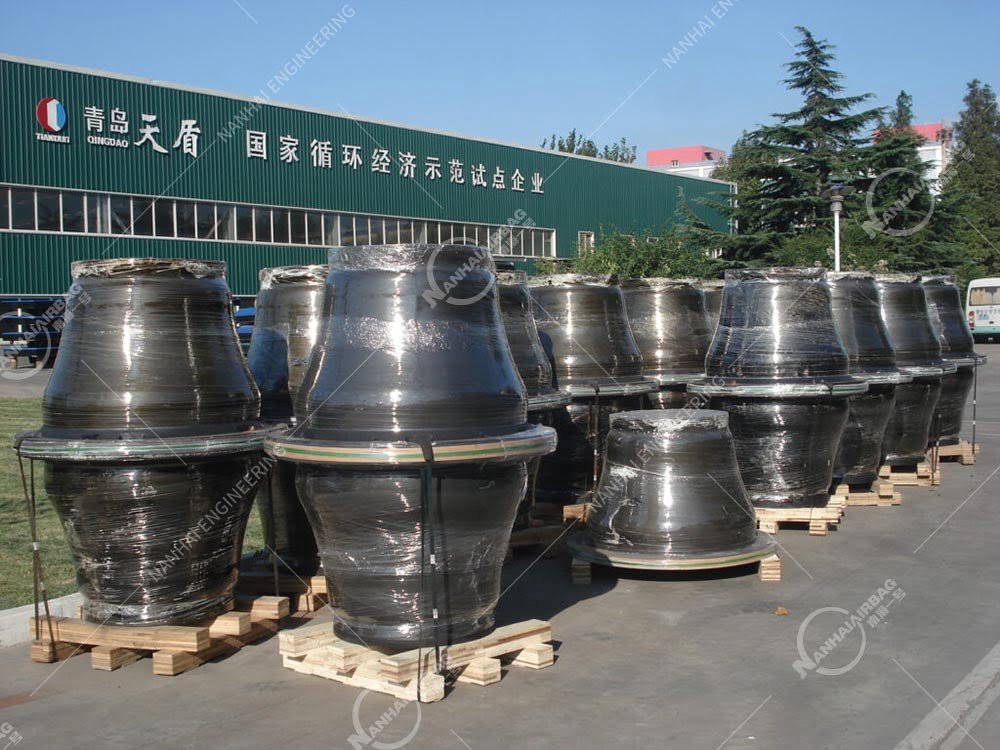
A Super Cone Rubber Fender is a solid, single-piece conical marine fender that absorbs berthing energy through controlled rubber compression. It is the upgraded successor to the cell fender, offering higher energy absorption, lower reaction force, up to 70% rated deflection, and stable performance under angled berthing and shear loads. Super Cone fenders are the preferred fixed-berth choice for container terminals, tanker and LNG jetties, RoRo/cruise berths, bulk terminals, dolphins, and monopiles.
If you are specifying fixed marine fenders, the Super Cone is often the sweet spot between performance and quay cost. Keep reading to see why ports replace cell fenders with cones, where cones fail if mis-specified, and how to avoid confusing them with pneumatic fenders or marine airbags.
What Is a Super Cone Rubber Fender?
A Super Cone Rubber Fender is a truncated-cone solid rubber buffer anchored to a quay, dolphin, or pile structure. The wide circular base spreads load into the structure; the conical body compresses axially while resisting shear and angular loading.
It is the third-generation evolution of the cell fender family. Instead of the cylindrical honeycomb cell, the cone shape gives:
- Longer compression stroke
- Flatter reaction-force curve
- Better energy-to-reaction ratio (E/R)
- More stable behavior when the hull hits off-square
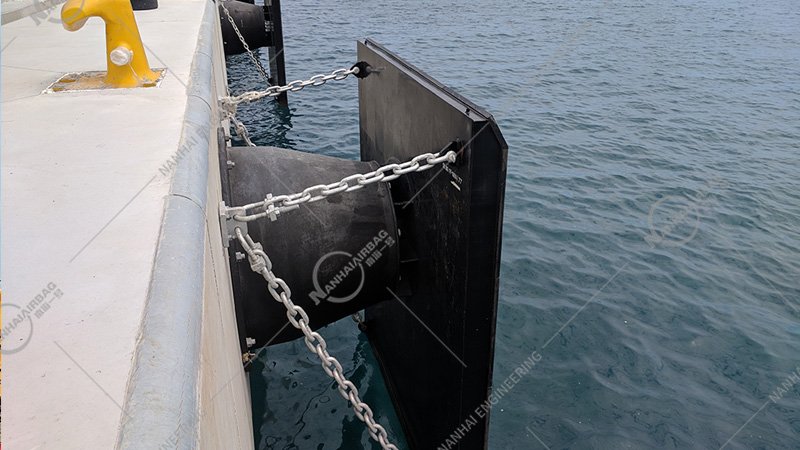
All Cone Fenders are typically single-piece mouldings, so they are robust, long lasting, and easier to install than multi-part systems. In service, they are almost always used with a frontal frame: a steel panel plus a UHMW-PE facing pad.
How a Super Cone Fender Works
Berthing energy is kinetic energy from the moving vessel. The fender’s job is to eat that energy without pushing destructive reaction force back into the hull or the wharf.
Step by step:
- Hull contacts the frontal panel. The rubber body never touches the ship directly in a proper cone system.
- UMHW-PE pad reduces friction. The hull slides instead of scraping, lowering shear load on the fender.
- Cone compresses axially. Rated deflection is commonly 70%, with maximum around 72%.
- Stress distributes through the cone. The conical geometry avoids the sharp base stress concentration seen in older cell designs.
- Energy is absorbed, reaction stays controlled. The force-deflection curve is relatively flat, so energy rises faster than reaction force.
- Fender rebounds. The rubber recovers, ready for the next berth.
That flat curve is the whole selling point. You get more cushioning per unit of push-back.
Why Engineers Specify Super Cone Fenders
Here is where the advantages become real. Each one below maps to a berthing problem you can picture on a busy quay.
1. High Energy Absorption, Low Reaction Force
The metric that matters is E/R—energy absorbed divided by reaction force. A good Super Cone gives a high E/R ratio, meaning it protects the ship and the structure simultaneously.
Example: A medium-to-large container berth designed for Post-Panamax calls may be limited by the existing quay’s allowable reaction force. Swapping cell fenders for Super Cones can raise energy absorption while staying inside the same reaction envelope—so larger ships berth without rebuilding the wharf.
2. Angular Berthing Tolerance Up to ~10°–15°
Ships do not kiss the dock square. Wind, current, tug timing, and pilot error create skew.
Cone fenders keep stable energy absorption under angular compression far better than cell fenders. Published correction data show cone fenders hold performance reasonably well up to about 10°–15°, while cell fenders need larger correction factors and lose more capacity.
Example: An open-pile RoRo terminal with strong lateral current used to crush or rip cylindrical fenders. After switching to Super Cones with frontal panels and shear chains, angular approaches stopped causing fender collapse. The wide base and cone geometry self-center the load instead of rolling the fender out of its mount.
3. Shear Resistance From the Wide Flange
Lateral loads come from waves, current, mooring line snap, and hull creep along the face. The Super Cone’s large base flange gives good shear stability.
In high-current or high-wave sites, designers still add:
- Shear chains
- Tension chains
- Properly sized frontal frame
- Overload stops
But the cone body itself is far more stable than a D-fender or small cylindrical unit.
4. Smaller Footprint, Lower Quay Cost
Because cone fenders pack more energy absorption per height, you can sometimes use a smaller fender and smaller frontal panel than a cell system of equal capacity.
That translates into:
- Lower cantilever load on the quay
- Smaller steel panels
- Easier retrofit into tight berthing lines
- Less concrete reinforcement at the fender pocket
Example: A retrofit oil-products berth with limited front-face depth could not fit the next cell size up. A Super Cone of equivalent energy fit the line, kept hull pressure down with a UHMW-PE panel, and avoided widening the apron.
5. Frontal Panel = Lower Hull Pressure and Easier Maintenance
Most Super Cone systems are not bare rubber against steel. They use:
- Steel frontal panel
- UHMW-PE facing pad
- Galvanized or stainless anchor set
- Support and shear chains as needed
Benefits:
- Spread contact pressure across a wider patch
- Keep hull pressure low enough for large tankers and cruise hulls
- Let the panel pivot slightly under skew
- Allow bolt-off replacement of the cone without scrapping the panel
With a frontal frame, hull surface pressure can be managed to project limits, often cited around 25 t/m² for large-vessel layouts.
6. Long Service Life in Harsh Marine Environments
Super Cone fenders use marine-grade rubber compounds, commonly NR/SBR blends, with hardness around 60–65 Shore A for the best absorption/recoil balance. Anchors are hot-dip galvanized or stainless.
With correct specification and inspection, service life is commonly quoted at 15–20 years in demanding ports.
UV, seawater, ozone, and abrasion are handled by compound selection—not by hoping black rubber survives.
Super Cone vs. Super Cell: The Real Comparison
This is the decision most port engineers actually face.
| Feature | Super Cone | Super Cell |
|---|---|---|
| Geometry | Truncated cone, single piece | Cylindrical cell stack |
| Rated deflection | ~70% | ~52.5% |
| Max deflection | ~72% | ~55% |
| Energy absorption | Higher per height | Good, stiffer curve |
| Reaction force | Lower at same energy | Rises faster |
| Angular tolerance | Strong, ~10°–15° | Needs correction factors |
| Shear stability | Good with wide flange | Very good, thicker sidewalls |
| Footprint | Smaller for same energy | Larger |
| Best use | Angled, exposed, space-tight berths | Continuous wharves, hard support |
Choose Super Cone when berthing angles, tidal movement, limited quay reaction, or retrofit space matter.
Choose Super Cell when you have a continuous wharf, standard spacing, low angular risk, and want a proven stiff reaction profile.
Super Cone Fender vs. Pneumatic Fender vs. Marine Airbags
Searchers confuse these constantly. They are not interchangeable.
Super Cone Rubber Fender
- Fixed to structure
- Solid rubber compression
- No inflation, no daily pressure check
- Best for permanent berths and high-cycle terminals
- Low maintenance, high lifecycle stability
Pneumatic Rubber Fender (Yokohama Type)
- Floating, air-filled
- Tracks tide and swell
- Best for STS transfer, tidal ship-to-dock, temporary ops
- Needs pressure management and valve checks
- Low hull pressure, portable
Marine Airbags
- Inflatable cylindrical bags
- Used for ship launching, dry-dock moves, heavy load handling, salvage buoyancy
- Not a berthing fender
- Different safety factors and geometry
📌 Rule: Super Cone fenders protect the berth. Pneumatic fenders cushion floating operations. Marine airbags move the ship. You may use airbags during construction and cones after handover, but do not substitute one for the other.
Where Super Cone Fenders Are Used
Super Cone rubber fenders suit almost any fixed berth with serious energy:
- Container terminals and Post-Panamax berths
- Crude, product, chemical, and LNG tanker jetties
- RoRo and cruise terminals
- Bulk and general cargo wharves
- Dolphins and monopiles
- Offshore platform approaches
- Parallel-motion systems for high-angle berths
They are especially strong in exposed sites where the ship hits at an angle and the quay cannot accept high reaction.
Standard Sizes and Specification Range
Cone fenders are made in heights from about 300 mm to 2000 mm. Common series include SCN/CO 300H through 2000H.
Typical range, model-dependent:
- Height: 300–2000 mm
- Energy absorption: roughly 35 kJ to 2500+ kJ·m depending on model and rubber grade
- Reaction force: scales with grade; specify P0, P1, P2, or P01 grades
- Rated deflection: 70%
- Max deflection: 72%
- Rubber hardness: 60–65 Shore A typical
- Temperature: confirm compound; common marine compounds handle broad coastal ranges
Do not size from height alone. Size from berthing energy and allowable reaction.
How to Specify a Super Cone Fender Correctly
Use the PIANC berthing energy method:
E = 0.5 × Cm × Md × Vb² × Ce × Cs × Cc
Then match the fender’s rated energy at 70% deflection, not at maximum squash.
Spec checklist
- ✅ Vessel displacement and design berthing velocity
- ✅ Berthing angle and angular correction factor
- ✅ Allowable quay reaction force
- ✅ Allowable hull surface pressure
- ✅ Cone model, rubber grade, and deflection rating
- ✅ Frontal panel size and UHMW-PE pad thickness
- ✅ Anchor bolt grade, galvanizing, embedment depth
- ✅ Shear and tension chains for exposed sites
- ✅ Overload stops if over-compression is possible
- ✅ PIANC-based performance data and class certificates (BV, ABS, DNV, LR, CCS)
A compliant line might read:
Super Cone Rubber Fender, CO1000H, PIANC performance data, P1 high-reaction rubber grade, 70% rated deflection, with steel frontal panel 1800×1200 mm, UHMW-PE face pad, hot-dip galvanized anchor set, shear chains, and overload stops.
Installation Mistakes That Kill Cone Fender Performance
Even the best fender fails if the structure is wrong.
- No clearance for deflection. Leave space around the cone and behind the panel. Interference spikes reaction force.
- Undersized frontal panel. Raises hull pressure and creates edge loading.
- Wrong anchor embedment. The wide flange needs proper concrete reinforcement.
- No shear chain in current. The cone is stable, but extreme lateral load still needs restraint.
- Ignoring angular factor. Perpendicular test data is not real berthing data.
- Mixing pneumatic logic into a fixed system. Cones do not “float”; they are structural elements.
Maintenance: Low, But Not Zero
Super Cone fenders are low-maintenance compared with pneumatic units, but inspections protect your capital.
Every 3–6 months
- Check rubber for cracks, cutting, abrasion, and permanent set
- Inspect frontal panel for denting or misalignment
- Check UHMW-PE pad wear
- Inspect chains, shackles, and U-rings
- Verify anchor bolts for corrosion or loosening
Annually
- Review berthing energy vs. actual vessel mix
- Check panel alignment and clearance
- Document wear for lifecycle replacement planning
Replacement signal
- Deep cracking
- Permanent deformation after rebound
- Panel damage causing edge contact
- Loss of clearance or abnormal reaction complaints from operators
Well-specified cone systems commonly run 15–20 years before major renewal.
Frequently Asked Questions
What is a Super Cone Rubber Fender?
A Super Cone Rubber Fender is a solid conical dock fender anchored to a quay or dolphin. It absorbs ship berthing energy through rubber compression, offering high energy absorption, low reaction force, and stable performance under angled and shear loads.
What is the difference between a Super Cone and a Super Cell fender?
The Super Cone is the upgraded cell-type fender. It reaches about 70% rated deflection versus 52.5% for a cell fender, gives a better energy-to-reaction ratio, and performs better at berthing angles up to about 10°–15°. Super Cell is stiffer, simpler to fit legacy wharves, and very shear-stable.
Why use a cone fender instead of a pneumatic fender?
Use a cone fender for permanent fixed berths with high cycling. Use a pneumatic fender for floating operations, STS transfer, or tidal berths where the fender must move with the waterline. Cones are fixed infrastructure; pneumatics are portable and air-filled.
Are marine airbags the same as Super Cone fenders?
No. Marine airbags launch ships, move heavy loads, and provide salvage buoyancy. Super Cone fenders are fixed berthing buffers. Airbags are not a substitute for a dock fender system.
What deflection can a Super Cone fender take?
Rated deflection is commonly 70%, with maximum deflection around 72%. Do not compress beyond the manufacturer’s rated travel without overload stops and structural review.
How long do Super Cone Rubber Fenders last?
With correct specification and inspection, 15–20 years is typical in demanding port environments. Life depends on berthing energy, UV/ozone exposure, hull pressure, and anchor system care.
What size Super Cone fender do I need?
Calculate berthing energy with the PIANC formula, then match rated energy at 70% deflection. Also check reaction force against quay capacity and hull pressure against vessel limits. Height alone is not enough.
Do Super Cone fenders need a front panel?
In almost all serious applications, yes. The steel frontal panel spreads load, lowers hull pressure, and lets the fender pivot under skew. The UHMW-PE pad reduces friction and shear. Bare-cone direct contact is not recommended for large vessels.
Which ports use Super Cone fenders?
Container terminals, LNG and tanker jetties, RoRo/cruise berths, bulk terminals, dolphins, monopiles, and exposed open-sea wharves. Any fixed berth with large vessels and angled approaches is a candidate.
What certifications should I ask for?
Ask for PIANC-based performance data and relevant class or third-party verification such as BV, ABS, DNV, LR, or CCS, plus material test reports and dimensional inspection. Do not accept “Yokohama type” language—this is a solid rubber fender, not a pneumatic fender.
