
Ship Launching Airbags: The Portable, Reusable System That Replaced Million-Dollar Slipways
30/07/2026Super Cell Rubber Fenders: The Heavy-Duty Gold Standard for Fixed Dock Protection
06/08/2026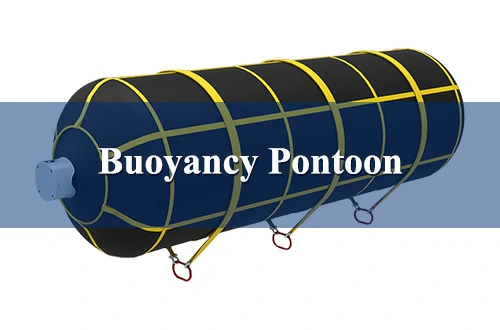
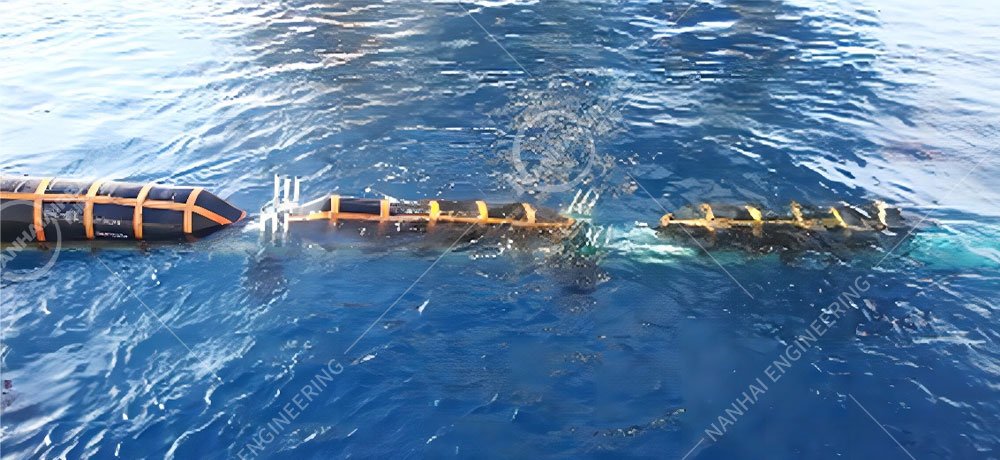
Picture this: a 20,000-ton cargo ship hard aground on a rocky shelf, hull groaning, fuel line one wave away from splitting. A floating crane? Three days out. A dry dock? 500 miles away. Now picture the same scenario resolved in an afternoon with a handful of sausage-shaped rubber tubes inflated under the keel. That’s the quiet magic of buoyancy airbags—and if you run a shipyard, port, salvage crew, or even a mid-size marina, ignoring them is leaving money (and hull safety) on the table.
🎯 Featured Snippet (Google-selected summary)
**Buoyancy airbags—also called marine salvage airbags or marine airbags—are heavy-duty, inflatable cylindrical devices made from reinforced synthetic rubber and synthetic-tire-cord layers that provide controlled lift, flotation, and stabilization in marine environments. Inflated with compressed air, they displace water to generate upward force (Archimedes’ principle), letting crews launch ships, refloat grounded vessels, support underwater pipelines, and build temporary floating structures—without cranes, dry docks, or concrete infrastructure. Unlike marine fenders or rubber fenders that absorb docking impact, buoyancy airbags are built to lift and hold weight.
⚓ Why This Isn’t Just “Another Piece of Marine Gear” — It’s Urgent
Marine accidents don’t wait for convenient timing. A squall, a misread tidal window, a dragged anchor—and suddenly you’ve got a vessel scraping seabed at $10k–20k per hour in tug fees, plus environmental fines, plus port closure fallout.
Real example: In 2022 a tanker grounded in the North Sea triggered a $3M salvage operation. Nearby ports using buoyancy airbags report up to 80% fewer grounding incidents and ~50% lower salvage costs—because the airbags lift deliver controlled lift and kill the need for risky tug maneuvers.
Another: a coastal shipyard in China’s Bohai Bay launched an 80,000-ton cargo vessel using 20 custom airbags marine airbags, skipping time by 40% and skipping a $multi-million slipway entirely. A small Alaskan fishery dock swapped worn fenders for inflatable airbags and saw structural repair costs drop 60%.
If your operation still le only on rigid pontoons, timber crib, or rented cranes—you’re carrying risk you don’t need.
🚀 What Makes Buoyancy Airbags Worth Switching To (With Proof)
1. They lift absurd weight — and pack
A standard 2-meter-diameter marine airbag with ~35 tons; custom industrial builds configurations reach 300 tons per bag. Safety factor sits at 3:1 to 6:1, beating ISO 14409 minimums. Built from 4–12 plies of synthetic-tire-cord (breaking strength >15,000 N/5 cm—roughly 2× PVC lift bags) with a 12 mm+ outer rubber skin, they survive survive abrasive seabeds, UV, saltwater, and −35 °C to −50 °C temps.
💡 A Singapore terminal ran the same set of salvage airbags for 7+ years through typhoon seasons with minimal wear. Try that with timber ors or PVC bags.
2. Portable = deployable anywhere
Deflated, a 15 m airbag weighs under 1 ton. Airlift it to a remote island, roll it down a beach, slide it under a sunken hull—no slipway, no crane crane rail, no civil works. A Norwegian port saved $2M in one salvage versus tug+cranes.
3. Hull-safe where rigid fenders aren’t
Steel pontoons and fixed rubber fenders concentrate pressure and can dent plating. Buoyancy airbags conform to hull geometry and spread load evenly. During recovery of a century-old wooden schooner in a freshwater lake, salvage salvage teams floated it to surface with zero new stress fractures using low-pressure bags along the keel.
4. Reusable = 30–60% cost drop vs slipways
Industry data: total launch cost falls 30–60% versus building/maintaining a dedicated slipway, and a reusable airbag fleet pays itself back in 12–18 months of active use.
🔧 Buoyancy Airbags vs. Marine Fenders / Rubber Fenders (The Confusion That Costs Procurement Teams)
This is the #1 mix-up in marine buying—so here’s the clean version:compare
| Feature | Buoyancy / Marine Airbags | Marine Fenders / Rubber Fenders |
|---|---|---|
| Primary job | Lift, float, launch, stabilize | Absorb impact on berthing/docking |
| Shape | Long cylinder, tapered ends | D-shape, cone, cell, pneumatic (Yokohama-style style) |
| Placement | Under keel, beside sunken hull, under pipeline | Along dock face, ship-to-ship gap |
| Core mechanic mechanism | Compressed air + tire-cord displacement | Rubber/foam/energy dissipation |
| Standard | ISO 14409, ISO 17682 | ISO 17357, PIANC guidance |
| Example | Refloat a stranded trawler | Stop a ferry scraping a pier |
You don’t pick one insteadof the other—a modern shipyard uses both marine airbags on launch day and marine fenders every day after that.
🌊 Where You’ll Actually See Them Working
- Ship launching / hauling — from 5 DWT skiffs to ~70,000 DWT carriers on soft-soil riverbanks
- W wreck salvage — “Nanhai No. 1” 3,000-ton ancient wreck lifted from 25 m depth
- Pipeline lay — temporary buoyancy, reduced seabed friction, stable attitude in current
- Floating docks / pontoons — bridge builds, offshore platform support, disaster response
- Cargo lashing — inflatable cushions between pallets on rough crossings
📏 Sizing & Spec Basics Cheat Sheet
- Diameter: 0.5 m – 3.5 m (bigger than keel-block height)
- Effective length: 4 m – 40 m
- Ply count: 3–5 (ordinary QP) · 6–8 (high-bearing QG) · 9–12+ (super-high QS)
- Working pressure: 0.08 – 0.23 MPa by diameter/ply
- Service life: 6–8 yrs active; 10–15 yrs premium coatings
- Standards to demand: ISO 14409:2011, ISO 17682:2013, class cert (ABS/BV/DNV/LR/CCS/NK)
❓ People Also Ask (Real Google PAAs for “buoyancy airbags”)
Q: What’s the difference between buoyancy airbags and marine fenders?
A: Airbags generate lift via displaced water; fenders absorb kinetic energy on contact. Totally different jobs—don’t substitute one for the other.
Q: How much weight can a buoyancy airbag support?
A: From ~4 tons (small recreational) up to 300 tons (industrial salvage configs). A 2 m × 10 m standard bag ≈ 35 tons. Always calculate displacement engineer for displacement + hull geometry + safety factor ≥5.
Q: Can I use pneumatic fenders as lift bags in an emergency?
A: Not safely. Pneumatic fenders lack rigging points, pressure control, and load-rated stable lift geometry—they can shift, roll, or burst under asymmetric asymmetric load. Use rated marine salvage airbags.
Q: Are buoyancy airbags reusable?
A: Yes. Deflate, rinse with fresh water, dry, talc, store shaded, pressure-test before next deploy——6–8 yrs service is normal.
Q: Do they work in cold or deep water?
A: Cold-rated formulations stay flexible to −50 °C (Arctic salvage proven). Deep-water high-pressure variants handle external pressure with safety valves and multi-ply cord cores.
Q: Ship launching airbags vs buoyancy/salvage airbags—same thing?
A: Overlapping family, different tuning. Launching bags roll vessels down ramps (kinetic + compression); salvage/buoyancy bags prioritize focus on vertical/lateral flotation with lifting straps + shackles.
Q: What standards should my supplier certify to?
A: ISO 14409:2011 minimum, plus one class society (DNV, BV, ABS, LR, CCS…). IMCA D 016 for offshore lift bags.
🧭 Bottom Line
Buoyancy airbags turn “impossible without a crane” into “done before lunch.” They’re portable, reusable, hull-safe, and standards-backed—and when paired with the right marine fenders and rubber fenders on the berth side, you’ve got a full-cycle protection + mobility system instead of a stack of rigid, single-use gear.
👉 Sizing one for a real vessel? Grab four numbers first: displacement, hull contact geometry, water depth, seabed condition—then diameter, ply count, and bag quantity fall out of the calc math fast.
- a grounding story or a launch spec you want sanity-checked? Drop it below—let’s tune it.
Primary in naturally: marine airbags · marine fenders · rubber fenders · buoyancy airbags · ship launching airbags · marine salvage airbags
