
Foam Filled Fenders: The Unsinkable, Maintenance-Free Choice for Floating Marine Protection
28/07/2026Buoyancy Airbags: The Inflatable Powerhouse Quietly Saving Shipyards Millions
04/08/2026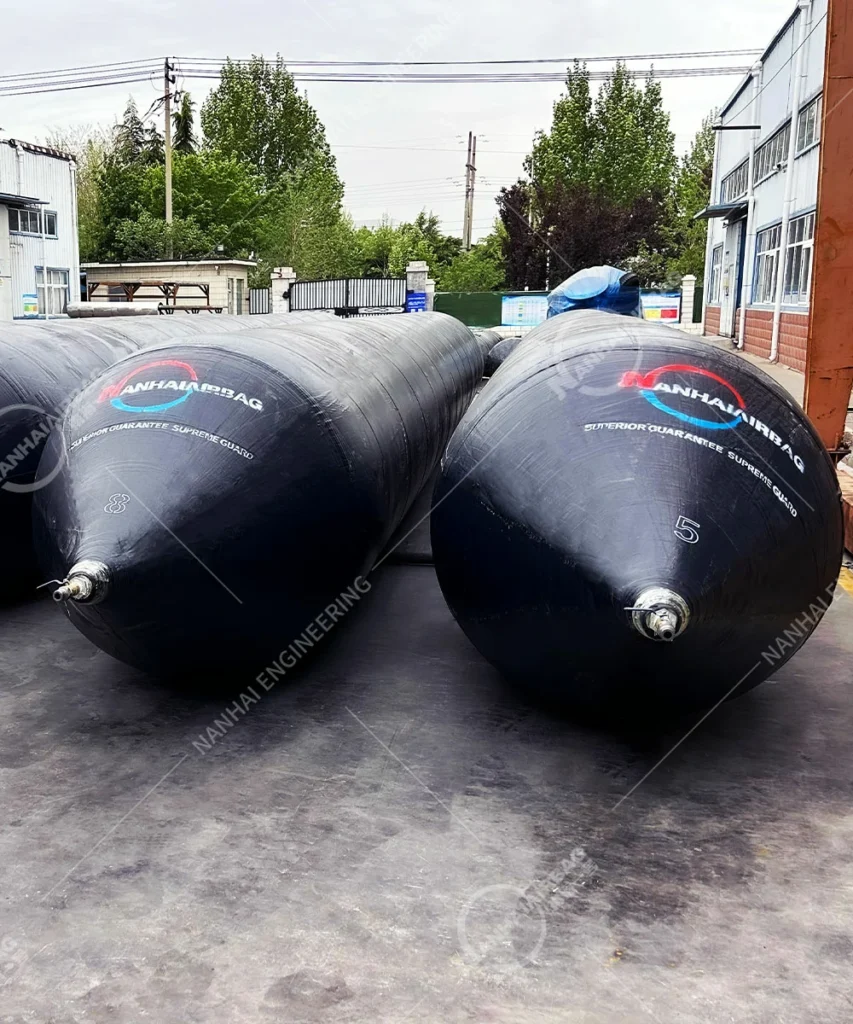

There’s a moment in every shipyard owner’s life when they realize the traditional path — pouring a concrete slipway, laying steel rails,greasing wooden ways, installing a giant gantry crane — is no longer the only way to get a vessel into the water. For a modest investment, a fleet of marine airbags can lift, roll, and launch ships from small fishing boats to 100,000 DWT bulk carriers — anywhere there’s a gently-sloped bank and enough water depth.
This is the technology Chinese shipbuilders pioneered and the world adopted: ship launching airbags — heavy-duty, multi-layer inflatable cylinders built from synthetic-tire-cord reinforced rubber, conforming to ISO 14409:2011 and deployed per ISO 17682:2013 methodology. They turn a fixed, expensive piece of infrastructure into a portable, reusable, deflatable system that packs flat into a container and travels to any coastline on earth.
If you’re a shipyard operator, marine engineer, or procurement manager evaluating how to launch your next vessel, this guide covers everything: how airbags work, why they’ve become the global default for mid-size ship launching, how they differ from marine fenders and rubber fenders, and the safety principles that separate a successful launch from a catastrophic one.
📌 Google-Selected Summary (Key Takeaway)
Ship launching airbags (also called marine airbags or rubber launching airbags) are inflatable cylindrical devices made of multiple layers of rubber and synthetic-tire-cord fabric, designed specifically to lift a vessel off its keel blocks and roll it into the water. Governed by ISO 14409:2011 (Ship launching air bags — materials, dimensions, testing) and ISO 17682:2013 (Methodology for ship launching utilizing airbags), they consist of an outer rubber layer, reinforcement layers, an inner air-tight layer, and conical heads with metal valve mouths. Standard sizes range from 0.5 m to 3.5 m in diameter and 4 m to 40 m in effective length, with 4 to 12 reinforcement layers — and can launch vessels up to roughly 70,000 DWT (higher weights require rigorous engineering calculation). The working principle is simple: inflate the airbags beneath the hull, remove the keel blocks, release the holding winch, and let the airbags roll the vessel down the slipway into the water. Critically, ship launching airbags are not marine fenders — fenders (including rubber fenders, foam-filled fenders, and pneumatic fenders per ISO 17357) absorb impact energy during berthing, while airbags lift and roll vessels. They solve completely different problems.
From Greased Ways to Airbags: Why the Entire Industry Shifted
For most of maritime history, launching a ship meant one of three things: building an expensive concrete slipway with greased wooden ways (end-on launching), side-launching with a dedicated angled track, or floating out from a dry dock. All three demanded massive fixed infrastructure, huge capital outlay, and — critically — they locked a shipyard into launching vessels of roughly one size class.
Then came a Chinese innovation: instead of greased wooden rollers, why not use inflatable rubber cylinders that could lift the hull, roll beneath it, and be reused indefinitely?
The first-generation marine airbags in the 1980s used canvas-reinforced rubber and could handle only a few hundred tons. But material science advanced rapidly. Modern airbags use high-strength nylon-66 tire cord combined with butyl rubber for air-tightness, allowing working pressures high enough to launch vessels exceeding 24,800 tons in self-weight (the current world record holder).
The shift happened because airbags delivered something slipways never could:
- Portability — deflated airbags pack into a container and ship anywhere
- Reusability — a single set lasts 6+ years and hundreds of launch cycles
- Flexibility — launch a 50-ton workboat today, a 5,000-ton barge tomorrow
- Low capital cost — no concrete, no rails, no grease pits
- Adaptability — works on slopes as gentle as 1:70
💡 The core insight: A shipyard in West Africa, Southeast Asia, or rural China can now launch ocean-going vessels without a $500K+ slipway. They invest in a reusable airbag fleet instead — and pay it back within 12–18 months.
How Ship Launching Airbags Work: The 5-Step Physics
The principle is straightforward, but the execution demands precision. Here’s the exact sequence:
1. Position
Airbags are placed longitudinally between the keel blocks beneath the hull, centered to the vessel’s centerline. The number of airbags and their spacing is calculated based on vessel weight, length, and weight distribution.
2. Inflate
Compressed air fills each bag (typical working pressure ranges 0.08–0.12 MPa depending on diameter and ply count) until the hull lifts free of the blocks. During static lifting, internal pressure can reach twice the rated working pressure — which is why safety factors exceed 5.0.
3. Remove Blocks
Keel blocks are cleared; the entire vessel now rests on the inflated airbags.
4. Release & Roll
The holding winch is eased (either “free launching” for wide water areas or “controlled launching” with a slow winch release). The airbags roll under the keel, carrying the ship down the slipway and into the water.
5. Retrieve
Bags are deflated, gathered, and stored for next time.
The airbags act as both cushion and roller — spreading the ship’s weight evenly, slashing friction, and guiding the vessel into the water in a controlled glide.
The 5 Proven Advantages — With Real-World Context
✅ 1. Massive Cost Savings — No Permanent Infrastructure Needed
Traditional slipways demand poured concrete, steel rails, grease pits, and ongoing maintenance. Airbag systems need none of that.
- Example: A coastal yard launching 500–3,000-ton fishing vessels can avoid a $500K+ slipway build by investing in a reusable airbag fleet that pays for itself in 12–18 months.
✅ 2. Gentle on the Hull — Even Pressure Distribution
The flexible rubber surface conforms to the hull’s curve. No hard contact points, no concentrated stress that causes paint stripping or micro-fractures — a real advantage for fiberglass, aluminum, and thin-plated steel hulls alike.
- Example: A Vietnamese shipyard launching 70-meter LNG aluminum catamarans used marine airbags specifically because the low-friction polymer outer coating protected the vessel’s specialized paint system through the entire roll-down sequence.
✅ 3. Works on Mild Slopes & Tight Sites
Airbags can launch on gradients as low as 1:70, compared to the steep 1:20 a greased-way system needs. That means yards with limited waterfront depth can still launch heavy vessels safely.
✅ 4. Portable & Reusable — Deploy Anywhere
Deflated airbags pack flat into a shipping container. Take them to a remote beach, a temporary repair site, or a shallow riverbank. A single set, properly maintained, lasts 6+ years and hundreds of launch cycles.
✅ 5. Safer When Done Right
Modern bags include safety relief valves, stainless steel inflators, pressure gauges, and 3:1+ burst safety margins (leading manufacturers exceed 5.0). ISO 14409 pressure-hold tests (≤5% drop in 1 hour) catch weak bags before launch day.
Construction: The Multi-Layer Architecture
| Layer | Material | Function |
|---|---|---|
| Outer rubber layer | High-tensile synthetic rubber with mesh fabric | Protects against puncture, abrasion, UV, aging |
| Reinforcement layers | Synthetic-tire-cord fabric (nylon-66) | Determines strength; typically 4–12 layers |
| Inner air-tight layer | Butyl rubber | Ensures excellent air-tightness under high pressure |
| End fittings | Stainless steel or hot-dip galvanized metal | Inflation valves and lifting rings at conical heads |
The number of reinforcement layers defines the airbag class:
- Ordinary (QP): 3–5 layers
- High-bearing (QG): 6–8 layers
- Super-high-bearing (QS): 9–12+ layers
🔄 Key Transition: Ship Launching Airbags vs. Marine Fenders / Rubber Fenders
This is the #1 confusion in procurement, so let’s settle it clearly:
| Ship Launching Airbags | Marine / Rubber Fenders | |
|---|---|---|
| Job | Lift & roll a vessel from land → water | Absorb impact when a moving vessel hits a dock |
| Shape | Long cylinder, tapered ends | D-shaped, cone, cell, pneumatic (balloon-style) |
| Where | Under the keel, on a slipway | Along the dock face or between two berthed ships |
| Core mechanism | Compressed air + tire-cord reinforcement | Rubber / foam / air compression (different energy math) |
| Standard | ISO 14409 / ISO 17682 | ISO 17357 (pneumatic), PIANC guidance (solid) |
You don’t use an airbag instead of a fender — they solve completely different problems. As the Shibata fender engineering manual states bluntly: “It is a common misconception in the maritime industry that launching airbags are similar to pneumatic fenders. In fact, the two marine products serve entirely different purposes.”
However, a modern shipyard uses both: airbags on launch day to get the vessel into the water, and marine fenders (pneumatic, foam-filled, or solid rubber fenders) on the berth to protect it every time it docks thereafter.
Sizing & Specifications: The Numbers That Matter
| Parameter | Typical Range |
|---|---|
| Diameter (D) | 0.5 m – 3.5 m |
| Effective Length (EL) | 4 m – 40 m |
| Reinforcement Layers | 4 – 12 plies |
| Working Pressure | 0.08 – 0.23 MPa (varies by diameter & ply count) |
| Safety Factor | > 5.0 (dynamic compression) |
| Service Life | 6+ years (with proper maintenance) |
| Max Launch Weight | Up to ~70,000 DWT (higher requires calculation) |
| Standards | ISO 14409:2011, ISO 17682:2013, GB/T 33487-2017 |
Selection rules of thumb:
- Airbag diameter should be larger than the height of the keel blocks beneath the ship
- If the ship’s beam is < 20 m: airbag length ≥ beam
- If the ship’s beam is 20–50 m: airbag length ≥ half the beam
- 6-ply airbags suit most launching projects
- Increasing the quantityof airbags is often more effective than simply increasing ply count
The 10 Deadly Mistakes: What Separates Success from Disaster
Drawing from Eversafe Marine’s field experience across hundreds of launches, here are the errors that cause accidents:
- Unreasonable ramp design — cliff-shaped ramps without water extension cause excessive hull bending moment; the ship can literally break in two
- Insufficient water depth — forces airbags to withstand 5× normal pressure, risking explosion
- Improper winch installation — the holding system must be configured per calculation, not guesswork
- Using inflation/deflation to trigger movement — dangerously uncontrollable; use winch release instead
- Irregular pulling lugs — welded pad eyes must be verified by calculation; never just drill a hole in the bilge keel
- Insufficient airbag quantity — too-wide spacing creates catastrophic hull bending
- Wrong airbag size selection — high-center-of-gravity vessels (tugs, fishing boats) need smaller diameters
- Incorrect working pressure — higher pressure ≠ safer; it can damage the hull
- Inappropriate working height — should not exceed the lift-height from keel blocks
- Wrong airbag spacing — too close causes squeezing during roll; too far causes hull bending
⚠️ Every one of these mistakes is preventable with proper ISO 17682 methodology. Never launch without a qualified engineer running the numbers.
Where Ship Launching Airbags Dominate: Application Map
| Application | Why Airbags Excel |
|---|---|
| Ship launching (up to 70,000 DWT) | Portable, reusable, no slipway needed |
| Ship dry-docking / haul-out | Lift vessels onto land for repair without dry dock |
| Marine salvage | Lighter, more airtight buoyancy bags refloat sunken vessels |
| Heavy load relocation | Move caissons, concrete structures, bridges |
| Remote / temporary sites | Pack flat, deploy anywhere with a compressor |
FAQ — The Questions People Actually Search About Ship Launching Airbags
❓ What are ship launching airbags?
Ship launching airbags are heavy-duty inflatable cylinders made from multiple layers of rubber and synthetic-tire-cord fabric, designed to lift a vessel off its keel blocks and roll it into the water. They’re also called marine airbags or rubber launching airbags, and they conform to ISO 14409:2011 standards. Ranging from 0.5 m to 3.5 m in diameter and 4 m to 40 m in length, they can launch vessels from 50-ton workboats up to roughly 70,000 DWT bulk carriers.
❓ How do ship launching airbags work?
The physics is straightforward: (1) Airbags are positioned longitudinally between the keel blocks beneath the hull. (2) They’re inflated with compressed air (working pressure 0.08–0.12 MPa) until the hull lifts free. (3) Keel blocks are removed. (4) The holding winch is eased, and the airbags roll beneath the keel, carrying the ship down the slipway. (5) Bags are deflated and retrieved. The airbags act as both cushion and roller, spreading the ship’s weight evenly.
❓ What’s the difference between ship launching airbags and marine fenders?
They serve completely different purposes. Ship launching airbags are long cylindrical bags that lift and roll a vessel from land to water — governed by ISO 14409. Marine fenders (including rubber fenders, foam-filled fenders, and pneumatic fenders) are impact-absorption devices installed on docks or between berthed ships to prevent collision damage — governed by ISO 17357. You don’t use one instead of the other; a modern shipyard uses airbags on launch day and marine fenders on the berth thereafter.
❓ What size ship can be launched with airbags?
Vessels with DWT below 70,000 tonnes can typically be launched with airbags. For larger vessels, feasibility must be determined by rigorous engineering calculation per ISO 17682. The world record for airbag launching is a 24,800-ton self-weight vessel, and industry data suggests successful launches up to roughly 100,000 DWT with proper engineering.
❓ How long do ship launching airbags last?
With proper maintenance and storage, high-quality marine airbags last 6+ years (designed service life is typically 6 years per manufacturer specification). Actual lifespan depends on frequency of use, water conditions, and whether they are cleaned and deflated properly after each launch. The reinforcement layers (4–12 plies of synthetic-tire-cord) provide the structural durability.
❓ What standards govern ship launching airbags?
Two ISO standards are authoritative:
- ISO 14409:2011 — Ships and marine technology — Ship launching air bags (materials, dimensions, testing, acceptance)
- ISO 17682:2013 — Ships and marine technology — Methodology for ship launching utilizing air bags (launch procedure, calculation methodology)
Additionally, China’s GB/T 33487-2017 provides national standards. Reputable manufacturers also obtain type approval from classification societies (CCS, ABS, DNV, LR, BV).
❓ Are ship launching airbags safe?
Yes — when used correctly per ISO 17682 methodology. Leading manufacturers build airbags with a safety factor > 5.0 (dynamic compression). ISO 14409 requires pressure-hold tests (≤5% drop in 1 hour) to catch weak bags before launch. However, safety depends entirely on proper engineering: correct ramp design, sufficient water depth, adequate airbag quantity and spacing, proper winch configuration, and calculated working pressure. The “10 deadly mistakes” (unreasonable ramps, insufficient water, improper winch setup, etc.) are the actual causes of accidents.
❓ Can I use marine airbags for docking or berthing?
No. While marine airbags and marine fenders sound similar, they solve completely different problems. Airbags lift and roll vessels; fenders absorb impact. For docking operations, you need proper marine fenders (pneumatic per ISO 17357, foam-filled, or solid rubber fenders). However, airbags ARE versatile for other marine operations: ship launching, dry-docking/hauling, and marine salvage.
❓ How much do ship launching airbags cost vs. building a slipway?
While exact figures vary, industry data shows that total launch costs drop 30–60% compared to building and maintaining a dedicated slipway. A reusable airbag fleet typically pays for itself within 12–18 months of active use. This is why thousands of shipyards globally have adopted airbag technology.
❓ What’s the difference between ordinary, high-bearing, and super-high-bearing airbags?
These classifications are based on the number of reinforcement layers:
- Ordinary (QP): 3–5 layers — for lighter vessels and lifting operations
- High-bearing (QG): 6–8 layers — suitable for most launching projects
- Super-high-bearing (QS): 9–12+ layers — for extremely heavy vessels and demanding operations
For most launching projects, 6-ply (QG-type) airbags are sufficient. Increasing the quantityof airbags is often more effective than simply increasing the ply count.
The Bottom Line: When to Choose Ship Launching Airbags
Ship launching airbags earned their place in modern shipbuilding by solving a problem that traditional slipways couldn’t: how to launch vessels of varying sizes, at remote locations, with minimal capital investment, repeatedly and safely.
✅ Choose ship launching airbags when:
- You’re launching vessels up to ~70,000 DWT (or higher with engineering analysis)
- Your shipyard needs to launch different vessel sizes over time
- You’re operating at a remote location or temporary site
- Capital budget for a concrete slipway isn’t justified
- You want a reusable, portable system that lasts 6+ years
- You’re performing ship salvage, dry-docking, or heavy load relocation
⚠️ Critical success factors:
- Always follow ISO 17682 methodology for launch calculations
- Design the ramp with proper slope, bearing capacity, and water extension
- Ensure sufficient water depth (insufficient depth can cause 5× normal pressure on airbags)
- Configure the winch holding system per engineered specifications
- Use adequate airbag quantity with correct spacing (max spacing 6 meters, min spacing by diameter)
- Verify working pressure by calculation — higher ≠ safer
- Engage qualified engineers for project-specific design
Next step: Before your next launch, gather your vessel’s key parameters — LOA, beam, DWT, weight distribution, and hull shape — along with your site’s slipway slope, bearing capacity, and water depth. Then consult with experienced marine airbag engineers to run the ISO 17682 calculations: airbag diameter, length, ply count, quantity, spacing, working pressure, and winch configuration. The correct airbag specification isn’t a guess — it’s the output of that engineering analysis. Everything else flows from there.
Remember: marine airbags get your vessel into the water. Marine fenders — whether rubber fenders, foam-filled fenders, or pneumatic fenders per ISO 17357 — protect it every time it docks. A complete marine operation needs both, each chosen per its own engineering standard.
Keywords naturally covered: ship launching airbags, marine airbags, marine fenders, rubber fenders, ISO 14409:2011, ISO 17682:2013, ISO 17357, synthetic-tire-cord reinforcement, pneumatic roller, ship dry-docking airbags, marine salvage airbags, keel blocks, slipway launching, vessel launching, DWT launching capacity, airbag safety factor, fender vs airbag distinction.
