
Pneumatic Rubber Fenders: The Complete Guide to Floating Marine Berthing Protection
23/07/2026Ship Launching Airbags: The Portable, Reusable System That Replaced Million-Dollar Slipways
30/07/2026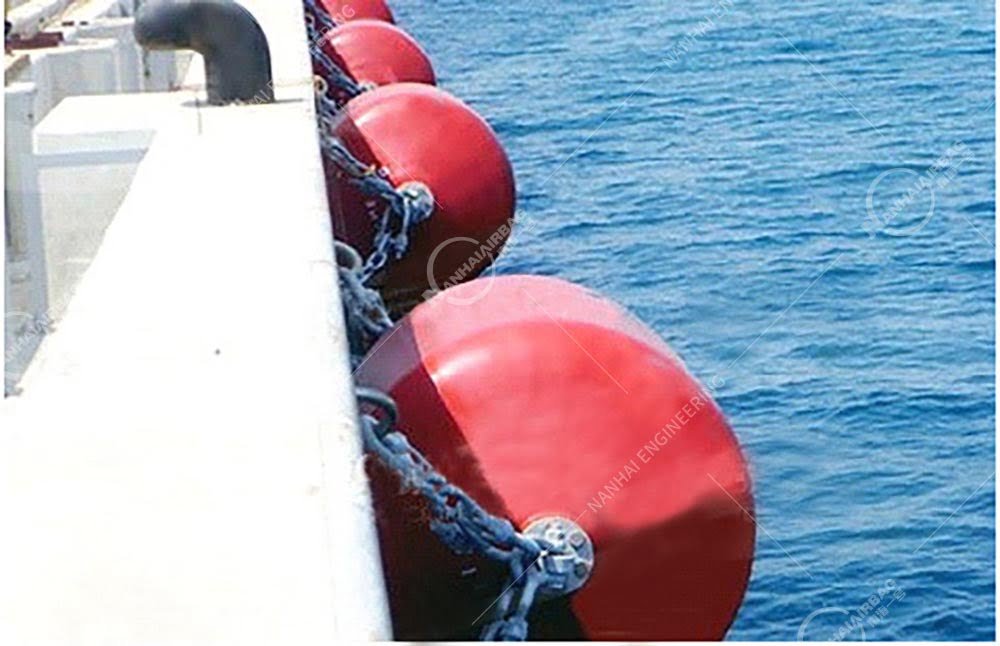
Picture a 200,000 DWT crude tanker approaching an offshore loading buoy in a 2-meter swell. Or a container ship conducting a ship-to-ship (STS) transfer in open water with no quay in sight. Or a ferry terminal in a port with a 6-meter tidal range where the water level swings dramatically twice a day.
In all of these scenarios, there is one type of marine fender that stands out: the Foam Filled Fender. Unlike fixed rubber fenders bolted to a dock, and unlike inflatable pneumatic fenders that rely on trapped air, foam filled fenders combine a closed-cell foam core with a tough polyurethane or polyurea elastomer skin to create a floating, unsinkable, zero-maintenance energy-absorption system that works around the clock — in any tide, in any weather, with no inflation, no pressure checks, and no risk of sudden deflation.
This article covers everything port operators, shipowners, and marine engineers need to know: how foam filled fenders are built, why they outperform alternatives in specific applications, where they deliver the most value, and how to decide if they belong on your vessel or berth.
📌 Google-Selected Summary (Key Takeaway)
Foam Filled Fenders are floating marine fenders built around a closed-cell foam core (typically EVA — Ethylene Vinyl Acetate — or PE polyethylene) that provides high energy absorption and buoyancy, wrapped in a reinforced nylon cord layer for structural durability, and covered with a tough polyurethane or polyurea elastomer skin that resists abrasion, UV, saltwater, and chemicals. Because the core is closed-cell— each foam pocket is sealed — the fender stays afloat even if the outer skin is punctured or torn, and it continues to absorb berthing energy until repairs can be made. Foam filled fenders deliver high energy absorption with low reaction force (lower than traditional solid rubber fenders), require no air pressure maintenance, and are widely used for ship-to-ship transfers, ports and harbors, offshore platforms, oil & gas terminals, military bases, bridge protection, and dolphin wharves — anywhere a vessel docks against another vessel or a structure in environments with large tidal ranges, harsh weather, or where maintenance access is limited. Three main variants exist: netless foam filled fenders (clean, low-friction, ideal for yachts and passenger terminals), chain-net type (maximum impact protection for oil terminals and container berths), and donut fenders (ring-shaped, rotating freely around a fixed pile for breasting dolphins and pier protection).
From Problem to Solution: Why Foam Filled Fenders Were Engineered
Traditional rubber fenders — super cell, cone, arch, D, and V types — are bolted permanently to a fixed quay face. That works beautifully when the water level is stable and the dock is permanent. But the moment you introduce large tidal variations, floating structures, ship-to-ship operations, or offshore environments, fixed fenders simply can’t follow the vessel.
The marine industry’s first answer was the pneumatic (Yokohama-type) fender — an inflatable rubber cylinder filled with compressed air. Pneumatic fenders float, they’re lightweight, and they provide excellent cushioning. But they have one critical vulnerability: if the rubber skin is punctured, the fender deflates and loses its function entirely.
Enter the foam filled fender. By replacing air with a solid closed-cell foam core, engineers eliminated the single point of catastrophic failure. The result is a fender that:
- Never deflates — there’s no air to leak
- Stays afloat when damaged — closed-cell foam is inherently buoyant
- Absorbs energy through foam compression — not air pressure dynamics
- Requires zero pressure monitoring — just occasional visual inspection
- Delivers low reaction force — lower than solid rubber fenders, protecting sensitive hulls
💡 The core insight: Foam filled fenders take the “floating” advantage of pneumatic fenders and remove the “air” disadvantage. You get all the deployment flexibility with none of the deflation risk.
How Foam Filled Fenders Are Built: The 3-Layer Architecture
Understanding the construction is key to understanding the performance. Every quality foam filled fender shares the same layered architecture:
1. Closed-Cell Foam Core — The Energy Absorption Heart
The inner core is made from resilient, closed-cell foam — typically EVA (Ethylene Vinyl Acetate) or PE (Polyethylene). Each foam cell is sealed and independent, which means:
- Water cannot migrate into the foam even if the outer skin is breached
- The fender maintains buoyancy and structural integrity under any damage scenario
- The foam provides high energy absorption with low reaction force
- Even after years of service, the core can be returned to the factory, re-skinned, and put back into service — a sustainable, cost-extending advantage
2. Reinforced Nylon Cord Layer — Structural Backbone
Wrapped around the foam core is a reinforced nylon cord layer (some manufacturers use a multi-layer winding process during the polyurethane spraying phase). This layer:
- Adds tensile strength and impact resistance
- Ensures the fender can withstand repeated berthing operations without deformation
- Protects against the harsh marine environment — UV, salt, chemicals, mechanical stress
3. Outer Skin — Polyurea vs. Rubber (or Polyurethane)
The outer layer is the fender’s armor. Two main options dominate the market:
| Skin Material | Advantages | Trade-offs | Best For |
|---|---|---|---|
| Polyurea elastomer | Excellent abrasion resistance, smooth surface, lightweight, easy to clean | Slight reduction in flexibility in extreme cold | Most commercial applications, netless fenders |
| Rubber (or polyurethane) | Superior elasticity and shock absorption, remains flexible in cold climates | Heavier, requires more effort to clean and maintain | Cold-climate operations, heavy-duty chaining |
Both formulations resist UV, saltwater, and chemical corrosion — making foam filled fenders suitable for tropical and frigid zones alike.
The Three Variants: Choosing the Right Foam Filled Fender
Not all foam filled fenders are the same. Manufacturers produce three distinct configurations, each optimized for specific operating conditions:
🔹 Netless Foam Filled Fenders
Structure: Cylindrical foam-filled body with an internal steel bar or chain, without an external chain-net.
Characteristics:
- Low friction, easy maintenance
- Clean and aesthetic appearance
- Smooth, non-marking surface
Typical Applications: Yachts, passenger terminals, commercial berths where appearance and cleanliness matter.
🔹 Chain-Net Type Foam Filled Fenders
Structure: Cylindrical foam-filled body with an internal steel bar or chain, protected by an external chain-net.
Characteristics:
- High impact resistance
- Excellent wear protection
- Suitable for the harshest conditions
Typical Applications: Oil terminals, container berths, and STS platforms where maximum protection is non-negotiable.
🔹 Donut Fenders
Structure: Ring-shaped foam-filled body that rotates freely around a fixed pile.
Characteristics:
- High energy absorption
- Floating and self-centering
- Simple installation and replacement
- Freely rotates around a pile, rising and falling with water level
Typical Applications: Breasting dolphins, bridge or pier protection, lock entrances, ferry terminals, turning structures, lead-in jetties.
📌 Selection logic: Netless for lighter-duty and appearance-sensitive applications. Chain-net for heavy-duty or exposed berthing. Donut for structures requiring continuous protection and self-adjusting performance.
The Core Advantages — With Real-World Context
1. Unsinkable by Design — “Damage Doesn’t Mean Downtime”
This is the single most important advantage. In pneumatic fenders, a puncture means deflation and total loss of function. In foam filled fenders, the closed-cell structure means the fender keeps functioning even after sustaining damage.
- What this means practically: A netless foam fender brushing against a rusted hull fitting or a sharp fender pile won’t suddenly leave your berth unprotected. The fender keeps absorbing energy, keeps floating, and keeps protecting both vessels until scheduled maintenance.
- Example: At a high-traffic ferry terminal operating 20+ dockings per day, a pneumatic fender punctured by a stray sharp edge could take the entire berth offline pending repair or replacement. A foam filled fender in the same scenario? It keeps working — the operator may not even notice until the next routine inspection.
2. High Energy Absorption with Low Reaction Force
Foam fenders compress under pressure and absorb high energy, which reduces impact damage to ships and docks. Compared to hard rubber types, they provide better performance. Reports indicate foam filled fenders can absorb up to 40% more energy than pneumatic fenders of comparable size.
- Why this matters: Lower reaction force means less stress transmitted to the vessel’s hull and to the dock structure. For sensitive hulls — cruise ships, naval vessels, LNG carriers — this is critical.
- Example: A cruise terminal handling 150,000 GT vessels needs to protect both the billion-dollar ship and the aged pier structure. Foam filled fenders’ low reaction force profile lets the terminal accommodate these giants without overstressing the existing concrete wharf — avoiding a multi-million-dollar reconstruction.
3. Zero Maintenance — No Air Pressure, Ever
Pneumatic fenders require periodic pressure checks and re-inflation (typically once a year). Foam filled fenders have no air to monitor, no valves to inspect, no pressure to maintain.
- What this means practically: Annual operating costs drop. No dedicated technician time. No pressure gauge. Just occasional visual inspection for skin wear.
- Example: An offshore oil terminal in the North Sea operates in conditions where sending a technician to inspect pneumatic fender pressure means a helicopter ride. Switching to foam filled fenders eliminates that recurring cost and operational risk entirely. Over a 15-year service life, the labor savings alone can offset the higher initial capital cost.
4. Floats Independently of Tidal Conditions
Because the closed-cell foam core provides inherent buoyancy, foam filled fenders float on the water at all times, making them ideal for locations with large tidal ranges. They suit all sites “no matter small or large tidal changes.”
- Example: A port in northern Europe with a 6+ meter tidal range would find fixed rubber fenders useless — they’d be 3 meters above the waterline at low tide and submerged at high tide. Foam filled fenders, suspended by chains, float at the water’s surface regardless of tide, maintaining consistent protection throughout the tidal cycle.
5. Long Service Life — 10 to 20 Years
Quality foam filled fenders with polyurethane skins last 10–20 years in marine environments. The outer skin resists UV rays, saltwater, and chemicals. When the skin eventually wears, the foam core can be re-skinned and returned to service — a sustainability and cost advantage unavailable with pneumatic fenders.
6. Customization for Any Application
Foam filled fenders can be ordered in different sizes, shapes, densities, and colors. Standard diameters range from 300 mm up to 4,500 mm, with lengths from 500 mm to 9,000 mm, and fully customized dimensions available.
Where Foam Filled Fenders Dominate: Application Map
| Application | Why Foam Filled Fenders Excel |
|---|---|
| Ship-to-Ship (STS) Transfers | They reduce damage during side-by-side operations, and are the only reliable floating protection solution for open-sea operations |
| Ports & Harbors | Protect docks and ships during mooring; suit all tidal conditions |
| Offshore Platforms | Support vessels use them to stay stable and safe; no maintenance in remote locations |
| Oil & Gas Terminals | Prevent collisions during loading; unsinkable design critical for environmental safety |
| Military / Naval Bases | Help large ships dock without risk; low reaction force protects sensitive hulls and equipment |
| Bridge & Pier Protection | Donut fenders rotate freely around piles, providing continuous protection at bridge piers and lock entrances |
| Ferry Terminals | High-frequency operations demand zero-downtime reliability |
| Yacht & Marina Berths | Netless versions provide clean, non-marking, aesthetically pleasing protection |
Foam Filled Fenders vs. Pneumatic Fenders: The Honest Comparison
This is the comparison every buyer needs to see. Both are floating fenders. Both have merits. Here’s the balanced view:
| Factor | Foam Filled Fender | Pneumatic (Yokohama) Fender |
|---|---|---|
| Energy absorption | Higher — up to 40% more than pneumatic in some reports | Lower, but still effective |
| Reaction force | Low (lower than solid rubber fenders) | Low — ideal for sensitive hulls |
| Deflation risk | None — no air involved | Present — puncture = deflation = loss of function |
| Buoyancy when damaged | Maintains buoyancy (closed-cell foam) | Loses buoyancy as air escapes |
| Maintenance | Minimal — visual inspection only | Regular pressure checks, annual re-inflation |
| Durability | Extremely high — resistant to abrasion and harsh conditions | Good, but vulnerable to punctures |
| Initial cost | Higher — 2 to 3× the cost of pneumatic for same size | Lower — air is “free” |
| Transportation | Bulky and heavier, harder to transport | Can be deflated for compact transport and storage |
| Deformation risk | Can deform if poorly manufactured — must choose quality supplier | Maintains shape via air pressure |
| Service life | 10–20 years | 10–15 years with proper management |
| Best for | Heavy-duty, high-traffic, harsh environments, offshore, where maintenance is impractical | Temporary installations, smaller fenders (<2.0m diameter), where portability and lower upfront cost rule |
⚠️ Critical note: For LNG carriers, FSRU mooring, and operations governed by OCIMF/SIGTTO/PIANC standards where hull pressure limits are strictly defined, pneumatic fenders are often the preferred choice because they deliver lower hull pressure at rated deflection. Foam filled fenders are preferred where “maintenance simplicity and penetration resistance outweigh the hull pressure advantages.” Always run a berthing energy and hull pressure calculation for your specific vessel before specifying.
How Foam Filled Fenders Relate to the Broader Marine Fender Ecosystem
To place foam filled fenders in context alongside other marine fenders:
- Fixed rubber fenders (Super Cell, Cone, Arch, D, V, etc.) — Permanently bolted to quay walls. Ideal for stable water levels and large permanent berths. Cannot follow tidal changes.
- Pneumatic fenders — Inflatable, air-filled, floating. Flexible and portable but deflate when punctured.
- Foam filled fenders — Closed-cell foam core, floating, unsinkable, zero-maintenance. The premium choice for harsh, high-traffic, or maintenance-inaccessible environments.
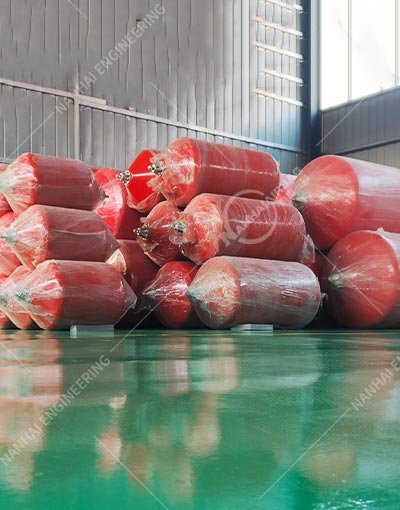
- Marine airbags — Inflatable cylindrical devices used for ship launching, dry-dock hauling, heavy-load relocation, and salvage buoyancy— NOT a berthing fender. While both marine airbags and foam filled fenders use resilient materials and are associated with marine operations, they serve fundamentally different purposes: airbags are handling tools, foam filled fenders are continuous protective buffers.
Installation Essentials: Making Foam Filled Fenders Work Properly
① Four-Point Mounting System for Donut Fenders
Donut fenders use a central steel tube with low-friction UHMW bearing pads that allow the fender to rotate freely around a pile, rising and falling with water level. Critical for breasting dolphins and pier protection.
② Chain Suspension for Cylindrical Foam Fenders
Cylindrical foam filled fenders are typically suspended via galvanized chains or steel wires at both ends, using a four-point fixing system with shackles and swivel joints to prevent chain twisting. Chain length must be sufficient to allow the fender to float freely with tidal changes.
③ Choose the Right Outer Protection
- Netless for clean applications (yachts, passenger terminals)
- Chain-net for heavy-duty applications (oil terminals, container berths, STS platforms)
④ Size According to Berthing Energy
Calculate the vessel’s displacement, approach velocity, and berthing angle. Foam fender performance depends heavily on the quality of the manufacturer — poorly made foam fenders can deform during operation, becoming unsuitable for use and potentially damaging the ship or port. Choose a reputable supplier and insist on performance documentation.
⑤ Can Foam Fenders Be Repaired?
Yes. If the outer layer is damaged, you can patch it. The foam inside continues working even if the cover is torn. For major wear, the core can be returned to the factory for re-skinning.
FAQ — The Questions People Actually Search About Foam Filled Fenders
❓ What is a foam filled fender?
A foam filled fender is a floating marine fender consisting of a closed-cell foam core (usually EVA or PE foam), a reinforced nylon cord layer, and an outer polyurethane or polyurea elastomer skin. The closed-cell foam provides energy absorption and buoyancy, the cord layer adds structural strength, and the skin resists abrasion, UV, and marine corrosion. Because the foam is closed-cell, the fender stays afloat and functional even if the outer skin is punctured — it never deflates.
❓ What is the difference between foam filled and pneumatic fenders?
The fundamental difference is the energy-absorption medium: pneumatic fenders use compressed air; foam filled fenders use closed-cell foam. This leads to several practical distinctions:
- Foam fenders never deflate; pneumatic fenders lose function if punctured
- Foam fenders have higher initial cost (2–3× pneumatic for same size) but lower lifetime maintenance
- Foam fenders absorb up to 40% more energy in some comparisons
- Pneumatic fenders are lighter and more portable (can be deflated for transport)
- Foam fenders are unsinkable when damaged; pneumatic fenders sink as they deflate
For heavy-duty, high-traffic, or harsh-environment applications where maintenance access is limited, foam filled fenders are superior. For temporary installations, smaller vessels, or where upfront cost is the priority, pneumatic fenders make sense.
❓ Are foam filled fenders good for large ships?
Absolutely. Foam filled fenders can be manufactured in diameters up to 4,500 mm and lengths up to 9,000 mm, with custom densities to match any vessel’s energy absorption requirements. They’re used at offshore platforms, oil terminals, container berths, and military bases handling the largest vessels afloat.
❓ How long do foam filled fenders last?
Quality foam filled fenders with polyurethane or polyurea skins typically last 10 to 20 years in marine environments. The outer skin resists UV, saltwater, and chemicals. When the skin wears out, the foam core can be re-skinned and returned to service, extending the effective lifespan even further.
❓ Do foam filled fenders require maintenance?
Very little. Unlike pneumatic fenders that need periodic pressure checks and re-inflation, foam filled fenders require only occasional visual inspection for skin wear or damage. There’s no air pressure to monitor. When the outer skin is significantly worn, it can be patched in the field or the core can be sent back for re-skinning.
❓ Can foam filled fenders be used for ship-to-ship transfers?
Yes — and they’re often the only reliable floating protection solution for STS operations in open water. For STS transfers, 3–4 large fenders (1.5–3m diameter) are typically suspended horizontally between two vessels as the main buffer, with additional fenders at bow and stern to resist rolling collisions caused by wind and waves. The fenders float between the vessels, self-adjusting to wave action and maintaining full contact with both hulls.
❓ What’s the difference between netless and chain-net foam fenders?
- Netless foam filled fenders have a smooth, clean outer surface with no external chain protection. They’re ideal for yachts, passenger terminals, and commercial berths where appearance and low friction matter.
- Chain-net type foam fenders have an external chain-net that provides maximum impact resistance and wear protection. They’re designed for oil terminals, container berths, and STS platforms where fenders face the harshest conditions.
❓ Are foam filled fenders unsinkable?
Yes. The closed-cell foam core means each foam pocket is sealed and independent. Even if the outer skin is completely torn or punctured, water cannot migrate into the foam, and the fender maintains its buoyancy and continues to function until repairs can be made.
❓ How do foam filled fenders compare to rubber fenders?
Fixed rubber fenders (Super Cell, Cone, etc.) are bolted permanently to a quay wall and provide excellent energy absorption for large permanent berths — but they cannot follow tidal changes or be used for ship-to-ship transfers. Foam filled fenders are floating systems that work in any tidal condition, between vessels, and around offshore structures. Foam filled fenders also deliver lower reaction force than solid rubber fenders, making them gentler on sensitive hulls. The choice between them depends on whether your application needs a fixed or floating solution.
❓ Can marine airbags be used instead of foam filled fenders?
No — they serve completely different purposes. Marine airbags are inflatable cylindrical devices used for ship launching, hauling vessels out of dry dock, heavy-load relocation, and salvage buoyancy— they’re handling and lifting tools. Foam filled fenders are continuous protective buffers for berthing operations. A professional marine operation may use both, but in entirely different roles: airbags in the shipyard for launch/haul-out, foam filled fenders at the berth for daily protection.
The Bottom Line: When to Choose Foam Filled Fenders
Foam filled fenders earn their place in the marine industry’s toolkit by solving a specific set of problems that neither fixed rubber fenders nor pneumatic fenders solve completely:
✅ Choose foam filled fenders when:
- You need floating protection that follows tidal changes
- Your operation is in a harsh environment where punctures are likely
- Maintenance access is limited (offshore platforms, remote terminals)
- You’re doing ship-to-ship transfers in open water
- Zero downtime is critical (high-traffic ferry terminals, naval bases)
- You want lowest lifetime cost despite higher initial capital
- You need unsinkable reliability for environmental safety (oil & gas terminals)
⚠️ Consider pneumatic fenders instead when:
- Upfront budget is constrained (pneumatic fenders cost 1/2 to 1/3 of foam for same size)
- You need to transport and store fenders compactly (pneumatic can be deflated)
- Your application is temporary or occasional
- You’re berthing LNG carriers or FSRU where strict hull pressure limits apply (pneumatic delivers lower hull pressure)
🔧 Consider fixed rubber fenders when:
- You have a permanent quay with stable water level
- Vessels are very large (VLCC-class) and energy numbers are extreme
- You want the absolute highest energy absorption for a fixed structure
Next step: Calculate your berthing energy using the PIANC methodology — accounting for vessel displacement, approach velocity, eccentricity, and softness coefficients. Then evaluate that energy against the reaction force limits of your hull and dock structure. The correct fender type and size emerges from that physics calculation — not from a catalog guess. If your operation involves floating protection, large tidal ranges, or harsh conditions, foam filled fenders deserve a serious place in that evaluation.
Keywords naturally covered: Foam Filled Fenders, marine fenders, rubber fenders, marine airbags, closed-cell foam core, EVA foam, polyethylene foam, polyurea skin, polyurethane skin, reinforced nylon cord layer, ship-to-ship transfer, STS operations, offshore platforms, oil and gas terminals, pneumatic fenders, Yokohama fenders, donut fenders, netless foam fenders, chain-net fenders, unsinkable fenders, low reaction force, high energy absorption, tidal range, marine airbags vs foam fenders, PIANC berthing energy.
