
Super Cone Rubber Fenders: The Ultimate Guide for Marine Berthing Protection
21/07/2026Foam Filled Fenders: The Unsinkable, Maintenance-Free Choice for Floating Marine Protection
28/07/2026
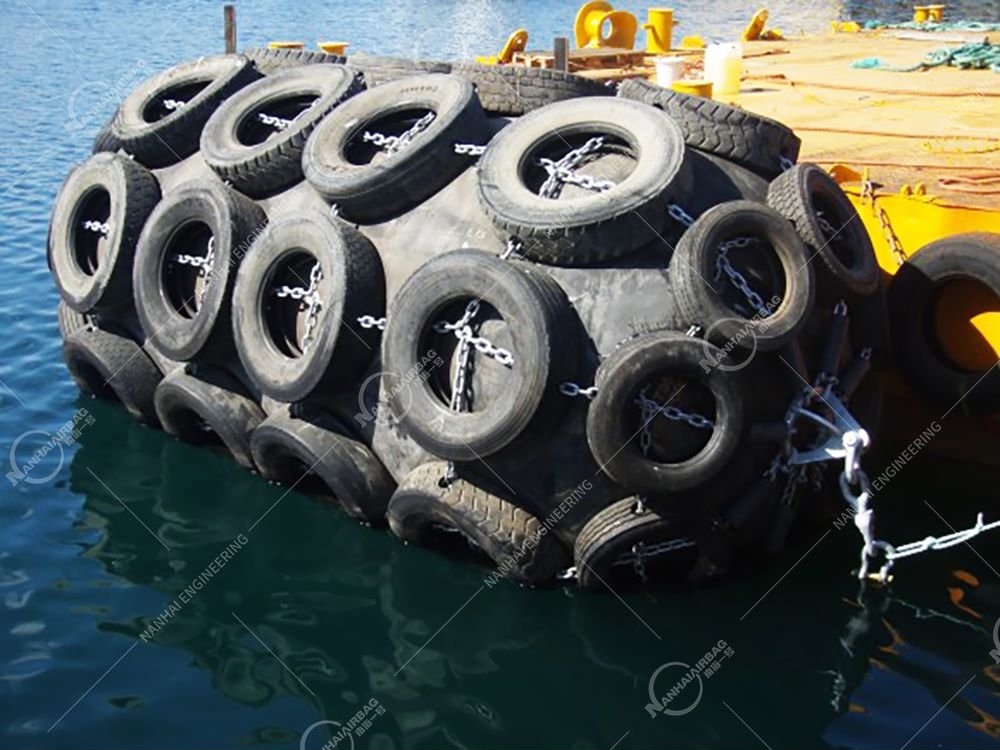
Pneumatic Rubber Fenders — also known as Yokohama-type fenders — are floating, air-filled cylindrical marine fenders that use compressed air as the energy-absorption medium. Complying with ISO 17357-1:2014, they deliver massive energy absorption with ultra-low hull pressure (as low as 50–80 kPa initial inflation), making them the #1 choice for ship-to-ship (STS) transfer, offshore platform berthing, and any scenario where fixed rubber fenders can’t go.
If you’ve ever seen two supertankers side-by-side transferring cargo in open water — no dock in sight — you’ve already witnessed the magic of pneumatic rubber fenders in action. Unlike the Super Cone Rubber Fenders we covered earlier (which bolt permanently to a quay), these fenders float. They ride the tide, they move with the swell, and they cushion collisions where there is no concrete wall to bolt anything to.
But here’s what most buyers get wrong: pneumatic fenders aren’t just “inflatable bumpers.” The engineering inside — synthetic-tyre-cord reinforcement, dual-layer rubber architecture, and precisely tuned internal air pressure — is what separates a ISO 17357-compliant fender from a glorified airbag.
Let’s unpack it.
How Pneumatic Rubber Fenders Work
At its core, a pneumatic fender is a cylindrical body with hemispherical heads at both ends, made of:
- Outer rubber layer — protects against abrasion, UV, seawater, and impact
- Synthetic-tyre-cord reinforced layer — the “skeleton,” arranged at engineered angles to hold internal pressure and spread stress (same tech used in truck tires)
- Inner rubber layer — seals the compressed air inside
- Steel flange + air/safety valve — for inflation and over-pressure release (fenders ≥Ø2500 mm must carry a safety valve per ISO 17357)
Compress air into that sandwich, and you get a fender that floats on the water surface and deflects up to 60% of its diameter under load — all while keeping reaction force soft on the ship’s hull.
💡 Key stat: A Ø3.3 m × L6.5 m P80 pneumatic fender absorbs ~30,150 kN·m of energy at 60% deflection (ISO 17357 GEA). That’s enough for VLCC-to-VLCC side-by-side transfer.
Why Ports and Ship Operators Choose Pneumatic Over Other Rubber Fenders
You might be wondering: “If Super Cone fenders are so good, why bother with pneumatics?”
Great question. They serve different jobs. Here’s where pneumatics win:
1. Ship-to-Ship (STS) Operations — No Fixed Dock Needed
This is the killer app. When two vessels berth alongside each other at sea — oil transfer, bunker barges, offshore wind crew transfer — there’s no jetty. Only a floating fender can bridge that gap.
Real example: In the South China Sea, LNG carriers routinely pair up with terminal platforms during monsoon-season offloads. Pneumatic fenders ride the 2–3 m tidal swing without losing contact — something a fixed marine fender like a cell or cone simply can’t do.
2. Low Hull Pressure = Fragile Hulls Stay Safe
Because energy is absorbed by compressing air (not just rubber), hull surface pressure stays remarkably low — typically 50–195 kPa depending on size and P50/P80 rating. That’s why you’ll see pneumatic fenders on:
- LNG carriers (thin membrane hulls)
- Aluminum-hulled fast ferries
- Yachts and patrol craft
3. Adapts to Tide and Vessel Roll
Pneumatic fenders float, so as the tide rises/drops or the vessel lists, the fender stays in the contact zone. No “gapping” like you get with poorly placed fixed fenders.
4. Easier to Deploy, Relocate, and Store
No civil works. No bolts into concrete. Net-type or sling-type units can be craned onto a tug, deployed at a temporary wharf, then rolled up and stored ashore. Perfect for:
- Emergency berthing after storm damage
- Temporary cruise ship terminals
- Military rapid-deployment docks
5. Shear and Angular Tolerance
The tyre-cord reinforcement makes pneumatic fenders surprisingly tough against shear (vessels sliding past each other) and inclined berthing angles — a common pain point in open-water STS.
P50 vs. P80: Which Initial Pressure Do You Need?
One of the first specs a buyer faces:
| Rating | Initial Internal Pressure | Energy Absorption | Reaction Force | When to Choose |
|---|---|---|---|---|
| Pneumatic 50 (P50) | 50 kPa | Baseline (ISO GEA) | Lower | Standard STS, general-purpose, lower reaction preferred |
| Pneumatic 80 (P80) | 80 kPa | ~20–30% higher than P50 | Higher | Heavy-duty berthing, larger tonnage, when space limits fender count |
⚠️ Rule of thumb: If hull pressure is your constraint (LNG, aluminum, yacht), go P50. If you’re tight on fender quantity and need max absorption per unit, go P80 — but check that your hull/dock can take the extra reaction force.
Pneumatic Rubber Fenders vs. Other Options
| Type | Fixed or Floating | Best For | Watch Out For |
|---|---|---|---|
| Pneumatic Rubber Fender | Floating | STS, offshore platforms, temporary berths | Needs air maintenance, chain/tyre net wear |
| Super Cone Rubber Fender | Fixed | Permanent high-traffic docks, container terminals | Can’t handle STS or big tidal swing |
| Cell Fender | Fixed | VLCC docks, high energy | Poor angular performance |
| Foam-Filled Fender | Floating | STS, no blow-out risk | Less energy/absorb per size vs. pneumatic |
| Marine Airbags | Floating (temporary) | Ship launching, salvage, heavy lifting | NOT for berthing — no certified energy rating |
📌 Common confusion: Buyers sometimes search “marine airbags vs pneumatic fenders” thinking they’re interchangeable. They’re not. Marine airbags are for launching a newly built ship down the slipway or salvaging a grounded vessel — pure buoyancy + rolling. Pneumatic rubber fenders are certified berthing devices with ISO 17357 performance tables. Different tool, different job.
Typical Sizes (ISO 17357 Reference)
Pneumatic fenders are sized by Diameter × Length. Common stock sizes:
- Ø500 × L1000 mm → Ø3300 × L6500 mm (and custom longer units up to L12000)
- Smallest (Ø500) suits workboats, yachts
- Mid-range (Ø2000–2500) is the STS sweet spot
- Large (Ø3300+) for VLCC/ULCC side-by-side
All standard sizes are available in Net Type (chain + tyre net protection) or Sling Type (heavy-duty nylon slings, no chain scuffing on hull).
💬 People Also Ask (PAA)
Q: What does “ISO 17357-1:2014 compliant” actually mean?
A: ISO 17357-1:2014 is the international standard that defines material, dimensions, performance (GEA — Guaranteed Energy Absorption), and testing for floating pneumatic rubber fenders. It replaced the older 2002 version with tighter design/certification rules. If a supplier can’t show a third-party (BV, ABS, CCS, LR) cert against ISO 17357-1:2014, walk away.
Q: How long do pneumatic rubber fenders last?
A: Properly maintained units typically run 10–20 years. Key factors: keep internal pressure within ±5% of rated, rinse after heavy fouling, store deflated + shaded when not in use, and inspect the tyre-net/chains for corrosion.
Q: P50 or P80 — which should I specify?
A: P50 for lower hull pressure (LNG, aluminum, sensitive coatings); P80 when you need more absorption from fewer fenders and the hull/dock can take the higher reaction force. Your naval architect should run the berthing energy calc to confirm.
Q: Net type or sling type?
A: Net type (chain + aircraft tyre) is the workhorse for heavy STS — extremely durable, but tyres can scuff delicate hull paint. Sling type uses heavy nylon straps — gentler on hull coating, preferred for yachts, navy, LNG where surface finish matters.
Q: Can pneumatic fenders be used on a fixed dock instead of cone fenders?
A: They can, but usually shouldn’t if the berth is permanent and high-traffic. Pneumatics cost more to maintain (air checks, net wear) and can drift if not properly tensioned. Fixed docks typically do better with Super Cone or cell fenders, reserving pneumatics for the floating dock, STS, or tidal-extreme cases.
Q: Are pneumatic fenders the same as marine airbags?
A: No. Marine airbags are for ship launching and heavy lifting (no ISO energy-absorption standard). Pneumatic fenders are certified berthing devices with documented GEA/Reaction/Hull Pressure numbers per ISO 17357. Don’t substitute one for the other.
Quick Buyer Checklist
If you’re specifying pneumatic rubber fenders for a project, tick these off:
- ✅ ISO 17357-1:2014 compliance (with third-party cert: BV/ABS/CCS/LR)
- ✅ P50 or P80 selected based on hull pressure budget
- ✅ Net type vs. sling type decided by hull coating sensitivity
- ✅ Safety valve included (mandatory ≥Ø2500 mm)
- ✅ Chain/net hot-dip galvanized or stainless for corrosion resistance
- ✅ Spare air valve + pressure gauge in the package
Bottom Line
Among all marine fenders, pneumatic rubber fenders occupy a unique lane: they’re the only ones that truly float and breathe with the sea. If your operation involves ship-to-ship transfer, offshore platforms, or tidal ranges that make fixed fenders impractical, pneumatics aren’t just “nice to have” — they’re the only sane choice.
And if you’re building out a full marine protection plan? You’ll probably end up mixing them: pneumatic fenders for the floating/STS side, Super Cone rubber fenders for the permanent quay, and yes — marine airbags for the day you actually launch the thing.
Specifying fenders for a STS project and stuck between P50 and P80? Drop your vessel DWT and typical sea state — happy to talk through the numbers.
