
Buoyancy Airbags: The Inflatable Powerhouse Quietly Saving Shipyards Millions
04/08/2026D Rubber Fenders: The Unsung Heroes of Every Dock
11/08/2026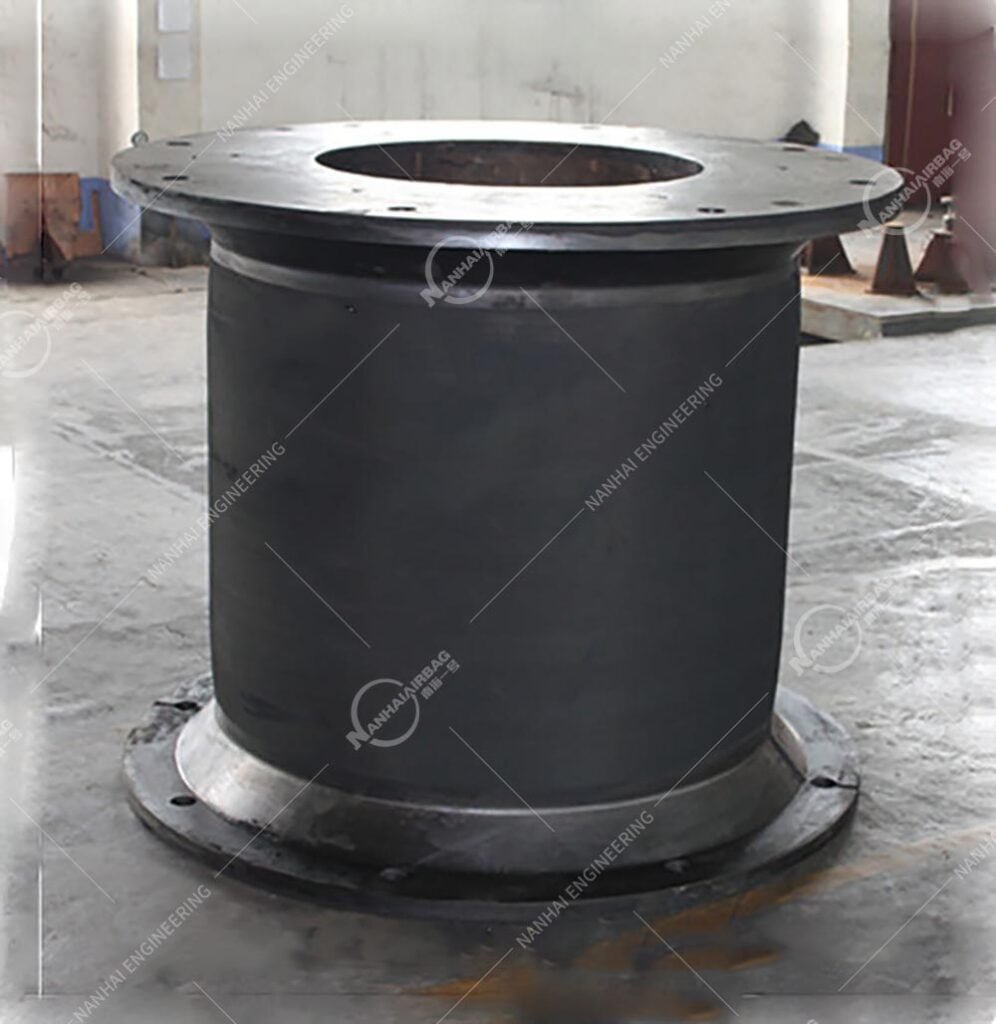

If you’ve ever stood on a quay wall watching a 180,000-DWT oil tanker ease into a berth — and walked away without a cracked concrete face or a dented hull — you’ve seen Super Cell Rubber Fenders doing their job. Alongside Super Cone Rubber Fenders and pneumatic rubber fenders, they form part of the elite tier of marine fenders that modern ports depend on.
But what exactly makes a Super Cell “super”? And how does it fit into a complete marine fenders strategy that might also include marine airbags for ship launching? Let’s dig in.
What Is a Super Cell Rubber Fender?
A Super Cell Rubber Fender is a fixed, compression-type rubber fender with a distinctive hollow cylindrical body. The “cell” refers to the central void; under impact, the rubber column buckles radially, dissipating berthing energy evenly in all directions.
The Super Cell is a structural refinement of the classic cell fender. The upgrade lies in:
- Smoother radius transition between the rubber body and the steel mounting flange
- Higher safe deflection: 52.5% (vs. 47.5% on older cells)
- ~15% higher energy absorption at the same reaction force
- Identical bolt-hole pattern to legacy cell fenders — meaning direct retrofit with no concrete re-drilling
The fender bolts permanently to a dock, wharf, or dolphin, and is almost always paired with a steel frontal panel and UHMW-PE face pads that spread the load and slash friction during angular berthing .
🔑 Why Ports Choose Super Cell Fenders — With Real-World Context
1. High Energy Absorption, Low Reaction Force
The headline metric for any marine fender is the E/R·H ratio (energy absorption ÷ reaction force ÷ height). Super Cell fenders push this to ~0.44, up from ~0.38 on standard cells — a ~15% efficiency gain .
Why it matters: Low reaction force means the concrete quay wall doesn’t need to be massively overbuilt. At a bulk terminal handling Cape-size carriers, that translates directly into lower civil engineering costs.
2. Frontal Panel + UHMW-PE = Ultra-Low Hull Pressure
Large LNG carriers and cruise ships have thin, sensitive hulls. A bare rubber fender would concentrate pressure into a small contact patch. The fix: a large steel frontal panel distributes the load, while UHMW-PE pads (bolted to the panel face) reduce the friction coefficient between ship and fender .
The result? Hull surface pressure can be held below 200 kN/m² — even below 25 t/m² on request for the most sensitive vessels . This makes Super Cell fenders especially suited for LNG berths and cruise terminals .
3. Excellent Angular & Shear Performance
Ships rarely hit a dock at a perfect 90°. The cylindrical geometry of Super Cell fenders handles off-axis approaches gracefully — energy absorption and reaction force stay predictable even at sharp berthing angles . Meanwhile, the wide circular base gives exceptional shear resistance, protecting both the fender and the quay from destructive side-loads .
Typical deployment: A multi-user commercial terminal might see everything from a 5,000-DWT feeder container ship to a 120,000-DWT bulk carrier on the same berth in a single week. Super Cell fenders are the go-to choice for exactly this kind of variable-load, high-traffic scenario .
4. Retrofit Without Rebuilding the Quay
Because the Super Cell shares the same bolt pattern as older cell fenders, port engineers can upgrade an existing berth to the modern profile without re-pouring concrete or re-drilling the embed plates . The old units unbolt; the new ones bolt in. That’s a massive cost and downtime saving on a busy quay.
5. Long Service Life, Minimal Maintenance
Built from high-grade natural rubber / SBR compounds with synthetic tyre-cord reinforcement, Super Cell fenders shrug off ozone, UV, seawater, and temperature extremes. Typical service life runs 10–15+ years before the rubber cell itself needs replacement — and even then, the embed plates stay put; only the fender unit is swapped .
Maintenance rhythm is refreshingly light :
- Visual inspection 1–2×/year for cuts, ozone cracking, abrasion
- Bolt torque check after initial settlement
- UHMW-PE pad replacement as a consumable — the rubber cell is undisturbed
- Full rubber cell replacement at end of life (embed plates reused)
Sizing & Standards
Super Cell fenders are available in a standardized range from SC400H (400 mm tall) up to SC3000H (3,000 mm tall), with maximum diameters spanning 650 mm to 3,350 mm . Representative performance at rated 52.5% deflection :
| Model | Reaction Force (RO) | Energy Absorption (RO) |
|---|---|---|
| SC400H | 51 kN | 8.8 kJ |
| SC800H | 211 kN | 74.5 kJ |
| SC1000H | ~275 kN | ~96 kJ |
| SC1600H | — | — |
| SC3000H | — | — |
(Exact figures vary by manufacturer and reaction-force class — RO/RL/RH/RS. Always request certified performance curves.)
Certifications to look for:
- PIANC 2002 / PIANC 2014 design guidelines
- ISO 17357-1:2014 when cross-referencing with pneumatic systems
- Third-party classification society approvals: ABS, BV, DNV, LR, CCS, NK, KR
A BV-certified PIANC 2002 compliance is considered the global baseline for serious terminal projects .
Super Cell vs. Super Cone vs. Pneumatic — Where Does Each Fit?
Port engineers often ask: “Should I specify Super Cell, Super Cone, or pneumatic fenders?” The answer is that they occupy different lanes within the broader marine fenders ecosystem:
| Fender Type | Mounting | Best For | Key Trait |
|---|---|---|---|
| Super Cell | Fixed | Large container, bulk, oil & gas, cruise, naval docks | 52.5% deflection, E/R·H ~0.44, proven workhorse |
| Super Cone | Fixed | Modern mega-berths, high angular performance | Up to 70% deflection, compact height envelope |
| Pneumatic (Yokohama) | Floating | Ship-to-ship (STS) transfer, extreme tidal ranges | Rides the tide, ultra-low hull pressure |
| Marine Airbags | Temporary | Ship launching, salvage, heavy lifting | Portable buoyancy — NOT a berthing device |
💡 Pro insight: At many multi-user terminals, the smart play is Super Cell fenders permanently mounted on the quay wall for everyday berthing, pneumatic fenders brought in for visiting VLCCs that exceed the berth’s design energy, and marine airbags staged for newbuild launches or salvage events. Together, they form a complete marine protection toolkit .
The key distinction: marine airbags are for launching and lifting — they have no ISO-rated energy absorption for berthing. Super Cell rubber fenders are fixed infrastructure that protects your dock 24/7/365. They’re complementary, not competing.
Typical Applications
Super Cell Rubber Fenders dominate in heavy-duty, fixed-dock scenarios :
- 🛢️ Oil & gas jetties — product terminals, tankers up to VLCC
- 📦 Container terminals — Post-Panamax and mega-container ship berths
- ⚓ Bulk / coal / iron ore terminals — Cape-size and Panamax bulk carriers
- ⛴️ RoRo and ferry terminals — high-frequency docking with angular approach
- 🛳️ Cruise terminals — large hulls, sensitive topside structures
- 🪖 Naval / military docks — controlled reaction force protects specialized hulls
- 🌊 Offshore platform approach jetties & monopiles
Basically: anywhere a large vessel docks against a permanent structure and the energy numbers are too high for smaller-profile rubber fenders.
💬 People Also Ask (Google PAA)
Q: What’s the difference between a Cell Fender and a Super Cell Fender?
A: They share the same bolt-hole pattern and basic hollow-cylinder concept, but the Super Cell is a structural refinement: safer deflection (52.5% vs. 47.5%), ~15% higher E/R·H efficiency (~0.44 vs. ~0.38), and longer life thanks to a rounded stress-distribution profile. Because the bolt pattern is identical, you can upgrade an existing cell-fendered berth to Super Cells without re-drilling the concrete .
Q: What standards apply to Super Cell Rubber Fenders?
A: Look for PIANC 2002 / PIANC 2014 design guidelines, OCIMF guidance for tanker jetties, ISO 17357-1:2014 if cross-referencing with pneumatic systems, and third-party classification society certification (ABS, BV, DNV, LR, CCS, NK, or KR) .
Q: How long do Super Cell fenders last?
A: The rubber cell typically serves 10–15+ years in harsh marine environments. The embed plates are permanent; only the fender unit itself is eventually swapped. UHMW-PE face pads are consumable and replaced as needed .
Q: Are Super Cell fenders better than marine airbags for dock protection?
A: They serve different jobs. Rubber fenders (Super Cell included) stay mounted on the wharf for continuous protection. Marine airbags are portable, used for launching, landing, and heavy lifting — not permanent berth defense. A complete marine setup usually needs both .
Q: Can Super Cell fenders handle LNG carriers?
A: Absolutely. Paired with an oversized frontal panel and UHMW-PE face pads, Super Cell fenders can hold hull surface pressure below 200 kN/m² — even below 25 t/m² on request — making them ideal for the thin-walled, sensitive hulls of LNG carriers .
Q: How do Super Cell fenders compare to Super Cone fenders?
A: Both are premium fixed fender types with excellent E/R ratios. Super Cone allows up to 70% deflection (vs. 52.5% for Super Cell) and can be shorter for the same energy — better when height is constrained. Super Cell offers a very wide base with exceptional shear resistance and is often the default for heavy-duty commercial terminals. The choice usually comes down to envelope constraints, quay wall load path, and which performance curve fits your berthing calculation .
Q: What size Super Cell fender do I need?
A: Sizing depends on vessel displacement, berthing velocity, approach angle, and allowable reaction force on the quay. Standard sizes run from SC400H (400 mm tall) to SC3000H (3,000 mm tall). Your fender supplier should run a PIANC-compliant berthing energy calculation to specify the exact model and reaction-force class (RL/RO/RH/RS) .
Specifying Super Cell Fenders: A Quick Checklist
If you’re procuring Super Cell rubber fenders for a project, tick these off:
- ✅ PIANC 2002 / 2014 compliance with third-party cert (BV, ABS, DNV, LR, etc.)
- ✅ Correct reaction-force class (RL / RO / RH / RS) matched to your quay’s structural limit
- ✅ Frontal panel + UHMW-PE pads specified for hull-pressure-sensitive vessels
- ✅ Size range covering your largest design vessel (SC400H → SC3000H)
- ✅ Identical bolt pattern to any existing fenders if this is a retrofit
- ✅ Rubber compound grade suited to your environment (NR/SBR blend standard; EPDM for chemical exposure)
Final Thought
Among all marine fenders, Super Cell Rubber Fenders earn their keep by giving port engineers margin: more energy absorbed, less reaction force punishing the quay, better angular tolerance, and 15+ years of service with minimal intervention. They’re the proven workhorse behind the world’s busiest container terminals, oil jetties, and naval docks.
Pair them with pneumatic rubber fenders for STS operations and marine airbags for newbuild launches, and you’ve got a complete marine protection strategy that covers every phase of a vessel’s life — from launch, to berthing, to side-by-side transfer at sea.
Specifying fenders for a new berth and trying to choose between Super Cell and Super Cone? Drop your largest vessel DWT, typical berthing angle, and quay wall load limit — happy to walk through the calculation.
