
D Rubber Fender: The Entry-Level Workhorse Every Wharf (and Tug) Should Have
14/07/2026Super Cone Rubber Fenders: The Ultimate Guide for Marine Berthing Protection
21/07/2026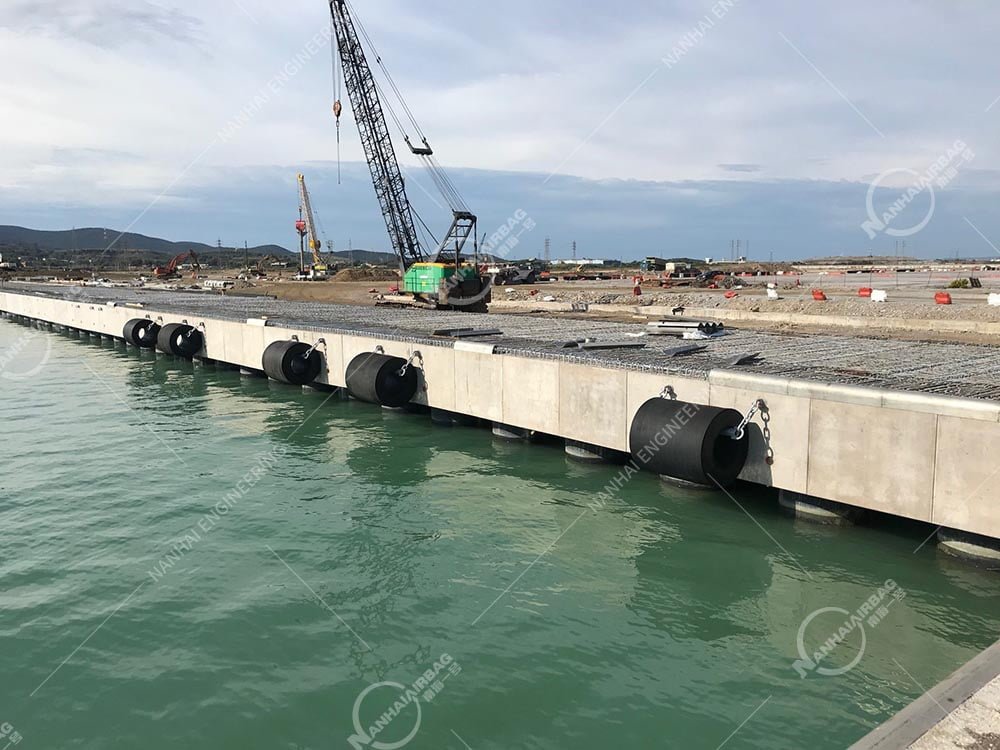
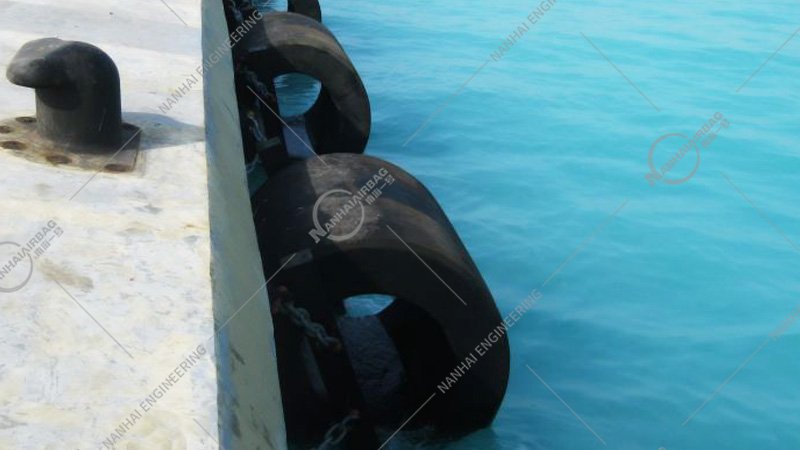
A Cylindrical Rubber Fender—also called GD fender or round fender—is a solid-extruded marine fender with a circular cross-section, typically hung from a wharf, dolphin, or pontoon by chains, steel rods, or straps passing through the center bore. It delivers moderate, direction-independent energy absorption (the round profile reacts the same no matter which angle the vessel hits) and is among the most versatile rubber fenders for small-to-medium berths, fishing ports, inland river terminals, and floating dock systems. While it can’t match a super cell or cone fender for peak energy, its hang-mount flexibility and low unit cost make it a staple across global ports—often specified alongside marine airbags in regional shipyards where slipway launching and general berth protection share the budget.
Why “Cylindrical” Keeps Showing Up on Every Quay Drawing
If D fenders bolt flat to a wall and W fenders line a wale, cylindrical fenders do something different: they hang. A round rubber extrusion, pre-bored through the center, gets threaded with a chain or steel rod and suspended from the wharf edge (or between two dolphins). When a vessel nudges in, the cylinder rolls and compresses—no fixed mounting face, no frontal panel, no complex brackets.
That hanging behavior is the whole point. And once you see whereengineers reach for it, the advantages click into place.
Let’s break them down—with real-world context.
🔑 Advantage 1: Direction-Independent Impact (The Round Profile Pays Off)
A circular cross-section compresses the same whether the boat hits head-on, at a shallow angle, or slightly off-center. No “flat back” to align, no “arch side” to orient.
Example: An inland river terminal on the Mekong handles push-tow barge trains that don’t always come in parallel—current + wind means the lead barge hits at 5–10° off. They specced φ200 and φ250 cylindrical fenders hung every 1.2 m along the concrete wharf edge. Because the round profile rolls with the angle, there’s no “edge-loading” issue like you’d get with a D or W. After two monsoon seasons, zero hull-paint claims and fender wear was still under 15%.
🔑 Advantage 2: Hang-Mount = Works on Floating Docks, Dolphins, and Old Wharves
Can’t bolt to a crumbling concrete face? No problem. Thread a galvanized chain or stainless rod through the bore, anchor to the deck above or to a pile cluster, and the fender floats just below the wharf edge. That makes cylindrical fenders the default for:
- Floating pontoon marinas
- Timber pile wharves (no flat wale available)
- Dolphin clusters in river channels
- Temporary / seasonal berths
Example: A fishing cooperative in West Africa had an old timber-pile wharf with no continuous wale—bolting D or W fenders would’ve meant rebuilding the entire front face. Solution: φ300 cylindrical fenders, galvanized chain hang, timber cleats on the deck above. Total install time: four days. Capex was ~60% lower than a wale + W-fender rebuild.
🔑 Advantage 3: Standard Sizes from φ150 to φ1000 mm—Scale It Wide
Cylindrical fenders cover a surprisingly broad range:
| Nominal Dia. (mm) | Typical Use | Energy (approx., @60% defl.) |
|---|---|---|
| φ150–φ200 | Small pontoons, marina fingers, kayak docks | ~0.8–2 kN·m/m |
| φ250–φ400 | Fishing wharves, river terminals, barge docks | ~3–9 kN·m/m |
| φ500–φ800 | Medium cargo piers, dolphin lines | ~14–35 kN·m/m |
| φ1000 | Heavy push-barge terminals, secondary oil jetties | ~55+ kN·m/m |
Above φ500, you’re getting close to what a small W or cone would handle—but the cylindrical still wins on hanging flexibility.
🔑 Advantage 4: Pairs With Marine Airbags in Regional Shipyards
Classic combo again: cylindrical rubber fenders guard the fitting-out quay, while marine airbags handle launch/land on the slipway next door. At a mid-size yard doing 5,000–10,000 DWT bulkers, you’ll often see φ400–φ500 cylindrical runs along the outfitting wharf + 1.8–2.0 m airbags on the launch way. One stays hung, one rolls—same procurement budget line, two jobs covered.
Where Cylindrical Sits vs. D / W / SC
| Fender Type | Mounting | Energy | Best For |
|---|---|---|---|
| Super Cell / Cone | Bolt to wharf (fixed) | ⭐⭐⭐⭐⭐ | Container terminals, oil jetties, naval |
| W-type | Bolt to wale (fixed) | ⭐⭐⭐ | Barge docks, inland terminals, tug bows |
| D-type (DD/DC) | Bolt flat (fixed) or hull-mount | ⭐⭐ | Fishing piers, marinas, tug sides |
| Cylindrical (GD) | Hang (chain/rod) – flexible | ⭐⭐–⭐⭐⭐ | Floating docks, dolphin lines, old wharves, river terminals |
Rule of thumb: if you canbolt to a wale, W or D is often cleaner. If you can’t—or the berth is floating, angled, or temporary—cylindrical is usually the answer.
Related Questions (People Also Ask)
Q1: What’s the difference between a Cylindrical (GD) fender and a D fender?
D fenders bolt flat to a wall or wale; cylindrical fenders hang by a chain/rod through the center bore. D gives you a defined mounting face and slightly higher energy per meter at low deflection; cylindrical gives you angle-independence and works where you can’t bolt (floating docks, old piling).
Q2: How do you install a cylindrical rubber fender?
Drill/place deck anchors above the wharf edge, run a galvanized chain or steel rod through the fender’s central bore, suspend the fender so its center sits ~300–500 mm below the wharf top (adjust for tide), and tension the chain. Ends are usually butted or mitered at corners.
Q3: What size cylindrical fender do I need?
Start with your max vessel DWT and berthing velocity. Rough guide: φ200–φ250 for up to ~2,000 DWT (fishing/tug); φ300–φ400 for 2,000–10,000 DWT (barge/inland); φ500+ for 10,000+ DWT or push-barge terminals. Always check reaction force against hull pressure—hull-mounted chains can overcompress if undersized.
Q4: Can cylindrical fenders be used on the ship side, not just the wharf?
Less common than DC D fenders for hull-mount, but yes—smaller φ150–φ200 cylinders are sometimes strapped to workboat belts or between push-barge faces for STS (ship-to-ship) cushioning. Chain protection sleeves help prevent chafing the rubber.
Q5: Cylindrical fender vs. marine airbags—do I need both?
Different jobs. Cylindrical fenders protect the berthduring daily docking (permanent hung). Marine airbags launch, land, and shift vessels on the slipway(portable, high-load). A complete regional shipyard specs both; a pure fishing wharf only needs fenders.
Q6: How long do cylindrical rubber fenders last?
8–12 years coastal (UV + salt spray), up to 15 inland. The weak point isn’t usually the rubber—it’s the chain/rod: galvanize properly and inspect every 12–18 months, or the hardware fails before the fender does.
One More Thing Before You Spec
The cylindrical fender doesn’t try to be a super cell. What it doestry to be is the fender you can hang off a crumbling timber wharf, a floating pontoon, or a dolphin cluster without rebuilding half the berth first. If your site has “no continuous wale,” “floating structure,” or “angles all over the place,” the GD deserves a seat at the table—and in most budgets, it’s already the cheapest invite.
Sizing a cylindrical run for a river terminal or floating dock? Tell me your max DWT, tide range, and whether you’ve got a wale or just piles—I’ll point you to the right φ and hang spacing.
