
Pneumatic Rubber Fenders: The Gold Standard for Ship-to-Ship & Dock Berthing Protection
28/05/2026D Shaped Rubber Fender: The Ultimate Guide to Port and Vessel Protection
04/06/2026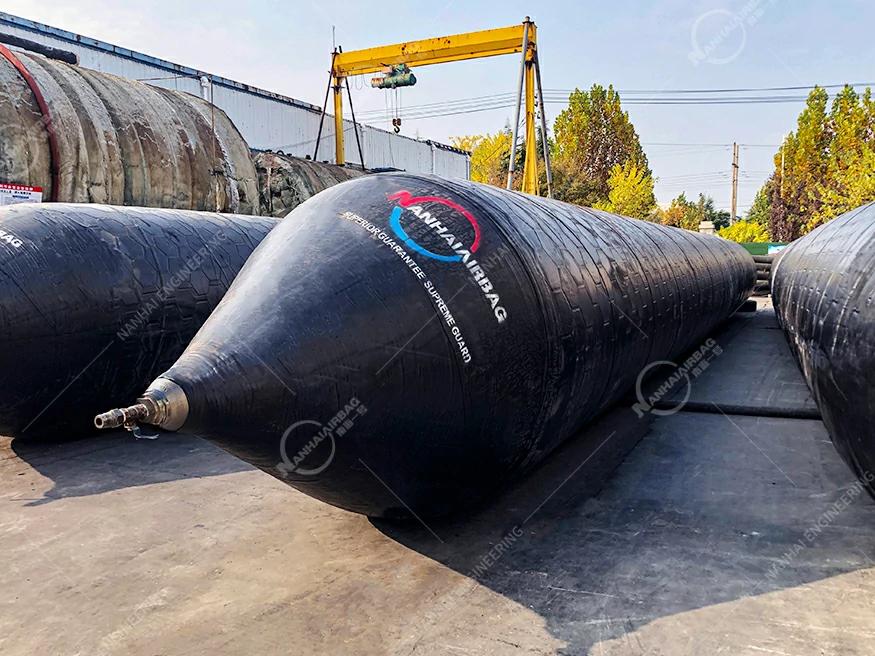
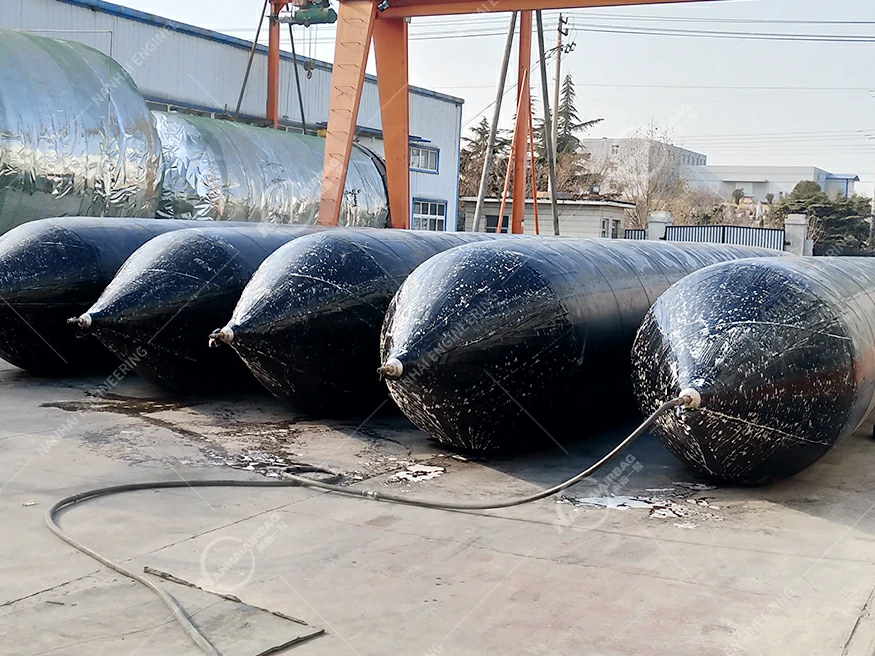
Ship launching airbags — also called marine airbags or rubber launching airbags — are heavy-duty, multi-layer inflatable cylinders that lift a vessel off its keel blocks and roll it smoothly into the water. Made from reinforced synthetic-tire-cord rubber under ISO 14409 / ISO 17682 standards, they replace expensive concrete slipways and dry docks with a portable, reusable system that works on slopes as gentle as 1:70.
Instead of relying on greased wooden ways, rails, or giant cranes, a row of inflated airbags acts as both cushion and roller beneath the hull — spreading the ship’s weight evenly, slashing friction, and guiding the vessel into the water in a controlled glide. It’s the reason thousands of shipyards from China to Southeast Asia to West Africa now launch everything from 50-ton workboats to 10,000+ ton barges with nothing but airbags, compressors, and a prepared slipway.
How Ship Launching Airbags Work (The Simple Physics)
The principle is straightforward:
- Position — Airbags are placed longitudinally between the keel blocks beneath the hull.
- Inflate — Compressed air fills each bag (typical working pressure 0.08–0.12 MPa) until the hull lifts free of the blocks.
- Remove Blocks — Keel blocks are cleared; the entire vessel now rests on the inflated airbags.
- Release & Roll — The holding winch is eased. The airbags rollunder the keel, carrying the ship down the slipway and into the water.
- Retrieve — Bags are deflated, gathered, and stored for next time.
Why Shipyards Are Switching: 5 Proven Advantages
✅ 1. Massive Cost Savings — No Permanent Infrastructure Needed
Traditional slipways demand poured concrete, steel rails, grease pits, and ongoing maintenance. Airbag systems need none of that. Industry data shows total launch costs drop 30–60% compared to building and maintaining a dedicated slipway.
Example:A coastal yard launching 500–3,000-ton fishing vessels can avoid a $500K+ slipway build by investing in a reusable airbag fleet that pays for itself in 12–18 months.
✅ 2. Gentler on the Hull — Even Pressure Distribution
The flexible rubber surface conforms to the hull’s curve. No hard contact points, no concentrated stress that causes paint stripping or micro-fractures — a real advantage for fiberglass, aluminum, and thin-plated steel hulls alike.
✅ 3. Works on Mild Slopes & Tight Sites
Airbags can launch on gradients as low as 1:70, compared to the steep 1:20 a greased-way system needs. That means yards with limited waterfront depth can still launch heavy vessels safely.
✅ 4. Portable & Reusable — Deploy Anywhere
Deflated airbags pack flat into a shipping container. Take them to a remote beach, a temporary repair site, or a shallow riverbank. A single set, properly maintained, lasts 8–15+ years and hundreds of launch cycles.
✅ 5. Safer When Done Right
Modern bags include safety relief valves, stainless steel inflators, pressure gauges, and 3:1+ burst safety margins. ISO 14409 pressure-hold tests (≤5% drop in 1 hour) catch weak bags before launch day.
Ship Launching Airbags vs. Marine Fenders / Rubber Fenders — Know the Difference
This is the #1 confusion in procurement, so let’s settle it clearly:
| Ship Launching Airbags | Marine / Rubber Fenders | |
|---|---|---|
| Job | Lift & roll a vessel from land → water | Absorb impact when a moving vessel hits a dock |
| Shape | Long cylinder, tapered ends | D-shaped, cone, cell, pneumatic (balloon-style) |
| Where | Under the keel, on a slipway | Along the dock faceor between two berthed ships |
| Core tool | Compressed air + tire-cord reinforcement | Rubber / foam / air compression (different energy math) |
| Standard | ISO 14409 / ISO 17682 | ISO 17357 (pneumatic), PIANC guidance (solid) |
You don’t use an airbag insteadof a fender — they solve completely different problems. A complete marine safety setup typically needs both: airbags for launch day, fenders for daily berthing protection.
Quick Spec Cheat Sheet
| Parameter | Typical Range |
|---|---|
| Diameter (D) | 0.8 m – 2.5 m (1.5 m & 2.0 m most common) |
| Effective Length | 6 m – 18+ m (must ≥ vessel beam) |
| Cord Plies / Layers | 4 – 8 ply (6-ply covers most jobs) |
| Working Pressure | 0.08 – 0.20 MPa (by diameter & ply count) |
| Certifications to Look For | ISO 14409, CCS / BV / ABS / DNV approval preferred |
| Burst Margin | Min. 3× working pressure |
Rule of thumb: Airbag diameter must exceed your keel-block height (add ~0.5 m minimum). If blocks are 1.0 m tall, go with D ≥ 1.5 m.
Keep Reading: Is Your Launch Setup Missing the Mark?
If your yard is still burning budget on concrete slipway repairs, fighting corrosion on steel cradles, or turning away oversized hulls because “the rail system can’t take it” — airbags are worth a hard look. The engineering is proven, the standard is there (ISO 14409), and the math is simple: less steel, less concrete, same ship in the water.
Below are the exact questions shipyard managers, marine engineers, and procurement officers type into Google before making the switch 👇
Related Questions (People Also Ask)
1. What are ship launching airbags made of?
Multiple layers: an airtight inner rubber liner, 4–8 plies of synthetic tire-cord fabric (the load-carrying skeleton), and an abrasion/UV-resistant outer rubber layer, with steel-flange end fittings and valves.
2. How much weight can ship launching airbags support?
A single 1.5 m × 12 m, 6-ply bag at rated pressure carries roughly 100–150+ tons along its contact length. A staggered row of bags handles vessels from a few hundred tons up to 10,000+ tons when properly calculated.
3. What’s the difference between marine airbags and rubber fenders?
Airbags launch and lift(weight-bearing, rolling interface under the keel). Rubber fenders protect during docking(impact-absorbing buffer between hull and dock/another ship).
4. How long do ship launching airbags last?
With correct pressure management, cleaning, talc treatment, and dry storage: 8–15 years and hundreds of cycles. The rubber ages out before the cord fails if you store them out of direct sun.
5. What certifications should I require from a supplier?
Ask for ISO 14409 compliance at minimum, plus classification-society type approval (CCS, BV, ABS, or DNV) and a documented burst-test / pressure-hold report. No certs = don’t buy.
6. Can airbags be used on any hull material — wood, FRP, aluminum?
Yes. The compliant surface actually makes them saferfor delicate hulls than hard cradles or steel ways, because there are no sharp pressure points. Just ensure correct pressure and clean ground prep.
7. How do I calculate how many airbags I need?
Formula: divide total launch weight by (bearing capacity per airbag at allowed compression) with a minimum 20% safety margin, then lay them out so unsupported spans between bags don’t overstress the hull. Most reputable suppliers will run this calc for you free — but always have a marine engineer sign off.
Need help sizing an airbag layout for a specific vessel? Drop the ship’s length × beam × displacement and your slipway angle — and I can walk you through the calculation framework step by step.
Keywords: marine airbags, marine fenders, rubber fenders, ship launching airbags, ISO 14409, vessel launching technology, inflatable launching systems
