
D Rubber Fenders: The Unsung Heroes of Every Dock
11/08/2026Tug Boat Fenders: The Only Thing Between Your Tug and a $40k Hull Repair
18/08/2026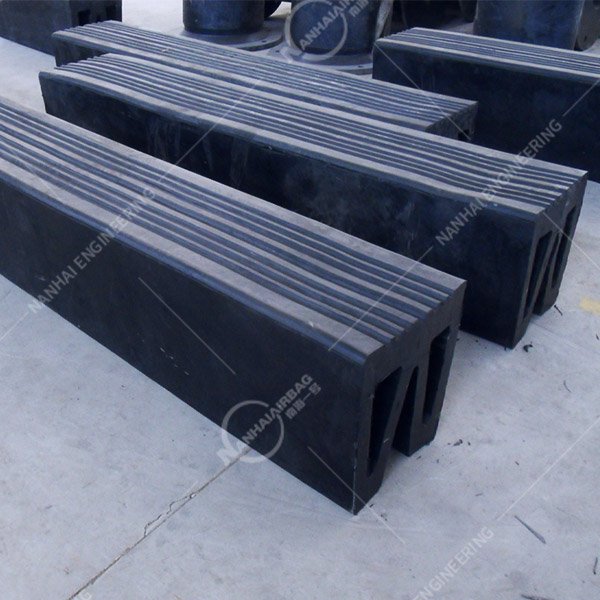
You’re standing on the bow of a 40-meter tug, threading between a pier and a 200-meter bulk carrier in a 25-knot crosswind. There’s no margin for error—one bad angle and your hull is grinding into steel. What’s the only thing between your tug and a $30,000 hull repair? A row of unassuming, black, W-shaped rubber profiles bolted along your bow.
W rubber fenders are the quiet achievers of the marine fenders world. Shaped like a double arch (“W”), these solid extruded rubber fenders are engineered to absorb excessive berthing impact while delivering low reaction force—meaning they soak up the hit without bouncing your vessel back like a trampoline. They’re the default choice for tugs, workboats, icebreakers, barges, and the corners of wharves and bridge piles worldwide. And if you operate in any of those categories, choosing the wrong fender isn’t just inefficient—it’s urgent.
🎯 Featured Snippet (Google-Selectable Summary)
W rubber fenders are solid, W-shaped marine rubber fenders designed for high energy absorption with low reaction force, making them ideal for tugs, workboats, barges, icebreakers, and the corners of wharves or bridge piles. Their double-leg structure flexes to wrap around hull curvature, and they can be installed in rows to create a continuous, resilient fender face. Unlike marine airbags—which are used for ship launching, lifting, and salvage—W rubber fenders are permanent impact-protection devices that resist UV, saltwater, and extreme temperatures down to -40°C. Standard sizes range from W320×200 up to W500×450, with lengths up to 2,000–3,000 mm, and can be customized to fit any vessel’s bow or stern profile.
⚠️ Why This Matters Right Now (Not “Someday”)
Most operators don’t think about fenders until something goes wrong. But consider:
- The Yangtze River bulk terminal that retrofitted its wooden-pile wharf with W-type rubber fenders (150×150 mm profile). Before the upgrade, small 3,000 DWT self-propelled barges were denting hull plates on old timber buffers. After switching, hull-damage claims dropped to near zero—while the fender cost was roughly one-third of a cone-fender equivalent.
- Ocean-going tugs and icebreakers operating in Arctic and Antarctic conditions, where rubber has to stay elastic at -40°C or risk cracking on the first hard contact.
- Bridge pile protection in tidal zones, where repeated impact from passing vessels gradually chips away concrete until the whole structure is compromised.
Here’s the urgency: If your vessel is under ~10,000 DWT and your berthing angles are moderate (≤5°), W fenders are usually the economic sweet spot among all rubber fenders on the market. Go bigger than you need (cone or super cell), and you’re burning capital. Go smaller (cylindrical or D), and you’re risking hull damage every single docking. The window is real, and the cost of missing it is measured in repair invoices.
🔑 Why W Fenders Outperform the Alternatives
1. The Double-Leg Geometry = Progressive Compression
When a vessel pushes into a W fender, each arch compresses independently. The middle arch gives a soft initial contact, then the side arches progressively engage—delivering a smooth force-deflection curve rather than a sudden spike. Translation: your hull feels a firm but controlled cushion, not a jarring bounce.
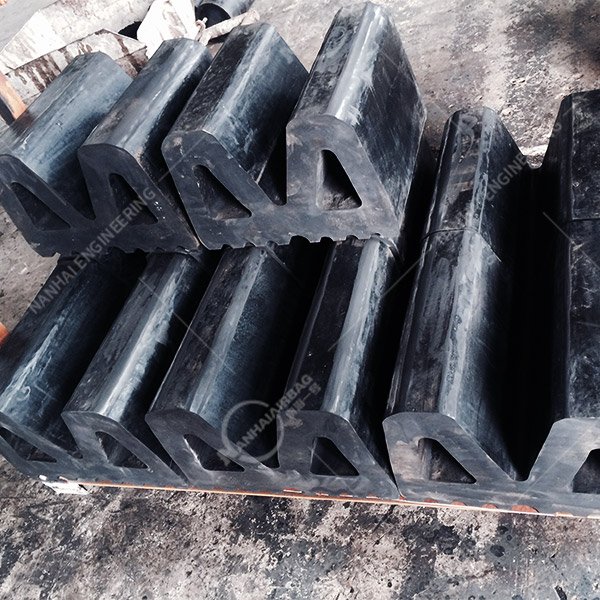
Compared to D-type rubber fenders of the same dimensions, W-type fenders generate 20–30% lower reaction force at equal compression. That’s the difference between a lightweight tug’s thin plating staying intact versus getting dented.
2. They Wrap Around Your Hull
The two flexible legs of the W profile can be bent to follow the curvature of a tug’s bow or stern. They can be pre-cut to suit the vessel’s bow/stern profile and easily curved to fit the hull radius. No other standard extruded fender does this as naturally.
3. They’re Built for the Extreme
W fenders are specifically designed for tugboats in extreme operating conditions. They feature:
- High energy absorption with low reaction force
- Rugged, wear-resistant synthetic rubber (natural rubber, SBR-based, or EPDM compounds)
- UV and saltwater resistance for 10–15 year service life
- Flexibility down to -40°C for Arctic and Antarctic operations
- Pre-drilled mounting holes on both sides for bolt-on installation to steel or concrete
4. Continuous Protection When Installed in Rows
W fenders can be mounted end-to-end in rows, creating a continuous, resilient fender face along a pier or vessel’s side. This is why they’re the ideal protection system for the corners of wharfs, bridge piles, and the berthing sections of pontoons.
🆚 Where W Fenders Sit in the Marine Fender Family
| Fender Type | Typical Use | Energy Absorption | Price Tier |
|---|---|---|---|
| Super Cell / Cone | Container terminals, oil jetties, naval | ⭐⭐⭐⭐⭐ | $$$ |
| Arch / V-type | Medium cargo piers | ⭐⭐⭐ | $$ |
| W-type | Barge docks, inland terminals, tugs, fishing piers | ⭐⭐⭐ | $ |
| Cylindrical (GD) | Light piers, pontoon walkways | ⭐⭐ | $ |
| Marine Airbags | Ship launching, lifting, salvage | N/A (not for berthing) | $-$$ |
Key distinction: Marine airbags are primarily for ship launching, lifting, and salvage operations, while W fenders are permanent impact-protection devices installed on vessels and docks. Both fall under the broader category of marine fenders—but they solve completely different problems.
📏 Standard Sizes (So You Know What’s Available)
| Model | A (mm) | B (mm) | C (mm) | D (mm) | Max Length (mm) | Weight (kg/m) |
|---|---|---|---|---|---|---|
| W320×200 | 480 | 420 | 260 | 300 | 2,000 | 59 |
| W400×250 | 400 | 250 | 220 | 350 | 2,000 | 87 |
| W480×300 | 480 | 300 | 265 | 300 | 2,000 | 129 |
| W500×450 | 500 | 450 | 270 | 450 | 2,000 | 193 |
All models can be customized. Widths range from 320 mm to 500 mm, with lengths up to 2,000–3,000 mm.
Design compression deflection: Up to 50% for many W-type fender designs, effectively buffering collision force between pier and ship during mooring and berthing.
🛠️ Installation: Simpler Than You Think
The open-bore design allows installation using steel pins through the fender’s core, secured to pre-welded brackets on the vessel or dock. For docks, the pre-cut holes on both sides of the W fender make mounting straightforward—stainless steel bolts (to avoid rust) are standard.
Most W fenders come with pre-drilled mounting holes for bolt-on installation to steel or concrete berths. For floating docks, they can be attached via chains or brackets to allow movement with tides.
❓ People Also Ask (Real Google PAAs for “W Rubber Fenders”)
Q: What’s the difference between W rubber fenders and D-shaped rubber fenders?
A: W fenders have a double-arch “W” cross-section that delivers moderate energy absorption at low reaction force, while D fenders have a single D-shaped chamber. W fenders generate 20–30% lower reaction force at the same compression, making them better for vessels with thinner hull plating (tugs, barges). D fenders are more compact and suitable for smaller quays, marinas, and piers.
Q: What vessels are W rubber fenders best for?
A: They’re the standard for ocean-going tugs, icebreakers, large harbor tugs, workboats, supply vessels, and barges. They’re also used for bridge pile protection and the corners of wharfs. Essentially: any vessel under ~10,000 DWT with moderate berthing angles.
Q: Can W fenders be used in cold climates?
A: Yes. Their rubber composition maintains elasticity down to -40°C, making them ideal for Arctic and Antarctic operations. They’re specifically designed for tugboats in extreme operating conditions.
Q: How long do W rubber fenders last?
A: With proper maintenance, W fenders typically last 10–15 years. Design service life is often rated at 20 years by manufacturers. Factors like UV exposure, water salinity, and impact frequency can affect lifespan—regular inspections for cracks or wear are recommended.
Q: Are W rubber fenders customizable?
A: Absolutely. Manufacturers offer custom sizes and lengths (up to 2,500–3,000 mm), and can pre-cut fenders to suit a vessel’s bow or stern profile. They can also be curved to fit hull radius, and optional UHMW-PE wear plates can be added for enhanced abrasion resistance.
Q: How are W fenders different from marine airbags?
A: Marine airbags are primarily for ship launching, lifting, and salvage operations, while W fenders are permanent impact-protection devices installed on vessels and docks. Both are marine fenders, but they solve fundamentally different problems—airbags provide temporary buoyancy and lift, while W fenders absorb kinetic impact during berthing.
Q: What certifications should I look for?
A: Common certifications include BV, CCS, ABS, KR, LR, PIANC, OCIMF, and ISO 9001. Ask your supplier for third-party inspection certificates from any of these classification societies.
Q: How do I choose the right size W fender?
A: Match the fender width to your vessel’s scale. Small workboats and tugs typically use W320×200 or W400×250; larger tugs and barges use W480×300 or W500×450. For continuous wharf protection, install them in rows. When in doubt, consult a marine fender engineer—the cost of undersizing is repeated hull damage.
🌟 The Bottom Line
W rubber fenders aren’t the flashiest product in the marine fenders catalog, but they’re the most pragmatic choice for an enormous slice of the industry: tugs, barges, workboats, and the wharfs they service. They deliver high energy absorption, low reaction force, hull-hugging flexibility, and 10–15 year durability at roughly one-third the cost of cone-fender equivalents.
Pair them correctly with other marine fenders—cone or super cell for heavy container terminals, cylindrical for light piers, and marine airbags for launching and salvage—and you’ve got a complete protection strategy for every phase of a vessel’s lifecycle.
👉 Sizing one for your tug, barge, or wharf? Grab three numbers first: your vessel’s DWT, your typical berthing angle, and your hull’s curvature at the bow/stern. Those three data points will tell you whether W320, W400, W480, or W500 is your match—and whether you need a single row or a continuous line.
Got a specific vessel profile you’re trying to protect? Drop the details below—let’s spec it out together.
Keywords: marine fenders · rubber fenders · W rubber fenders · marine airbags · W-type fender · tugboat fenders · barge fenders
